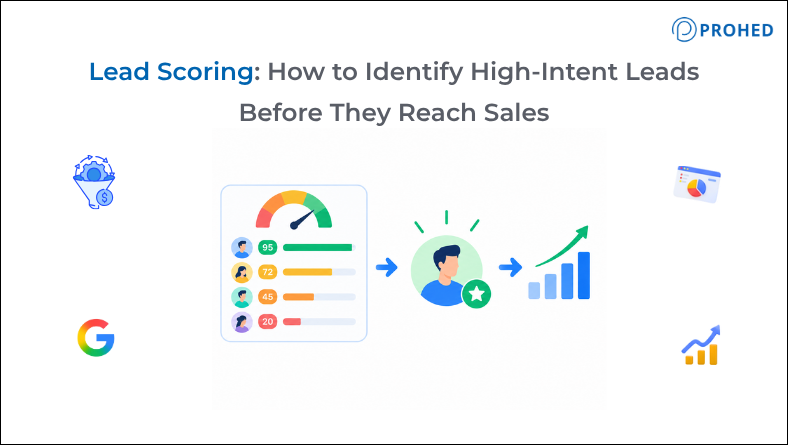
Not every lead deserves the same amount of attention, yet most sales teams treat them that way. Lead scoring fixes this by assigning each prospect a numerical score based on two things: who they are, and what they’ve done. The higher the number, the more likely that person converts if someone follows up quickly. At PROHED, a performance marketing agency based in Gurgaon, we build these scoring models for D2C and B2B brands, usually because a client wants their marketing budget to stretch further during a period like India’s festive season, when both lead volume and response time become unforgiving.
There’s a pattern we see constantly: teams invest heavily in generating leads, then spend almost no time deciding which ones are actually worth chasing.
That gap becomes expensive fast once October rolls around. Enquiries, form fills, and sign-ups surge across beauty, wellness, fashion, gifting, and home categories. Somewhere in that flood sits a small percentage of buyers who are genuinely ready to purchase, and if a brand can’t tell them apart from window shoppers, good leads sit untouched while a sales rep works through the pile in the wrong order.
Lead scoring solves exactly this. None of this is new, the concept has existed for over a decade, but a lot of brands either never built a system, or built one years ago and haven’t looked at it since.
Why the Festive Season Makes Lead Scoring Critical for D2C Brands
Enquiry volumes for Indian D2C brands usually climb three to five times over baseline between October and November. Sometimes more, depending on the category. On paper that’s a good problem. In practice, it only stays a good problem if someone can act on the right leads quickly.
Take two people who both land in your CRM as “leads” this week. One visited the same product page three times, added it to cart, and downloaded a size guide. The other clicked an ad, spent ten seconds on the homepage, and left. Your analytics dashboard won’t tell them apart. One of them is close to buying. The other probably isn’t.
Here’s what tends to happen without a prioritisation system: leads get worked in the order they came in. So a genuinely hot lead from day three sits in a queue behind five lukewarm ones from day one, and by the time anyone calls, that buyer has already checked out somewhere else.
The only real fix is building the scoring system before the traffic shows up, not halfway through the rush, when everyone’s already underwater.
Related Read: Festive Season Marketing for D2C Brands: How to Scale Sales Without Burning Ad Budget
The Two Pillars of a Lead Scoring Model
1. Demographic or Firmographic Fit
This covers who the lead is. For a D2C brand, that usually means:
- Location, metro versus Tier 2 city matters for both delivery timelines and pricing sensitivity
- Device type, since mobile-first buyers in India often behave quite differently from desktop shoppers
- Where they came from (organic search, paid ads, an influencer referral)
- Whether they’re a first-time visitor or a returning customer
B2B brands layer on more: company size, industry, and how senior the person’s role is.
2. Behavioral Signals
This is the part that actually matters more, in most cases: what the lead has done, not just who they are. A visitor who’s browsed three pages and used a size guide is telling you far more than any demographic field ever could.
Here’s a rough guide to weighting common behaviours:
Behaviour | Signal Strength | Suggested Score |
Viewed product page once | Low | +2 |
Viewed same product page 3+ times | Medium | +8 |
Added to cart without purchasing | High | +15 |
Started checkout, didn’t complete | Very High | +20 |
Opened email, clicked through | Medium | +10 |
Filled a contact or enquiry form | High | +15 |
Watched a product video to completion | Medium | +8 |
Used a size guide or configurator | High | +12 |
Referred by a customer review site | Medium | +10 |
Treat these as a starting draft, not gospel. Pull up your own conversion data before locking in any number.
Building a Lead Scoring System: Step by Step
Step 1: Decide what “qualified” actually means for your brand
It sounds like a formality, but it isn’t. A ₹299 impulse buy and an ₹8,000 skincare kit don’t get bought the same way. Different consideration windows, different signals, different everything.
Step 2: Pull five to eight behaviours that show up before conversion
Go back through the last 12 months of customers who bought. What did they do beforehand? Did they search the site? Come back more than once? Whatever shows up repeatedly becomes a positive signal.
Step 3: Do the same for behaviours that predict a dead end
Some leads engage just enough to look promising and then vanish. A single homepage bounce. Emails opened but never clicked. Blog traffic with zero product page views. These pull the score down.
Step 4: Pick a cutoff for sales handoff
A workable starting point is three tiers: Hot (40+), Warm (20–40), Cold (below 20). Hot leads get called immediately. Warm ones go into a nurture track. Cold leads sit in a slower email flow until they either warm up or don’t.
Step 5: Plug the model into your CRM
Doing this by hand doesn’t scale past a handful of leads a day. HubSpot, LeadSquared, WebEngage — any of these can score leads automatically and kick off the right follow-up once a threshold is crossed.
Lead Scoring for D2C Brands vs B2B: What’s Different
Factor | D2C Lead Scoring | B2B Lead Scoring |
Primary signals | Behavioural (pages, cart, video) | Behavioural + firmographic |
Consideration window | Hours to days | Weeks to months |
Key conversion event | Purchase | Demo, trial, or sales call |
Score decay | Fast (offers expire) | Slower |
Negative signals | Single bounce, unsubscribes | Wrong company size, wrong role |
Score decay is the one D2C brands underestimate most, particularly during festive season. Say a lead hits Hot status on October 20 and nobody calls them by the 25th — that score needs to drop on its own, because the buying window that made them Hot in the first place is closing. Build this decay logic in from the start, or your sales team ends up chasing people who bought from someone else last week.
What Good Lead Qualification Does to Revenue
A Box Of Stories, a subscription commerce brand, worked with us to overhaul how leads got prioritised as part of a broader marketing engagement. Subscriptions went up 35%. Acquisition costs dropped 40%. A meaningful chunk of that came simply from the sales team spending time on the right enquiries instead of treating every lead as equally urgent.
Read the full A Box Of Stories case study here
That pattern holds across most D2C categories we’ve worked in. Same budget, same traffic, but route the genuinely ready buyers to immediate action and nurture the rest, and the numbers move.
Mistakes to Avoid When Building a Lead Scoring Model
Relying only on demographic data is probably the most common one. A lead can match your ideal customer profile perfectly and still be completely cold if they’ve never engaged with anything. In most D2C funnels, behaviour should outweigh demographics by a wide margin.
Setting scores once and forgetting about them is close behind. Buyer behaviour shifts, seasons change, and a model that was accurate in January can quietly go stale by June. Check quarterly whether your top-scoring leads are actually the ones converting.
Treating every channel the same is another trap. Someone arriving via a Google Shopping click and someone arriving via a blog post rarely have equivalent intent, even if their on-site behaviour looks identical afterward.
And skipping negative signals entirely tends to inflate every score over time until the whole system stops meaning anything. Without a way to pull scores down, everyone eventually looks like a hot lead.
Conclusion
Lead scoring won’t get you a single additional lead. What it does is make the leads you already have worth more, by telling you which ones to act on now and which ones can wait.
Walking into festive season without this in place means treating October as a volume problem, when really it’s a prioritisation problem. The brands that win Diwali aren’t necessarily the ones with the biggest lead count, they’re the ones that know exactly who to call first.
At PROHED, qualification logic goes into B2B and D2C lead generation from the outset rather than getting bolted on later. Our B2C Lead Generation and B2B Lead Generation services cover CRM integration, lead scoring setup, and follow-up automation for brands that want their festive season traffic to actually turn into revenue.
Frequently Asked Questions
1. What is lead scoring?
A way of ranking leads by how likely they are to convert. It combines who someone is with what they’ve done, and produces a single score that tells a sales team where to focus first.
2. How does lead scoring actually work in practice?
Every action or trait gets assigned points. A product page visit might be worth 5. Adding to cart, 15. Abandoning checkout, 20. Once a lead crosses a set number, they get routed to immediate follow-up; everyone else drops into a nurture sequence.
3. What are the main types of lead scoring models?
Four, broadly: demographic (who someone is), behavioural (what they’ve done), predictive (built on historical conversion patterns, usually AI-driven), and hybrid models that mix all three. Most growing brands start with a demographic-behavioural hybrid before moving to anything predictive.
4. How do you actually calculate a score?
Start with the behaviours that show up before a purchase in your own data. Assign point values based on how strongly each one correlates with an actual sale, add the positives, subtract the negatives, and set a threshold for priority treatment.
5. What separates a good scoring system from a mediocre one?
It ties into your CRM, updates itself as leads act, decays scores over time, includes negative signals alongside positive ones, and gets recalibrated regularly against real conversion numbers. A system built a year ago and never revisited is often less useful than having none at all.
6. Does this only apply to B2B, or does it work for D2C too?
Both, but the inputs differ. D2C scoring leans almost entirely on behaviour – cart abandonment, repeat visits, video completions, because the decision happens fast. B2B adds firmographic weight since the sales cycle is longer. D2C brands feel the benefit most during high-volume periods, when it’s easy to lose genuinely hot buyers in the noise.
7. Why does this matter specifically during India’s festive season?
Because volume spikes and speed becomes everything. Without scoring, leads get worked in arrival order rather than by likelihood to buy, and in a short buying window with competitors circling the same customers, that ordering mistake costs real revenue.
8. How long does setup actually take?
A basic behavioural model: one to two weeks, assuming your CRM and analytics are already tracking properly. A predictive model built on historical data takes closer to four to six weeks once you factor in calibration. No existing CRM infrastructure means adding more time on top of that.
Is your brand ready to prioritise the right leads before the festive season traffic arrives? PROHED can set up lead scoring and nurture automation before the peak period begins.
Schedule a Free Strategy Call with PROHED Today