Most app founders can tell you exactly what they spent on paid installs last month, down to the rupee. Ask what percentage of downloads came from someone actually searching the App Store or Play Store on their own, and the answer gets vague fast. ASO services exist to fix that blind spot, improving how an app ranks, appears, and converts inside app store search results, so downloads stop depending entirely on ad spend. At PROHED, an app marketing agency working across gaming, EdTech, and logistics apps, we treat ASO as the organic counterpart to paid install campaigns, not a replacement for them, but a channel that makes every paid rupee work harder once it’s actually running properly.
What Are ASO Services, Exactly?
App store optimization, ASO for short, is the work of improving an app’s visibility and conversion rate within app store search and browse results. That covers everything from keyword strategy in your title and description to the screenshots, videos, and ratings that decide whether someone who finds your app actually bothers to tap install.
A proper set of app store optimization services typically covers:
- Keyword research and optimisation, figuring out what people actually search for and weaving those terms naturally into titles, subtitles, and descriptions
- Creative asset optimisation, testing icons, screenshots, and preview videos to lift the conversion rate once someone lands on your listing
- Category and competitor positioning, understanding where your app actually sits relative to whoever people are comparing you against
- Ratings and review management, since both directly influence ranking and conversion, and neither one improves just by sitting there
- Localisation, adapting keywords and creative for different regions and languages instead of running one generic listing globally
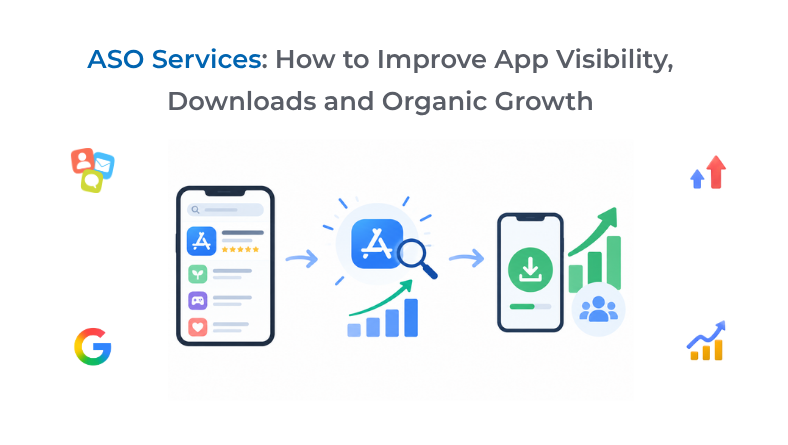
How ASO Increases App Downloads
Downloads really happen in two distinct stages, and most ASO strategy work focuses on improving both separately rather than treating it as one big problem.
- Stage one is getting found in the first place: This is where keyword optimisation and category ranking matter most. If your app doesn’t show up when someone searches a relevant term, nothing downstream matters much.
- Stage two is getting the actual tap: Once someone sees your app in search results, your icon, your first screenshot, and your rating are doing all the convincing. A strong ranking that leads to a weak listing just means more people see your app and scroll right past it, which is arguably worse than not ranking well at all, since you’re burning that impression without capturing it.
| Element | Primary Job | Impact |
|---|---|---|
| App title and subtitle | Keyword ranking | Discoverability |
| Icon | First impression, stops the scroll | Click-through rate |
| Screenshots | Show value in seconds | Conversion rate |
| Preview video | Demonstrate the app in action | Conversion rate |
| Ratings and reviews | Trust signal | Ranking and conversion both |
| Description | Deeper detail, secondary keyword placement | Ranking, minor conversion impact |
Icons and the first couple of screenshots do a disproportionate amount of the actual convincing, since most users make up their mind within a few seconds of glancing at a listing, well before they’d ever scroll down to read a full description.
The Main ASO Ranking Factors Worth Prioritising
Both major app stores weigh a mix of signals, and while the exact algorithm isn’t public and shifts around periodically, a few things have stayed consistent enough to actually build a strategy on:
- Keyword relevance and density in the title, subtitle (iOS), and short description (Android), with the title carrying the most weight on both platforms
- Download velocity and install rate, since a spike in downloads or a strong conversion rate from impressions signals relevance back to the algorithm
- Ratings and review volume, where both the average score and how recent the reviews are seem to factor into ranking
- Retention and engagement metrics, particularly on the Play Store, where Google factors in how long people actually keep and use an app after they install it
- Update frequency, since stores tend to favour apps that show active, ongoing development over ones that look abandoned
That retention piece gets underestimated a lot. An app that gets installed constantly but uninstalled just as fast sends a genuinely negative signal that can hurt ranking over time, which is part of why ASO and actual product quality can’t really be separated from each other.
Related Read: How a Fleet Tech Brand Cut App Marketing Cost Per Action by 67%
Building an ASO Strategy That Actually Works
A structured approach beats sporadic tweaks here, mostly because app store algorithms respond to sustained signals, not one-off changes made once and forgotten.
- Start with keyword research specific to your category: Generic, high-volume keywords tend to carry brutal competition from apps that have been ranking for years. Long-tail, category-specific terms with genuine search intent often convert better even at lower search volume, and they’re a lot easier to actually break into.
- Test creative systematically, not by gut feel: Both app stores support experimentation features that let you test different icons, screenshots, or preview videos against each other with real traffic, rather than just guessing which version looks better.
- Treat reviews as an active channel, not a passive metric: Prompting satisfied users for a review at the right moment, right after a positive in-app action ideally, genuinely moves your rating over time. Responding publicly to negative reviews also tells prospective users that issues actually get dealt with, not ignored.
- Localize for markets that actually matter to your growth plan: A straight translation isn’t the same thing as localization. Search behaviour and terminology genuinely differ by region, and running the same English keyword set everywhere leaves real downloads sitting on the table.
- Monitor and iterate monthly, not quarterly: App store algorithms and competitor listings shift around often enough that a strategy set once and left alone tends to decay within a few months, sometimes faster.
Where ASO Fits Alongside Paid Mobile App Marketing
ASO and paid install campaigns work best as a pair, not competing budget lines fighting for the same money. Strong ASO lowers your cost per install over time by improving organic conversion, which also happens to be one of the exact signals stores reward with better ranking. Paid campaigns, in turn, can drive the download volume that gives ASO a stronger velocity signal early on, before organic momentum has had time to build.
We’ve seen this play out clearly in app-focused performance marketing work. With Rivigo, a logistics and transportation platform, campaigns landed 150K app downloads while cutting cost per install by 40% and pushing installs up 2.5X, a result that came from paid strategy and store-side optimisation reinforcing each other rather than working in silos. Our work with Yara, an AgriTech platform, followed a similar pattern, focused on reducing install costs and improving retention while scaling past 1 million app installs, exactly the kind of combination that depends on the app store listing converting well once paid traffic actually arrives there.
How PROHED Approaches App Store Optimization Services
We treat ASO as inseparable from the bigger app growth picture, not a standalone checklist you tick off once. That means pairing keyword and creative optimisation with the retention data coming out of paid campaigns, since what drives someone to install and what makes them actually stay are closely linked signals both stores reward.
Our approach for app clients usually includes ongoing keyword tracking and adjustment, systematic screenshot and icon testing rather than a one-time creative refresh that never gets revisited, and review management that actively prompts for feedback instead of passively waiting for it to trickle in. As an organic growth agency in India working alongside performance marketing for app clients, we’ve found ASO investment consistently lowers blended user acquisition cost, since organic and paid growth end up reinforcing each other instead of quietly competing for the same budget.
Conclusion
ASO isn’t something you set up once and walk away from. App store algorithms, competitor listings, and how people search all shift continuously, which means a strategy that worked six months ago needs a second look now, not just blind faith that it’s still working. Get the fundamentals right, keyword relevance, creative that actually converts, reviews treated as something you actively manage, and organic downloads start compounding in a way paid spend alone rarely manages by itself.
FAQs
1. What are ASO services?
ASO services cover the ongoing work of improving how an app ranks and converts within app store search results, including keyword optimisation, creative asset testing, and review management. The goal is boosting organic downloads so you’re not relying entirely on paid install campaigns just to stay visible.
2. How does ASO increase app downloads?
It works in two stages, first improving how often your app shows up in relevant searches through keyword and category optimisation, then improving how many of those viewers actually tap install through stronger creative and better ratings. Both stages genuinely need attention, since ranking well but converting poorly still leaves downloads sitting there unclaimed.
3. How much do ASO services cost?
Costs shift quite a bit based on app complexity, how competitive your category is, and whether you need ongoing management or just a one-time audit and setup. Most agencies run ASO as a monthly retainer, mainly because the work leans so heavily on continuous testing rather than a single fixed deliverable you tick off and forget.
4. What are the main ASO ranking factors?
Keyword relevance in your title and description, download velocity, ratings and review volume, and how well users stick around after installing all factor into how both stores rank a listing. Update frequency matters too, since stores tend to favour apps that show consistent, active development over ones that look like nobody’s touched them in a year.
5. What is the difference between ASO and SEO?
ASO focuses specifically on ranking and converting inside app store search algorithms, which weigh different signals like install velocity and retention that traditional web SEO doesn’t touch at all. SEO focuses on ranking web pages inside search engines like Google, relying on backlinks, on-page content, and technical site factors that simply don’t exist inside an app store environment.
6. Can ASO alone replace paid app install campaigns?
For most apps, not really, ASO works best as a complement to paid campaigns rather than a full replacement, since paid traffic often provides the early download volume that strengthens organic ranking signals in the first place. The two genuinely reinforce each other, paid driving early velocity, strong ASO lowering blended acquisition costs as time goes on.
7. How long does it take to see results from ASO?
Keyword ranking improvements can show up within a few weeks of optimisation, though real, sustained organic download growth usually takes two to three months to fully kick in. That’s because app store algorithms weigh sustained signals like retention and review trends over time, not just whatever you changed last week.
8. Does app rating really affect app store ranking?
Yes, ratings work as both a trust signal that decides whether someone actually downloads and a ranking factor both major app stores actively weigh. Even a small handful of recent negative reviews can measurably hurt visibility if the trend keeps declining, which is exactly why active review management matters more than most app owners assume going in.
Want to know how much untapped organic growth your app is currently missing? Talk to PROHED, an app marketing agency that pairs ASO strategy with performance marketing for measurable, sustained download growth.
Schedule a Free Strategy Call with PROHED Today