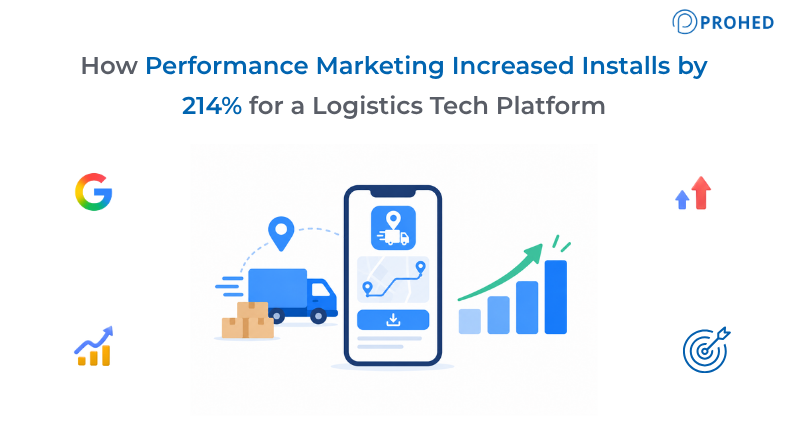
Performance marketing helped a logistics tech platform serving 50,000+ businesses grow installs 214%, qualified leads (MQLs) 98% and acquisitions 93% by optimizing for user intent instead of lead volume. PROHED, a performance marketing agency in Gurgaon, explains how.
Think of a marketing dashboard where every number is green. Leads are up. Cost per lead is down. And the sales team is still asking why so few of those leads ever book a truck.
That’s where this platform was sitting when we got involved. The brand was trusted, the product worked, and the lead volume was there. What nobody could say was which campaigns were bringing in real customers.
What followed wasn’t a bigger budget or a lucky quarter. We changed what the campaigns were built to chase. Here’s how it played out.
The Starting Point: Plenty of Leads, Too Few Customers
The platform is WheelsEye, one of India’s leading logistics technology platforms. It connects businesses with truck transportation services across the country, and more than 50,000 businesses trust it. The industry it serves is fragmented and crowded.
The campaigns weren’t failing, exactly. They were delivering volume. The trouble was everything after the lead:
- Campaigns produced volume but not quality
- Customer journeys were fragmented across touchpoints
- Visibility after the lead stage was limited
- High-intent users were hard to pick out, so ad spend was hard to optimise
When an account can’t see past the lead, it optimises for the only thing it can see. That’s how you end up with a cheap cost per lead and an expensive customer.
Logistics B2B App Marketing: Why It’s Harder Than Marketing a Consumer App
Most app marketing advice is written for consumer apps. A logistics app plays by different rules.
| Factor | Consumer app | Logistics B2B app |
|---|---|---|
| Who decides | An individual | A business owner or operations manager |
| Type of purchase | Often one-off or impulse | Repeat bookings with higher stakes |
| Journey | Install, then use | Inquiry, qualification, onboarding, booking |
| Success signal | Install or first session | Qualified lead, first booking, repeat bookings |
| Main risk | Low-quality installs | Installs that never become customers |
That last row is the one that matters. In logistics B2B app marketing, an install is a starting point. It tells you someone was curious, not that anyone is ready to book freight.
B2B App User Acquisition: The 4 Moves That Worked
1. Chase intent, not lead volume
We stopped optimising for lead volume and started going after high-intent users. That meant tighter audience targeting, smarter signals and better downstream conversion.
“Signals” is the word to focus on. Ad platforms learn from the events you give them. Give them form fills and they find more people who fill in forms. Give them qualified outcomes and they start finding people who look like your qualified customers.
2. Build measurement that follows the whole journey
We built a measurement framework that tracked each customer from inquiry to qualification to final acquisition. For the first time, the team could see which campaigns drove business results, not just which ones produced cheap leads.
A quick test for your own account: pick any campaign and ask how many acquisitions it produced last month. If the answer is a shrug, the funnel has a blind spot. Our guide on lead scoring is a useful place to start defining what “qualified” means.
3. Go app-first for trucking platform app growth
The app was identified as the platform’s most important customer touchpoint. So we restructured campaigns around high-quality app installs, which let us optimise on real engagement signals instead of form fills.
In practice, a shift like this usually means sending post-install activity back to the ad platforms. The platform then learns which installers go on to engage, not just who tapped download.
4. Optimise toward business outcomes
Campaign objectives moved to MQLs, demand creation and acquisitions. That handed Google Ads and Meta Ads higher-value signals to learn from, and efficiency improved as they gathered better data.
How to Reduce App Install Cost Without Losing Quality
A low install cost feels like a win right up until you check what those installs did next. The aim is to reduce app install cost per qualified user, not per download.
- Define “qualified” with your sales team: If marketing and sales disagree, no campaign can optimise for it.
- Send downstream events back to the platforms: Qualified leads and acquisitions teach algorithms more than installs ever will.
- Tighten audiences before you widen budget: Scaling a loose audience scales the waste.
- Refresh creative on a schedule: Fatigue quietly pushes costs up.
- Review cost per qualified user weekly, not just cost per install.
| Metric | What it tells you |
|---|---|
| Cost per install (CPI) | How efficiently you earn downloads |
| Cost per MQL | How efficiently you find qualified interest |
| Cost per activated user | Whether installs turn into engaged users |
| Cost per acquisition | Whether the business model works |
| Day-7 retention | Whether installers stick around |
The Growth in Numbers
Here’s where the account landed:
- Installs: +214%
- Marketing qualified leads (MQLs): +98%
- Acquisitions: +93%
- Ad spend: +115%
Installs grew nearly twice as fast as spend, which is the reverse of what usually happens when you push more money into a weak setup. MQLs and acquisitions also rose together, a sign that the extra volume was real demand and not noise.
Curious About the Full Story?
The numbers above are real. The page behind them lays out the platform’s goal, the challenges it faced, the four strategic interventions and the headline results.
If you run a logistics, supply chain or B2B app and your installs aren’t turning into customers, it’s worth a few minutes. Read the full case study here.
Digital Marketing for Logistics Companies: Where Each Channel Fits
| Channel | Role | Watch out for |
|---|---|---|
| Google Ads (search) | Captures people already looking for freight or truck services | Broad keywords that attract the wrong buyer |
| Google app campaigns | Drives installs across the Play Store ecosystem | Optimising for installs instead of in-app events |
| Meta Ads | Awareness and remarketing to engaged users | Loose targeting that inflates lead volume |
| SEO and content | Builds steady, lower-cost demand over time | Slow payback, so start early |
The right mix depends on who actually books. A business owner searching on Google behaves differently from an operator scrolling through social media, so the two shouldn’t get the same message. For a wider view, see our performance marketing guide for Indian brands and our piece on lead generation funnel optimisation.
How PROHED Builds Performance Marketing for Logistics and B2B Apps
Our marketing strategists start every engagement with one question: what should this campaign be judged on? For this platform, the answer wasn’t installs or leads. It was acquisitions. Everything in our marketing approach follows from that choice, with tracking, audiences and bidding signals built backward from the business result.
It’s a method we’ve used in logistics before. For Rivigo, another logistics platform, our clients and results page reports 150K app downloads, a 40% lower cost per install and 2.5x installs. Rivigo’s business head credits our app-focused advertising for their cost-effective scale-up.
The same thinking runs through our app install campaigns, B2B lead generation and performance marketing services, all built to work as one connected system.
Conclusion
This platform’s growth came from a change in focus: from generating leads to driving measurable business results. Intent-first targeting, full-funnel measurement, an app-first structure and outcome-based optimisation turned 115% more spend into 214% more installs and 93% more acquisitions.
If your app is collecting installs that don’t turn into customers, the fix usually starts with what you measure and optimise for, not with a bigger budget.
FAQs
1. What marketing channels work best for logistics apps in India?
Google Ads (search and app campaigns) works well for capturing intent, and Meta Ads for awareness and remarketing. Add SEO and follow-up by call or WhatsApp, and weight the mix by who actually books.
2. How do you reduce CPI for a B2B logistics app?
Tighten targeting, refresh creatives and optimise toward in-app events instead of raw installs. Then judge cost by qualified users, because a cheap install that never books isn’t cheap.
3. What is a good cost per install benchmark for B2B apps in India?
Published benchmarks vary widely by source and category, so no single figure is reliable. Benchmark against your own cost per qualified user or acquisition instead.
4. How is marketing a logistics platform different from a B2C app?
Buyers are businesses making repeat, higher-stakes bookings, so qualification and sales follow-up matter more than raw downloads. Journeys also run through more touchpoints, which makes full-funnel tracking essential.
5. Why optimise for MQLs and acquisitions instead of installs?
Higher-value signals teach ad platforms which users become customers. Installs alone tend to reward cheap, low-intent downloads.
6. How long does it take to see results from a B2B app campaign?
Efficiency gains can start showing within weeks once tracking is set up properly. Full-funnel results take longer, because B2B journeys run over a longer cycle.
Want your logistics or B2B app judged on customers, not just installs? Book a performance marketing review with PROHED and we’ll show you where your funnel leaks.
Schedule a Free Strategy Call with PROHED Today