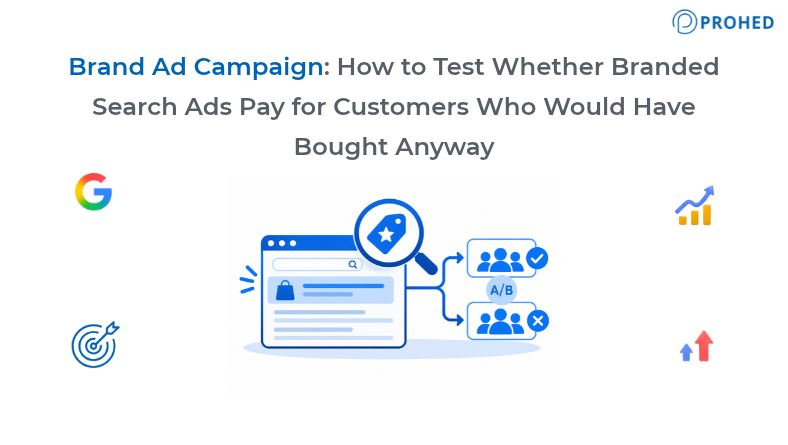
A brand ad campaign on your own name is worth running only if it brings sales you wouldn’t get anyway. You can test that with a geo holdout, comparing total conversions. PROHED, a performance marketing agency in Gurgaon, shows how.
Check your Google Ads account. The branded search campaign probably has the best ROAS in it, by a wide margin. That’s the problem. Those people typed your name. They were already on their way.
Key takeaways
- High ROAS on branded search often reflects intent that existed before the ad.
- A geo holdout test gives a far better answer than any in-platform report.
- Keep branded ads if competitors bid on your name, and trim them if nobody does.
- Performance Max can serve branded queries unless you add brand exclusions.
What Are Branded Search Ads, and Why Do They Look So Profitable?
Branded search ads run on queries that contain your brand name, such as your company, product names and common misspellings. These branded keywords have high click-through rates, low costs per click and high conversion rates, so the campaign looks like a star performer.
Attribution gives the ad full credit, even when the organic result would have won the same click. That’s why the number in your dashboard and the sales the campaign actually adds can be very different.
Should You Run Ads on Your Own Brand Name?
Sometimes yes, sometimes no.
| Keep branded ads if… | Trim or pause them if… |
|---|---|
| Competitors bid on your brand name | Nobody else bids on your name |
| Marketplaces or affiliates show up above you | You rank first organically with strong sitelinks |
| Your organic listing is weak or crowded | A holdout test shows low lift |
| You need control over offers and messaging | The ads only repeat what the organic result says |
If you’re unsure, the answer comes from a test, not an opinion.
How to Test Whether Branded Search Is Incremental?
Method 1: A geo holdout (the best option)
- Pick two sets of comparable regions, such as states or city clusters, with similar sales patterns.
- Pause branded ads in the test regions and keep them running in the control regions.
- Run it for three to four weeks, covering full weekly cycles, and avoid sale and festive windows.
- Compare total sales in both sets of regions, paid and organic combined, against their pre-test baseline.
The key rule is to look at total sales, not ad-attributed sales. If total sales hold up after you pause, the ads weren’t adding much.
Method 2: A time-based pause
Pause the campaign for two weeks and compare against the previous period. It’s easier to run, but seasonality can mislead you, so use geo holdouts if you can.
Method 3: Checks that don’t need a pause
- Open Auction Insights. Are competitors showing up on your brand searches?
- Compare branded organic clicks in Search Console with paid clicks for the same queries.
- Check impression share. If it’s already near 100% and nobody competes, the budget may be overkill.
How to Calculate Incrementality?
Here’s an illustrative example. Say the branded campaign in your test regions spends ₹60,000 a month and reports ₹6 lakh in revenue. After you pause it, total revenue in those regions falls by only ₹90,000 against the control.
- Incrementality: ₹90,000 ÷ ₹6 lakh = 15%
- Incremental ROAS: ₹90,000 ÷ ₹60,000 = 1.5
At a 45% contribution margin, break-even ROAS is about 2.2. So an incremental ROAS of 1.5 means the branded ads are losing money, even though the dashboard shows 10x.
Does Branded Search Cannibalise Organic Traffic?
Partly, and the test shows how much. When your paid and organic listings both appear, some clicks that would have gone to organic go to the ad. You pay for traffic you’d have earned free.
That changes when competitors or marketplaces are present. Then your ad protects your position, and pausing it can hand your own customers to someone else.
How Performance Max and AI Max Affect Branded Search Spend?
Performance Max can serve branded queries unless you tell it not to. Brand exclusions are optional, and they’re set per campaign. They apply to Search and Shopping inventory, and some Google documentation also lists YouTube search, so check the current help page. In Search campaigns, brand settings now sit inside the AI Max settings.
Without exclusions, Performance Max can flatter its own ROAS with branded traffic that was already coming. A cleaner setup is to keep a separate branded Search campaign and exclude your brand from Performance Max. Then judge Performance Max on new customers only. Google notes that brand settings limit reach and can lower performance, so measure after you change them. The rules are in Google’s brand settings help page.
How Much Branded Search Spend Is Too Much?
There’s no safe percentage. Let the test set the cap.
Two signals tell you it’s too high. The branded campaign’s ROAS sits far above everything else in the account, and impression share is already close to 100% with no competitors. Check your MER (marketing efficiency ratio) too. If you trim branded spend and MER holds steady, those rupees weren’t pulling their weight. They were probably part of your wasted ad spend. Our guide to reducing wasted ad spend in Google Ads covers the other leaks.
What to Do After the Test?
| Result | Action |
|---|---|
| Low lift, no competitors | Cut to a small defensive budget, or pause |
| High lift, or competitors bid on you | Keep it, and manage bids against impression share |
| Mixed result | Keep exact match only, remove broad brand variants and lower bids |
Whatever you decide, keep the offer and sitelink copy fresh, since branded ads are your best chance to control the message.
How PROHED Tests Branded Search?
We treat branded search as a hypothesis to prove, not a given. For D2C and ecommerce accounts, we run geo holdouts with total revenue and MER as the scoreboard, and we check Performance Max and AI Max brand settings first. The result is a branded budget set by evidence, with the savings moved to non-brand and prospecting campaigns that win new customers.
Conclusion
Branded search ads aren’t bad, but they’re often over-credited. Test them with a geo holdout, judge them on total sales, and keep them only where they earn their place.
If you’re looking for data-driven marketing agencies in India, the best performance marketing agency for D2C brands in India, or a digital marketing agency for ecommerce, PROHED is built for this brief. As a performance marketing agency in Gurgaon, we run paid media, measurement and reporting together, so every rupee is accounted for.
FAQs
1. Should you run ads on your own brand name?
Yes, if competitors, marketplaces or affiliates also show up on your brand searches. If nobody competes and you rank first organically, the ads may add little.
2. How do you test whether branded search is incremental?
Pause branded ads in matched test regions and keep them live in control regions, then compare total sales, paid and organic, over three to four weeks.
3. Does branded search cannibalise organic traffic?
Partly. Some clicks go to the ad that would have gone to organic, and only a test shows how many.
4. How much branded search spend is too much?
There’s no fixed percentage. If branded ROAS far exceeds every other campaign and impression share is near 100% without competitors, you’re likely overspending.
5. How does Performance Max affect branded search spend?
It can serve branded queries unless you add brand exclusions, which inflates its ROAS. Keep a separate branded Search campaign and exclude your brand from Performance Max.
Not sure your branded campaign is paying for itself? Book a branded search audit with PROHED and we’ll show you what a holdout test would reveal.
Schedule a Free Strategy Call with PROHED Today