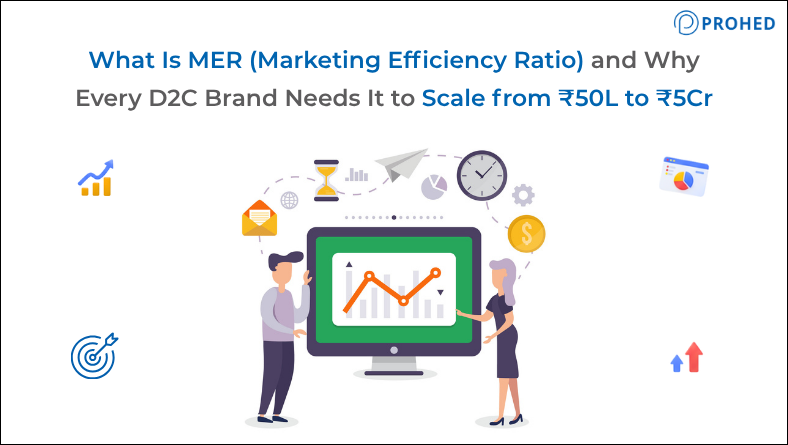
What is MER (Marketing Efficiency Ratio)? MER = Total Revenue ÷ Total Marketing Spend across all channels.
It tells you whether your entire marketing system is profitable, not just individual campaigns. For D2C brands scaling in India, it’s the single most important budget metric that ROAS simply doesn’t give you. – Prohed, Performance Marketing Agency, Gurgaon
Most D2C founders scaling past ₹50 lakhs hit a frustrating wall. The Meta ROAS looks acceptable. Google campaigns seem healthy on paper. However, revenue growth has slowed, CAC is climbing, and no single dashboard explains why. The answer, more often than not, is hiding in a metric most D2C brands haven’t even set up yet, the Marketing Efficiency Ratio, or MER.
If you’ve been optimising channel by channel and still wondering why your D2C brand isn’t growing as fast as your ad spend, this article will show you exactly why and what to do about it.
Why D2C Brands Can’t Scale on ROAS Alone
ROAS is a channel-level metric. It tells you how much revenue a specific campaign appears to have driven. However, it doesn’t account for how channels interact with each other, and that gap grows more damaging the more channels you add.
Here’s what actually happens in a typical D2C purchase journey. A customer discovers your product on Instagram three times over two weeks. Then, they click a Google Shopping ad and complete a purchase. Meta claims zero credit. Google claims 100%. Neither platform accounts for the organic search visit that happened in between, or the retargeting ad that kept the brand visible throughout.
Consider a real pattern we see often. A D2C skincare brand spending ₹6 lakhs monthly across Meta and Google was about to pause its Meta campaigns because ROAS had dropped to 1.8x. Before doing so, they calculated overall MER, it sat at 4.1x, well above their 3x floor. Pausing Meta would have collapsed warm audience pools within 30 days, pushing Google conversion costs up by an estimated 35-40%. They kept Meta running. The following month, MER held at 3.9x and monthly revenue crossed ₹28 lakhs for the first time.
As a result, individual performance marketing metrics become progressively less reliable as you scale. D2C brands that optimise purely by channel ROAS often end up cutting spend on channels doing critical awareness or consideration work, simply because those channels don’t show direct conversion credit.
MER sidesteps the attribution problem entirely. Instead of asking “which channel drove this sale?”, it asks “did marketing as a whole produce a return worth the investment?” For D2C brands scaling from ₹50 lakhs to ₹5 crore, that shift in thinking is genuinely everything.
See how a D2C Ayurveda brand scaled from 1.8x to 4.2x ROAS using a MER-first restructure
MER vs. ROAS vs. CAC: Which Metric Should Drive D2C Scaling Decisions?
This is worth answering directly, because most D2C brands use all three without clarity on when each one applies.
- ROAS is the right metric for campaign-level decisions. Which ad sets to scale, which creatives to pause, which audiences to expand. It answers “is this specific spend working?”
- CAC (Cost to Acquire a Customer) is the right metric for unit economics and payback period analysis. It answers “how much does a new customer cost, and how long before we recover that?”
- MER is the right metric for total budget decisions. How much to spend in aggregate, whether it’s safe to increase overall marketing investment, and whether the system as a whole is healthy. It answers “should we put more money into marketing this month?”
Across D2C brands Prohed has worked with, those tracking MER as a primary metric have consistently scaled 2x faster than those optimising by channel ROAS alone. The difference isn’t creative quality or channel selection, it’s the fact that MER-first brands never cut spend that the system actually needs just because one platform’s dashboard looks weak on a given week.
At Prohed, across D2C brands we’ve worked with in 2025-26, the most common scaling mistake we see is founders using ROAS to make decisions that should be made using MER. They see a channel-level ROAS dip during a scale-up and cut spend, even though overall MER is still healthy and the business could safely keep going. That one mistake, repeated across quarters, is what keeps most D2C brands stuck between ₹50L and ₹1 crore longer than they need to be.
Metric | What It Answers | Use It For |
ROAS | Is this campaign working? | Ad-level optimisation |
MER | Is total marketing spend healthy? | Budget scaling decisions |
CAC | What does a customer cost? | Unit economics, payback period |
How D2C Brands Should Calculate Their Target MER
Your target MER isn’t a benchmark from a blog post. Instead, it should be reverse-engineered from your own margin structure, because D2C margins vary significantly across categories.
Start with your blended gross margin. If your average gross margin is 60% and you want to protect a 15% net margin after all marketing costs, then marketing spend can be a maximum of 45% of revenue. That translates to a minimum target MER of approximately 2.2. A brand with tighter margins, say 45% gross, protecting the same 15% net margin has only 30% left for marketing, which means a minimum MER of 3.3. The math changes significantly by category, which is why copying someone else’s target is a mistake.
Before increasing any client’s monthly budget at Prohed, even by ₹5 lakhs, we calculate this number first. Target MER becomes the guardrail for every budget decision that follows, so scaling decisions are made from data rather than from optimism.
Once you have your target MER, every budget conversation changes. Instead of asking “can we afford to spend more on Meta?”, you ask “is our overall MER currently above target, and does it have headroom to absorb more spend without falling below the floor?”
The D2C Funnel Problem That Quietly Destroys MER
MER doesn’t deteriorate randomly. When it starts declining as budgets increase, it almost always points to a structural gap in the funnel marketing architecture, and this is a pattern that shows up across every D2C category.
Brands with weak top-of-funnel investment see this consistently. Without awareness spend feeding new people into the funnel, warm audiences shrink over time. Retargeting pools dry up. Consequently, conversion costs at the bottom of the funnel rise because the brand ends up trying to convert cold audiences with bottom-of-funnel messaging, and cold audiences don’t respond well to that.
A D2C home goods brand we worked with had been spending 80% of their ₹12 lakh monthly budget on conversion campaigns. MER was sitting at 2.1x, below their 2.5x floor and dropping month on month. After redistributing 25% of budget toward awareness and shifting another 15% toward mid-funnel consideration content, MER recovered to 3.2x within 60 days. Monthly revenue moved from ₹25 lakhs to ₹38 lakhs over the same period. The budget didn’t change. The funnel structure did.
According to Redseer’s 2024 D2C India report, over 60% of Indian D2C brands that plateau between ₹50L and ₹2Cr monthly revenue are running bottom-heavy funnel structures, with less than 20% of spend allocated to awareness. That statistic alone explains most of the MER compression stories we hear.
At Prohed, we’ve seen this consistently across D2C verticals – beauty, Ayurveda, baby care, apparel, and home goods. The brands whose MER holds at scale are almost always the ones where the full funnel is genuinely active, not just the conversion layer. This is precisely why performance marketing at Prohed is always built as a connected system rather than a collection of isolated campaigns.
3 MER Practices Every D2C Brand Should Implement
1. Track MER Weekly, Not Monthly
Monthly MER reporting is too slow to catch problems before they compound. Therefore, weekly tracking is essential once you’re spending meaningfully across multiple channels. A sudden MER drop mid-month usually signals one of three things: a channel has fatigued, a competitor has increased spend in your target segments, or a seasonal shift has reduced conversion rates. Catching that in week two rather than week five makes the difference between a correctable dip and a wasted quarter, and in D2C, wasted quarters are expensive.
2. Run Incremental Tests Before Major Budget Increases
When overall MER is healthy and above target, the system has headroom. The question then becomes: which channel to increase first? The answer comes from incremental testing. Specifically, increase spend on one channel by 20-30%, hold everything else constant, and measure what happens to overall MER over two to three weeks. If MER holds or improves, that channel has capacity. If MER drops meaningfully, you’ve found the ceiling for that channel at this stage. This removes guesswork from scaling decisions entirely and is a core part of the marketing analysis framework Prohed builds for D2C brands preparing to cross the ₹1 crore monthly revenue mark.
3. Use MER as a Business Metric, Not Just a Marketing One
One of the most underused applications of MER in D2C is in financial planning and investor conversations. A brand that can show stable or improving MER across several months of increasing spend is demonstrating something far more valuable than a single strong ROAS month. It’s showing that the marketing system scales predictably. Furthermore, MER connects marketing performance directly to P&L in a way that channel-level metrics simply don’t. Founders and finance teams understand “for every rupee spent on marketing, we generate ₹4.2 in revenue” far more clearly than they understand attribution figures from individual ad platforms.
What Healthy MER Looks Like for D2C Brands at Each Revenue Stage
These benchmarks are drawn from patterns across D2C verticals. Your actual target will vary by category and margin structure, but these give a useful orientation point.
Monthly Revenue Stage | Typical Healthy MER Range |
₹10L – ₹50L | 3.5x – 5x |
₹50L – ₹1Cr | 3x – 4.5x |
₹1Cr – ₹5Cr | 2.5x – 4x |
₹5Cr+ | 2x – 3.5x |
MER naturally compresses somewhat as revenue scales, and that’s expected. However, a sharp drop during a scale-up period almost always points to a structural issue, a broken funnel stage, misallocated budget, creative fatigue, or warm audience depletion. In those situations, a marketing analysis audit typically resolves the issue faster than channel-by-channel optimisation, because the root cause is usually systemic rather than campaign-specific.
How Prohed Helps D2C Brands Scale With MER
At Prohed, MER tracking is built into every D2C client engagement from day one, not as a reporting exercise, but as the primary framework for every budget conversation.
Every service Prohed offers, including Search Engine Marketing, SEO, Social Media Marketing, E-commerce Marketing, B2C and B2B Lead Generation, is structured to contribute to a single, unified MER. No channel operates in isolation, optimising locally while underperforming as a system.
Additionally, marketing automation setup is built into the performance stack for D2C brands at the ₹1 crore-plus monthly spend level. Automated dashboards calculate MER in real time, flag threshold breaches automatically, and support incremental testing across channels simultaneously, without relying on weekly manual data pulls that slow down decision-making.
Recognised widely as a trusted marketing agency in Gurgaon and among the leading names in performance marketing metrics and D2C campaign architecture across India, Prohed brings the same MER-first thinking to brands at every stage of scale. The reason D2C brands choose Prohed as their marketing strategy partner isn’t just execution capability. It’s the fact that every channel decision is made in the context of how the whole system is performing, and that’s what produces consistent, scalable growth rather than one strong month followed by an unexplained plateau.
FAQs
1. What is MER in marketing, and how is it different from ROAS?
MER (Marketing Efficiency Ratio) measures total revenue divided by total marketing spend across all channels, while ROAS only measures return on a single channel or campaign. MER gives you the full picture of how efficiently your marketing system is performing, which is what actually matters when you’re making budget decisions at scale.
2. What is a good MER for a D2C brand in India?
It depends on your margin structure, but generally a healthy MER for D2C brands in India falls between 3x and 5x at the ₹10–50 lakh monthly revenue stage, and between 2.5x and 4x once you cross ₹1 crore monthly. The key is to calculate your own target based on gross margin, not to chase an industry average that may not match your economics.
3. Why does MER drop when I increase my ad budget?
Almost always, it points to a funnel architecture problem rather than a budget problem. When you scale spend without a properly active top-of-funnel, warm audience pools shrink, retargeting becomes less efficient, and conversion costs rise, all of which pull MER down. Fixing the funnel structure is usually the answer, not pulling back the budget.
4. How often should a D2C brand track MER?
Weekly, once you’re spending meaningfully across multiple channels. Monthly MER tracking is too slow to catch problems before they compound into a wasted quarter. A mid-month dip spotted in week two is correctable; the same dip spotted at month-end is already expensive.
5. Can MER replace ROAS entirely for D2C brands?
Not quite, they answer different questions. MER tells you whether total marketing spend is healthy and whether it’s safe to scale. ROAS tells you which specific campaigns or ad sets are performing well and which to pause. You need both, but MER should be the primary lens for budget decisions and ROAS for campaign-level optimisation.
6. What’s the connection between funnel marketing and MER?
They’re directly linked. D2C brands with strong full-funnel activity tend to see MER improve as they scale, because each new customer acquired feeds the retargeting pool, which converts at lower cost. Brands with only bottom-of-funnel activity tend to see MER deteriorate under increased spend. The funnel structure is what determines whether MER compounds or collapses at scale.
7. How do I set a target MER for my D2C brand?
Start from your gross margin. Subtract the net margin you want to protect after marketing, and the remainder is the maximum percentage of revenue you can allocate to marketing. Invert that to get your minimum MER floor. For example, a 60% gross margin brand protecting 15% net margin has a 45% marketing spend ceiling, which equals a minimum MER of roughly 2.2.
8. Is MER useful for early-stage D2C brands not yet running multi-channel campaigns?
Yes, even if you’re only running one channel. MER simply equals revenue divided by that channel’s spend, which is functionally the same as blended ROAS at that stage. The real value becomes clearer as you add channels, but building the habit of tracking it early means the framework is already in place when you scale.
9. What role does marketing automation play in MER tracking for D2C brands?
At high spend levels, manual MER tracking becomes impractical. Marketing automation enables real-time dashboards that calculate MER continuously, flag threshold breaches automatically, and support incremental testing across channels simultaneously without relying on slow weekly manual pulls.
10. How does working with a D2C performance marketing agency help improve MER?
A good agency connects every channel to a single MER target rather than optimising each one in isolation. At Prohed, every service, from paid media to SEO to social, is built around a unified MER framework, so budget decisions are made based on how the whole system performs, not how individual dashboards look on any given day.
Ready to build a marketing system where MER improves with scale rather than deteriorating under it?
Schedule a Free Strategy Call with PROHED Today