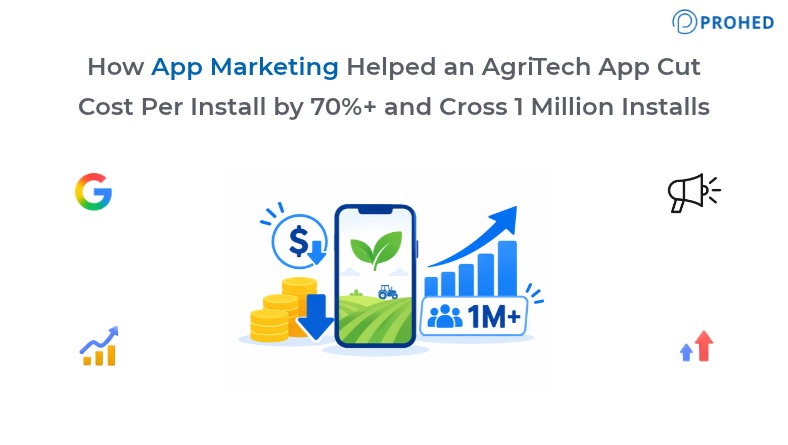
App marketing helped a hyper-local weather app for Indian farmers cut cost per install by more than 70% and cross 1 million installs, using Google, Facebook, Instagram and YouTube campaigns. PROHED, a performance marketing agency in Gurgaon, explains how.
A weather app sounds like an easy sell. Everyone checks the forecast. But try getting a farmer in a district you’ve never visited to download an app, trust its forecast and open it again tomorrow.
That was the brief. The result was 1 million installs at a far lower cost per install, with fewer uninstalls along the way. We’ll name the app at the end, once you’ve seen how it was done.
The Results at a Glance
| Metric | Result |
|---|---|
| App installs | 1M+ |
| Cost per install | Down 74% (more than 70%) |
| Cost per click | Down 54% |
| Uninstall rate | Declined |
| Retained users | Up month on month |
The Challenge: Reaching Farmers in Every Region of India
The goal was to reach farmers across India, grow installs and active users, and keep them using the app. It gives farmers hyper-local forecasts for their own fields, so its value is obvious once someone tries it. Getting them to try it is the hard part.
Agritech app marketing typically faces three hurdles: geography and language spread across the country, trust in a new digital tool, and demand for forecasts that rises and falls with the farming season. The campaign had to explain the app clearly, not just push downloads.
Three Objectives, One Scorecard
- Lower cost per install: Reach more farmers for less.
- 1 million or more installs: Scale without losing efficiency.
- Stronger retention: Installs only matter if people stay.
That third point matters more than it looks. A campaign judged only on install volume tends to find cheap, low-intent users. Tracking retention from day one changes what the campaign learns.
App Install Campaigns That Worked: 4 Moves
The case study credits a mix of research, data analysis and optimum ad placement, which lifted qualified downloads. The details of each campaign aren’t public, so here’s what that approach rests on.
- Start with the farmer, not the platform: Research who needs the app, where they are and what they want from a forecast.
- Let the data pick winners: Track which audiences, creatives and placements bring installs that stay, then cut the ones that bring cheap installs that vanish.
- Place ads where farmers already spend time: The campaigns ran across Google, Facebook, Instagram and YouTube.
- Judge quality, not just cost: Read CPI alongside uninstall and retention numbers.
How to Reduce CPI Without Hurting Install Quality?
Anyone can lower CPI by chasing the cheapest audiences. Keeping quality means working differently:
- Define a good user: Decide what action, such as opening the forecast, marks a real user.
- Optimise for that action, not the install: Train the ad platform on what you actually want.
- Test creative in batches: Refresh ads before fatigue pushes costs up.
- Cut weak placements quickly: Cheap clicks from poor placements often produce installs that disappear.
- Watch day-one and day-seven retention next to CPI, every week.
| Metric | What it measures | When to use it |
|---|---|---|
| Cost per install (CPI) | Cost of each download | Judging reach efficiency |
| Cost per action (CPA) | Cost of a chosen action, such as a first forecast viewed | Judging install quality |
| Retention rate | Users still active after a set period | Judging long-term value |
| Uninstall rate | Users who remove the app | Spotting low-intent traffic |
Cost per action marketing matters because CPI alone rewards volume. A cost per action advertising model tied to an in-app event rewards quality.
Which Channels Do What in an App Install Campaign?
The case study doesn’t publish a channel split, so this is how each platform typically earns its place:
| Channel | Typical role | Watch out for |
|---|---|---|
| Google Ads app campaign | Reaches people across Search, Play Store and YouTube from one setup | Optimising for installs instead of in-app actions |
| YouTube | Demonstrates the app and builds trust through video | Long videos with weak openings |
| Facebook and Instagram | Reach and remarketing across wide audiences | Loose targeting that inflates installs |
Retention Marketing: Why Installs Alone Don’t Count
The case study reports a falling uninstall rate and retained users rising month on month. That’s the point of retention marketing: give people a reason to come back after the first open. For a weather app, timely forecasts and alerts are a natural reason.
Installs get the headline, but retained users are what the business actually keeps.
The Brand Behind the Results: Yara FarmWeather
The app is Yara FarmWeather, a hyper-local weather app for Indian farmers from Yara. Its campaigns ran across Google, Facebook, Instagram and YouTube and reached over 1 million installs. Want the full story? Read the Yara FarmWeather case study.
We saw a similar shift from installs to qualified users with a logistics tech platform, where the same approach grew installs 214%.
How PROHED Approaches App Marketing?
Our app install campaigns begin with a clear picture of your ideal user, based on data from your existing audience. We then shape targeting, creative and bidding around that user, which tends to bring better quality and stronger retention. Our app marketing playbook lays out the full process.
Paid installs aren’t the only lever. Better app store optimisation lifts organic downloads, which lowers your blended acquisition cost. Our performance marketing service ties all of it together.
Conclusion
Reaching a million installs at a falling cost took research, ongoing data work and a focus on users who stay. There was no shortcut, and no single trick.
If you’re looking for the best performance marketing agency to grow an app, ask how each one measures quality and retention, not just CPI.
FAQs
1. What is a good cost per install in India?
It varies widely with the app category, platform and audience, so no single figure fits every app. Compare CPI with cost per activated or retained user to see whether your installs are actually worth it.
2. How do you lower CPI without hurting install quality?
Refine your audiences, optimise toward an in-app action and cut weak placements. Watch retention and uninstall rates alongside CPI.
3. Which channels work best for agritech apps?
Video on YouTube and Google app campaigns help explain a new app, while Facebook and Instagram add reach. The Yara case study used all four and let performance data guide the mix.
4. How do regional-language creatives affect install cost?
Creatives in a user’s own language can improve relevance and click-through, which may lower CPI. The case study doesn’t publish a language breakdown, so test it region by region.
5. What does it take to reach 1 million installs?
Research, steady data-led optimisation and a focus on retention, built up across channels over time. The case study describes the growth as gradual.
Want your app to grow without costs spiraling? Book an app marketing review with PROHED and we’ll show you where your install quality leaks.
Schedule a Free Strategy Call with PROHED Today