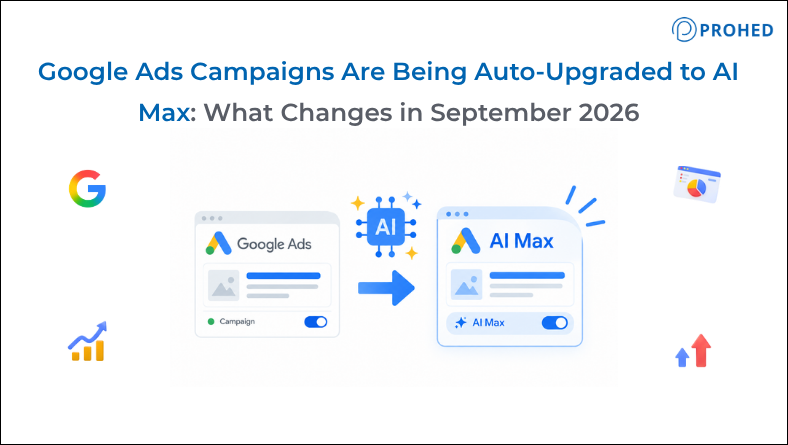
A Google Ads campaign using Automatically Created Assets or campaign-level Broad Match will be auto-upgraded to AI Max starting September 1, 2026, with no manual opt-in required. Google is migrating these campaigns in place, carrying over existing budgets, bid strategies, and brand controls. Dynamic Search Ads follow later, in February 2027. PROHED, a google ads agency that manages search engine marketing for clients across categories, has already started reviewing affected accounts ahead of the September window.
If you haven’t touched your Google Ads campaign settings in a while, this update is worth five minutes of your time. Google isn’t asking permission this time, it’s just migrating campaigns on its own schedule, and the accounts that prepare beforehand tend to come out with cleaner matching than the ones that let it happen automatically.
What’s Actually Changing on September 1?
Any search campaign still running Automatically Created Assets or the campaign-level Broad Match setting gets rolled into AI Max sometime between September 1 and September 30. Google confirmed migration happens gradually across the month, not all at once. According to Google’s own announcement on the transition, campaigns using Automatically Created Assets and the campaign-level Broad Match setting will continue to be auto-upgraded starting in September 2026, with existing settings carried over to minimize disruption.
Dynamic Search Ads were originally scheduled for the same September window, but Google pushed that timeline back to February 2027 after advertiser feedback about fourth-quarter planning risk. Two separate deadlines are worth remembering here, not one.
Migration Timeline at a Glance
| Date | What Happens |
| August 3, 2026 | Creating new Campaign-level Broad Match or legacy Automatically Created Assets configurations is switched off |
| September 1–30, 2026 | Existing ACA and Broad Match campaigns are auto-upgraded to AI Max, rolled out gradually |
| January 15, 2027 | Reminder notifications sent to advertisers still running Dynamic Search Ads |
| February 1–28, 2027 | Dynamic Search Ads auto-migrate to AI Max, and new DSA ad groups can no longer be created |
What This Means for Advertisers?
A few practical changes come with this upgrade, and most of them happen without any action needed:
- Search term matching turns on by default, meaning ads can now serve against queries beyond your exact keyword list, closer to how Performance Max already works.
- ACA campaigns also get text customization turned on, letting Google rewrite parts of your ad copy dynamically.
- Budgets and bid strategies stay untouched during the migration itself.
- Brand inclusions and exclusions carry over automatically, so brand safety settings don’t need to be rebuilt.
- Search term controls, negative keywords, and location of interest settings remain adjustable after the upgrade completes.
AI Max vs Performance Max vs Standard Search Campaigns
| Feature | Standard Search | AI Max | Performance Max |
| Matches beyond exact keywords | No | Yes, via search term matching | Yes, across all Google inventory |
| Dynamic ad copy generation | Limited | Yes, with text customization | Yes |
| Manual keyword control | Full | Partial, with negatives and exclusions | Minimal |
| Inventory covered | Search only | Search only | Search, Display, YouTube, Discover, Maps, Gmail |
Related Read: Google’s New PMax Network Control: Should You Opt Out of Search Partners and Display Network?
How to Prepare Before September 1?
A short window remains before the auto-upgrade reaches most accounts. It’s worth using it:
- Audit which search campaigns are still using Automatically Created Assets or campaign-level Broad Match.
- Review and tighten negative keyword lists now, since search term matching widens what queries can trigger your ads.
- Reconfirm brand inclusion and exclusion settings before the migration, even though Google says they’ll carry over.
- Baseline your current search terms report so post-migration matching behavior can actually be compared against something.
- Decide whether to opt in manually before September or let the automatic migration handle it, since doing nothing is itself a choice here.
Where PROHED Fits Into This?
As a google ads agency handling search engine marketing across paid media accounts, PROHED treats platform changes like this as routine account hygiene rather than a surprise to react to later. That means auditing google ads campaigns for legacy settings, cleaning up negative keyword lists, and setting brand controls deliberately before Google’s automatic timeline takes over.
This kind of proactive review tends to matter more for brands running search alongside other pillars of the Google marketing platform, since a messy search term migration can quietly affect Performance Max and Display campaigns pulling from the same account signals.
Conclusion
This isn’t a minor settings update buried in a release note. Search campaigns using Automatically Created Assets or campaign-level Broad Match are moving to AI Max automatically, whether an advertiser opts in or not. The accounts that spend the next few weeks cleaning up negatives and reconfirming brand controls will simply have a smoother September than the ones that find out after the fact.
FAQs
1. What is AI Max in Google Ads?
AI Max is Google’s expanded automation layer for Search campaigns, combining search term matching beyond exact keywords with dynamic text customization for ad copy. It’s positioned as a middle ground between standard Search campaigns and the fully automated Performance Max.
2. Will my Google Ads campaign be affected by the September migration?
Only if it currently uses Automatically Created Assets or the campaign-level Broad Match setting. Standard keyword-based campaigns without these features aren’t part of this particular upgrade.
3. Can I opt out of the AI Max auto-upgrade?
Not directly. The only way to avoid it is turning off Automatically Created Assets or campaign-level Broad Match on affected campaigns before Google’s migration window reaches your account in September.
4. What happens to Dynamic Search Ads campaigns?
They follow a separate, later timeline. Google delayed DSA migration to February 2027 after advertisers flagged concerns about disruption during fourth-quarter planning, so DSA campaigns aren’t affected by the September upgrade.
5. Does AI Max change my budget or bid strategy?
No, budgets and bid strategies carry over unchanged during the migration. What changes is how broadly your ads can match search queries and whether Google dynamically adjusts your ad text.
6. Is AI Max the same as Performance Max?
No, though they share some automation logic. AI Max stays within Search inventory, while Performance Max spans Search, Display, YouTube, Discover, Maps, and Gmail. AI Max also retains more manual controls than Performance Max typically allows.
7. How does search term matching affect my keyword strategy?
It widens what queries can trigger your ads beyond your literal keyword list, based on intent rather than exact match. This makes negative keywords and search term monitoring more important than they were under standard matching.
8. Should I upgrade to AI Max manually before September, or wait for the automatic migration?
Upgrading manually gives you the chance to set search term matching, text customization, and brand controls deliberately, rather than accepting Google’s default configuration. For accounts with tight brand or messaging requirements, this is usually the safer route.
Ready to Get Ahead of the AI Max Migration?
Letting Google auto-upgrade your search campaign without a review first means accepting its defaults, not yours. Talk to PROHED’s paid media team about auditing your Google Ads campaigns before the September window closes.
PROHED is a google ads agency and performance marketing agency in Gurgaon, supporting search engine marketing and search campaign management for clients across D2C, EdTech, and B2B sectors
Schedule a Free Strategy Call with PROHED Today