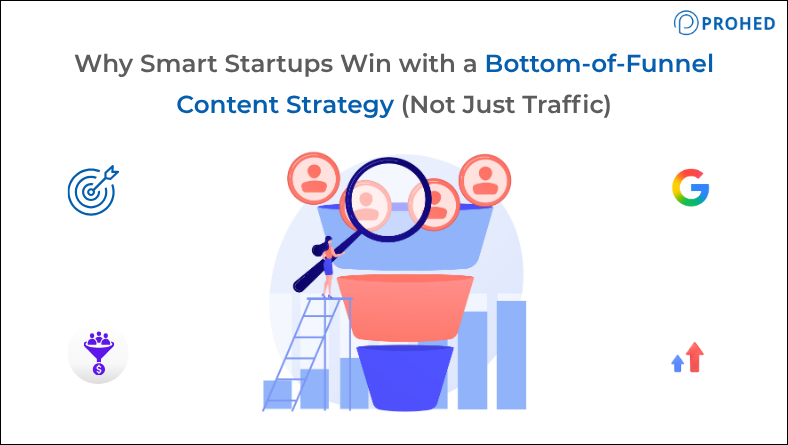
Most startups are sprinting in the wrong direction. They burn through their runway chasing “eyeballs” more clicks, more views, more fluff. Then they’re shocked when the revenue flatlines. The uncomfortable truth? Traffic without intent is just noise. The startups winning right now have stopped obsessing over top-of-funnel reach and quietly moved their chips to the bottom of the funnel.
If you have been building content just to rank, it is time to rethink the whole approach.
Content Types and Their Business Value
Funnel Stage | Content Type | Core Purpose | Conversion Intent |
TOFU | How-to guides, infographics | Awareness & reach | Low (Casual browsing) |
MOFU | Case studies, webinars | Trust & consideration | Medium (Solution seeking) |
BOFU | Comparison pages, pricing | Decision & purchase | High (Ready to buy) |
Stop paying for noise. If your traffic is high but your revenue is flat, your content is likely misaligned with your buyers’ intent. Identify the BOFU gaps in your funnel and start turning clicks into customers.
Book a Content Strategy Audit Call with PROHED Today
Where Most Startups Get Stuck
Before jumping into what makes a bottom-of-funnel (BOFU) strategy so powerful, let’s look at how funnels work in the real world. Most marketers lean on the TOFU-MOFU-BOFU framework.
- TOFU (Top of Funnel): This is for awareness. Think blog posts and social media designed to bring in a wide audience.
- MOFU (Middle of Funnel): This builds trust. You’re looking at comparison guides and case studies to nurture leads.
- BOFU (Bottom of Funnel): This is where the money is made. Pricing pages, testimonials, and “vs” pages for people ready to pull the trigger.
The problem? Most startups invest almost entirely in TOFU content. It is easier to measure in vanity metrics. A blog post with 10,000 visitors feels like success, but if zero people convert, it is just an expensive distraction. Understanding these stages is what separates scaling startups from struggling ones.
Why Bottom-of-Funnel Content Drives Real Growth
Think about the last time you bought a software tool. You probably weren’t searching for “what is digital marketing.” You were likely searching for “best performance marketing agency for startups” or “Razorpay vs Stripe for Indian businesses.” That is bottom-of-funnel behavior. That is where decisions happen.
BOFU content targets people already in buying mode. Because of that, it converts at a much higher rate than awareness content. A single well-crafted comparison page can consistently outperform dozens of generic blog posts. Not just in lead volume, but in lead quality.
Also, this content is usually less competitive. Everyone is fighting for broad head terms. Very few startups invest in the specific, intent-driven queries that actually close deals. That gap is your opportunity.
What a Smart BOFU Content Strategy Looks Like
So, what does a solid bottom-of-funnel content marketing strategy actually include? Here’s how the best-performing startups are doing it.
1. Competitor Comparison Pages
Pages like “[Your Brand] vs [Competitor]” are some of the highest-converting pieces of content on the internet. People searching for these terms have already done their research. They just need one final push, and your comparison page can be that push.
2. Use Case and Industry-Specific Pages
Instead of one generic “our services” page, smart startups build pages for each industry they serve. “Content strategy for SaaS startups” performs far better than just “content strategy” because the intent is far more specific.
3. Detailed Case Studies and ROI-Driven Testimonials
Social proof placed at the decision stage does heavy lifting. A case study that shows a 3x increase in qualified leads is far more persuasive than a generic “our clients love us” statement.
4. Objection-Killing Pricing & FAQ Pages
Transparency is a massive trust signal. If a lead has to hunt for your pricing or email a “sales” alias just to see a timeline, they’ll probably just leave. Startups that answer the hard questions upfront on their site don’t just build trust, they cut their sales cycle in half by filtering out the wrong people early.
5. The “Best of” Niche Listicles
These aren’t just for SEO; they are for closing. When someone searches for “top performance marketing agencies for startups in India,” they aren’t browsing for fun, they’re holding a credit card. Ranking here means you’re catching the buyer at the exact moment they’re looking for a winner.
Also Read: How to Build an SEO Content Strategy That Drives Organic Traffic in 90 Days
The Mistake Most Startups in India Are Making Right Now
For startups in India, the challenge is even more specific. The Indian ecosystem is incredibly crowded. With hundreds of companies launching every month in cities like Bengaluru, Mumbai, and Gurgaon, the competition is fierce. Yet, most of these brands are still filling content calendars with broad TOFU content that doesn’t convert.
Meanwhile, leaner competitors are publishing smarter. They focus on BOFU pages to capture decision-ready buyers. With AI-generated fluff flooding the web, search engines are now rewarding content that shows real expertise and specific use cases. Specificity is the new competitive moat.
How Prohed Approaches Content Strategy for Startups
At Prohed, this is something we’ve seen play out firsthand across dozens of startup clients, from early-stage D2C brands to scaling SaaS companies. A full-funnel approach is something we advocate for, but the BOFU layer is typically where the biggest, fastest wins are found.
Our content strategy services aren’t built around publishing volume. Instead, they’re built around revenue impact. Every piece of content is mapped to a specific stage of the buyer journey, a specific intent signal, and a specific conversion outcome.
Beyond content, we don’t treat content as an island. Your SEO, paid ads, and social strategy need to work together to create a frictionless path to the “Buy” button. It’s this “multi-funnel” sync that separates a report that looks pretty from a business that actually grows. Content should be a conversion engine, not a digital brochure.
If you’re investing in SEO or content and not seeing leads, the issue usually isn’t the volume of content. It’s the intent-alignment. That’s the gap we help startups close.
TOFU Still Has a Role – Just Not the Lead Role
Don’t get me wrong, awareness matters. You need people to know you exist, especially if you’re a new face in a crowded market. But Top-of-Funnel (TOFU) content shouldn’t be your foundation; it should be your support.
The smarter play looks like this:
- The Engine: A lean, high-impact layer of BOFU content doing the heavy lifting.
- The Bridge: MOFU content (case studies/guides) that walks leads through the door.
- The Atmosphere: TOFU content running in the background to keep the brand top-of-mind.
The Bottom Line
The winners aren’t those who publish the most; they’re those who publish with the most intention. A focused BOFU strategy will outperform a high-volume TOFU approach every single time when you measure what actually matters: qualified leads and real revenue. With AI churning out a sea of generic “meh” content every single day, your only real survival tactic is to be specific. When you address exactly what a buyer is thinking, you build a competitive moat that no bot can replicate. The startups that get this right now are the ones that will be impossible to knock down later.
If your current content isn’t bringing in checks, don’t blame the writing, it’s usually the strategy that’s broken. That’s a leak you’ll want to plug sooner rather than later.
Tired of chasing page views and ready to start driving actual leads? At Prohed, we don’t just “do content.” We’re a growth marketing agency that turns your articles and pages into revenue engines. We focus on performance, not just vanity metrics.
Frequently Asked Questions
1. How much of my content should be focused on the bottom of the funnel?
While it varies, a healthy balance for a scaling startup is often 50% BOFU content. You need enough awareness to fill the top, but enough conversion content to ensure that traffic doesn’t go to waste.
2. Will BOFU content help my SEO rankings?
Yes, but in a different way. It might not get the massive traffic volumes of a “How To” guide, but it signals to Google that you have deep, specific expertise in your niche, which boosts your overall site authority.
3. How do I find BOFU keywords for my business?
Look at your sales calls. What questions do people ask right before they sign? Phrases like “pricing,” “integration,” “alternative to,” and “reviews” are all goldmines for bottom-of-funnel keywords.
4. Can I use BOFU content for my social media ads?
Absolutely. In fact, sending paid traffic to a BOFU comparison or pricing page often results in a much lower cost-per-acquisition than sending them to a generic blog post
Schedule a Free Strategy Call with PROHED Today