Your brand could be doing everything right. Great content, solid SEO, strong ad performance. And still be completely invisible where it matters most in 2026. Not invisible on Google. Invisible to AI.
Think about how many people are now typing questions into ChatGPT, Gemini, or Perplexity instead of scrolling through search results. They’re asking things like “which performance marketing agency should I hire?” or “what’s the best CRM for a B2B startup?” and they’re trusting whatever answer comes back. No clicking through ten blue links. No comparing options. Just one confident AI response, and a decision made.
So here’s the uncomfortable question: when someone asks an AI about your industry, is your brand even being mentioned?
That’s exactly what LLM seeding is designed to fix. And if your brand strategy hasn’t accounted for it yet, this is the conversation you need to have right now.
LLM Seeding: At a Glance
Phase | The “Old” Way (SEO) | The “New” Way (Seeding) |
User Journey | Search → Scroll Links → Click | Question → Instant AI Answer |
The “Audience” | Human users & Search Bots | Large Language Models (LLMs) |
Strategy | Keywords & Backlinks | Narrative Seeding & Entity Clarity |
End Goal | Clicks to your website | Being the “Recommended” Brand |
Success Metric | Search Rankings (SERP) | AI Mention Frequency & Sentiment |
Is Your Brand Invisible to AI?
In 2026, having a great website doesn’t matter if the AI tools your customers trust don’t know you exist. If you’re tired of being “the best-kept secret” in your industry while your competitors own the AI conversation, it’s time to shift your strategy.
At Prohed, we specialize in making sure brands aren’t just found on Google, but are recommended by the models that matter.
Don’t wait for the models to finish training without you. Let’s make sure your brand is the answer the world is looking for.
Book a free AI Visibility & LLM Audit with PROHED Today
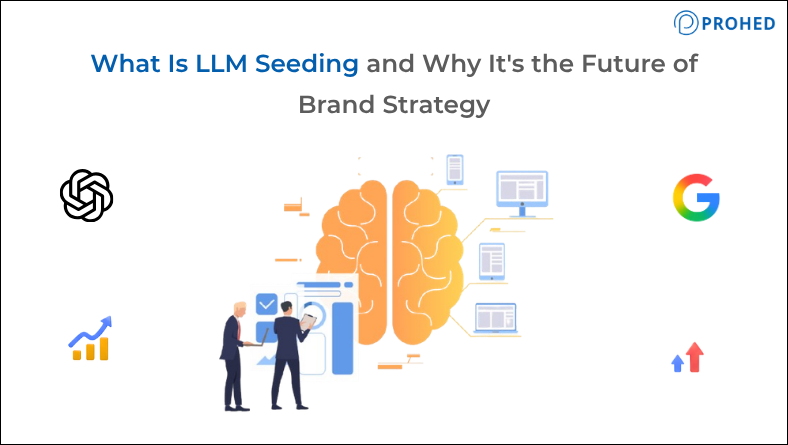
So, What Exactly Is LLM Seeding?
LLM stands for Large Language Model. It’s the technology sitting behind tools like ChatGPT, Google’s Gemini, Claude, and others. These models are trained on enormous amounts of text pulled from across the internet: articles, forums, documentation, reviews, news, and more.
LLM seeding, then, is the practice of deliberately placing accurate, well-structured brand information into the kinds of sources these models are likely to learn from or reference when generating answers.
It’s not about gaming anything. It’s about making sure the right narrative about your brand is present in the right places. So when an AI is asked something relevant to your industry, your brand is part of the answer it gives.
Think of it this way. Traditional SEO got your website to rank on a results page. LLM seeding gets your brand into the answer itself, before the user even sees a link.
How Is This Different From SEO or AEO?
A lot of marketing teams treat these like the same thing, but they really aren’t.
SEO (Search Engine Optimization)
This is the classic game of “show me the links.” It’s about ranking on Google or Bing so people click through to your site. You’re essentially fighting for visibility on a list of blue links.
AEO (Answer Engine Optimization)
This goes a step further. It’s about being so clear that Google pulls your content into that “zero-click” box at the top of the page. You aren’t just a link anymore; you’re the direct answer on the results page.
LLM Seeding is the deep work. You aren’t just trying to show up on a page; you’re trying to get inside the “brain” of the AI itself. You’re shaping how the model understands your brand’s expertise so that when someone asks ChatGPT a question, your brand is the recommendation it gives by default.
Generative Engine Optimization and LLM seeding go one layer deeper still. Instead of optimising for a results page, you’re optimising for the model itself. You’re shaping the AI’s understanding of your brand, your expertise, and your relevance to specific topics.
The difference is significant. SEO and AEO are reactive. Users still go to a search engine and then find your content. With LLM seeding, your brand becomes part of the AI’s knowledge base. It’s proactive brand positioning at the infrastructure level of how information is generated and delivered.
Why Does This Matter for Brand Strategy Right Now?
Honestly, because most marketing teams are still playing by rules that were written three years ago.
People are using AI tools to shortlist vendors, research products, and make purchase decisions. Not occasionally. Regularly. And the brands showing up in those AI responses aren’t always the market leaders or the biggest spenders. More often, they’re the ones whose information is structured clearly, cited widely, and consistently present across sources that AI models actually trust.
That changes the game for brand strategy in a real way. Having a great website and a decent Google ranking used to be enough. It isn’t anymore. Your brand’s story now needs to exist in a format and in places that LLMs can actually learn from.
And the window is still open. Most brands genuinely haven’t started thinking about this yet. The ones that move early won’t just gain an edge in AI search visibility. They’ll shape how their brand is described and recommended by tools that millions of people use every single day.
Also Read: AI Search Optimization: How AI Is Transforming SEO in 2026
What Does LLM Seeding Actually Look Like in Practice?
Don’t expect a single “mic drop” moment here. Seeding is a marathon, a series of smart, steady moves that build a massive wall of authority over time.
You start with the meat-and-potatoes content: the deep-dive guides and explainers that are factually bulletproof. Here’s a pro-tip: AI models couldn’t care less about your vague brand fluff or “market-leading” adjectives. They are hungry for cold, hard data and well-referenced answers to the exact questions people are typing into their chat windows. If your content actually solves a problem rather than just selling a product, you’ve already won half the battle.
Third-party mentions are the other big piece of the puzzle. When high-authority sites, industry directories, and review platforms talk about your brand consistently, LLMs take notice. They start to “pattern match.” The more your brand is referenced accurately across the web, the more the AI begins to understand exactly who you are and what you do. This makes your digital PR and outreach more than just a reputation play, it’s literally training the model.
Forum and community presence is the most overlooked goldmine. Places like Reddit, Quora, and niche industry boards are the primary “textbooks” for LLM training data. But don’t just go in there and post ads, you’ll get banned, and the AI will ignore you. Show up with genuine, helpful advice. Building that organic association in community threads is how you teach AI tools to recommend you.
Finally, you need entity clarity. If your brand’s name, description, and category are a mess across your website and Google Business Profile, the AI gets confused. Ambiguity is your biggest enemy here; if the model isn’t 100% sure what you are, it won’t risk recommending you.
Where Does Brand Strategy Fit Into All of This?
LLM seeding doesn’t work without a clear brand strategy behind it. You can’t seed a brand that doesn’t have a clear identity. It’s like trying to tell a story when you haven’t decided who the main character is.
Start with the fundamental questions: What is the one thing you want to be the “go-to” answer for? Which industry questions should trigger your name? Why should an AI trust you over a generic competitor?
Once you’ve nailed that down, everything else, your PR, your community posts, your structured data, starts pulling in the same direction. Without this strategic North Star, your content will feel scattered, and the AI will never be able to piece together a coherent story about your brand.
This is also where agencies that understand both brand strategy and performance marketing genuinely earn their keep. LLM seeding sits across content strategy, SEO, earned media, and digital PR. It needs a joined-up approach. Siloed execution won’t get you far.
How Prohed Thinks About This
The team at Prohed has been paying close attention to how AI-driven discovery is reshaping the way brands get found. And the conclusion is pretty straightforward: performance marketing in 2026 doesn’t work in isolation.
Paid campaigns drive traffic, sure. But if AI tools aren’t recognising or surfacing your brand in organic, conversational discovery, you’re missing a significant part of the funnel entirely.
That’s why Prohed’s approach to brand strategy increasingly looks at how brands are represented in AI-generated contexts, not just on search results pages. Through structured content production, strategic digital PR, SEO-led thought leadership, and building citation signals across the right platforms, the goal stays the same. Make your brand the answer AI gives, not just a result someone might or might not click.
Alongside Google Ads, Meta Ads, LinkedIn campaigns, and conversion rate optimisation, Prohed helps brands think about discoverability in the fuller sense. Because in 2026, a complete growth strategy has to account for where your audience is actually looking, and increasingly, that’s inside an AI chat window.
The Bottom Line
LLM seeding isn’t a trend to bookmark for later. It’s already shaping which brands get mentioned and which ones get quietly skipped, inside tools that hundreds of millions of people use to make real decisions every day.
The brands building their LLM visibility now are setting themselves up to own the AI-generated conversation in their category. The ones waiting are slowly becoming invisible in a channel they haven’t even started thinking about yet.
Your brand strategy needs to account for this. Not next year. Now.
Want to future-proof your brand’s visibility across both paid and organic AI-driven channels? Prohed is a results-focused Performance Marketing Agency in India, working with growth-stage brands and established businesses to build strategies that perform, wherever your audience is looking.
Frequently Asked Questions
1. What is LLM seeding in simple terms?
LLM seeding is the practice of placing your brand’s information into sources that large language models like ChatGPT or Gemini learn from or reference. The goal is simple: make sure your brand shows up in AI-generated answers when someone asks a relevant question, rather than only appearing in traditional search results.
4. Is LLM seeding the same as SEO?
Not really. SEO is about winning the “link game” so people click through to your site. LLM seeding is about winning the “knowledge game.” It’s about becoming so baked into the AI’s understanding of a topic that it mentions you as a definitive answer before the user even thinks about clicking a link. They work best as a tag-team.
3. How do I know if my brand is actually showing up in AI answers?
The simplest way? Go ask. Fire up ChatGPT, Gemini, or Perplexity and ask them the tough questions about your niche. See who they recommend. While more sophisticated tracking tools are starting to pop up, “manual stress-testing” is still the best way to see how your brand strategy is holding up in the AI era.
4. What kind of content actually “sticks” with an AI?
AI prefers substance over style. It looks for factual, high-utility content like in-depth guides, FAQ pages, and credible third-party reviews. Fluffy, promotional marketing speak usually gets filtered out. If it’s helpful to a human, it’s usually helpful to the model.
Schedule a Free Strategy Call with PROHED Today