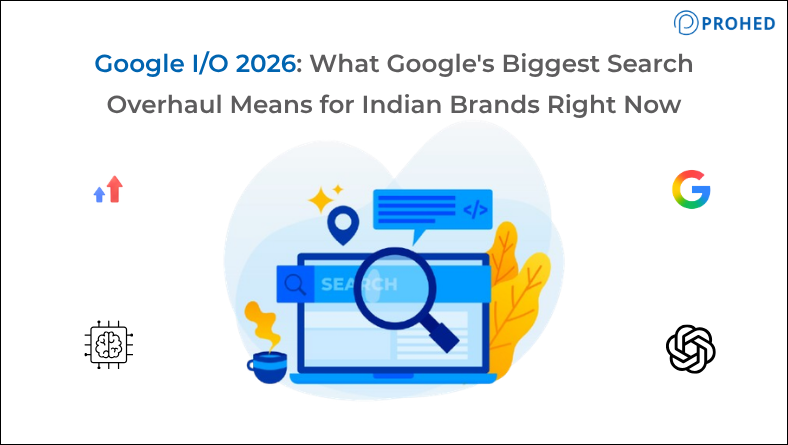
What happened at Google I/O 2026?
Google announced the most significant transformation in search history, AI Mode surpassing 1 billion monthly users, a fully redesigned AI-powered search bar, and the launch of Search Agents that evaluate content 24/7 without user input. For Indian brands, the changes are live now.Most Indian brands are still running their digital strategy on a search model that Google officially retired on May 19, 2026. The keyword rankings, the blue links, the traffic projections built around click-through rates, all of it was built for a version of search that has now fundamentally changed.
At Google I/O 2026, Sundar Pichai announced that AI Mode has surpassed 1 billion monthly active users in just one year, calling it Google’s biggest upgrade to Search ever. AI Overviews now reaches over 2.5 billion monthly active users worldwide. Search, as Pichai put it, has stopped feeling like individual queries and started feeling like an ongoing conversation.
At Prohed, we’ve been watching this shift build across every vertical we work in, D2C, EdTech, real estate, BFSI. The brands that are already adjusting their strategy are pulling ahead. The ones waiting to see how it plays out are quietly losing ground.
What Actually Changed at Google I/O 2026
The Search Bar Has Been Rebuilt From Scratch
Google announced the biggest upgrade to the search box in over 25 years. The intelligent search bar now puts AI tools directly at the user’s fingertips, making it easier to ask questions that don’t fit neatly into keywords. Users can share complex, specific criteria and receive a direct, conversational response rather than a list of links to evaluate.
This matters immediately for local businesses trying to capture modern search intent. If you look at a top-tier digital marketing agency, you’ll notice they are already shifting focus to conversational queries because Google integrated AI Mode into the Android search bar on April 29, 2026. By replacing the traditional prompt with “Ask Google” on Android, which powers the majority of India’s 800 million internet users, the primary interface for search has fundamentally changed.
AI Mode Is Now the Default Experience
Before I/O 2026, 25% of all Google searches were already triggering an AI Overview, rising to 48% for informational categories. Ranking number one no longer guarantees you appear in the answer.
AI Mode goes further. Rather than a static AI Overview at the top of results, AI Mode delivers a fully conversational, iterative search experience where follow-up questions flow naturally from the first query. Moreover, the context stays with the user as they explore deeper. As a result, the path from question to answer increasingly bypasses the traditional results page entirely.
Search Agents Now Operate in the Background
This is the announcement that most brands haven’t fully processed yet.
Google introduced Search Agents at I/O 2026, AI agents that operate in the background 24/7, intelligently reasoning across blogs, news sites, social posts, and real-time data to find exactly what a user needs at exactly the right moment. Users can create and customize multiple agents for different tasks. An agent monitoring “best D2C skincare brands in India” is running searches, evaluating content, and forming brand associations, without the user ever typing a fresh query.
This changes the audience for your content in a significant way. Increasingly, the primary reader of a brand’s digital content is not a human. It is an AI agent deciding whether to recommend that brand. Therefore, content structured for human readability alone is no longer enough.
What This Means for Indian Brands Specifically
Organic Traffic Patterns Are Shifting Fast
According to Prohed’s internal campaign analysis across D2C client accounts in Q1 and Q2 2026, click-through rates on top organic positions have dropped significantly since AI Overviews began appearing prominently in Indian search results. What used to be reliable organic traffic from informational queries is now being absorbed by AI-generated answers before the user ever reaches the results.
Consequently, a brand that built its acquisition strategy entirely around organic click-through traffic is now facing a structural problem that no amount of additional content production will fix on its own.
Zero-Click Is the New Normal for Informational Queries
High-volume informational categories, particularly finance, healthcare, and education, face the most significant exposure. AI is now rendering calculators, comparisons, and direct answers on the results page itself, removing the reason to click through.
For Indian EdTech brands, BFSI companies, and healthcare businesses that have built large content libraries around informational queries, this is the part that requires the most urgent rethinking. The traffic model that justified that content investment has changed. Accordingly, the content strategy needs to change with it.
Transactional Queries Remain Relatively Protected
AI Overviews appear on only 4% of shopping queries, which means direct commerce is somewhat protected for now. For D2C brands and e-commerce businesses, transactional intent searches “buy organic face wash online India,” “best running shoes under 3000” are still largely displaying traditional results.
This is important context. Not every part of search has changed equally. The brands that understand which of their queries are at risk and which are relatively stable will allocate their adaptation efforts more effectively than those treating every keyword as equally affected.
The 3 Things Indian Brands Need to Do Right Now
1. Shift From SEO to GEO and AEO
Traditional Google SEO Update responses focus on keywords, backlinks, and page speed. Those fundamentals still matter. However, they now need to be supplemented with Generative Engine Optimization (GEO) and Answer Engine Optimization (AEO).
GEO is about getting your brand cited in AI-generated responses, not just ranked in results. AEO is about structuring content so that AI engines can extract direct, citable answers from it. Both require content that is specific, factual, well-sourced, and structured around the questions your audience is actually asking. Vague, keyword-stuffed content gets deprioritized. Specific, authoritative, well-structured content gets cited.
Across D2C and performance marketing clients managed by Prohed in 2025-26, brands that began implementing GEO principles alongside their paid campaigns saw measurably stronger AI citation frequency within the first 60 days. The reason is consistent with what the data shows broadly: AI engines use brand familiarity and multi-source presence as trust signals. When paid, organic, and earned media all reference a brand consistently, AI systems learn to treat it as credible.
Want the bigger picture?
See how AEO, SEO, and GEO work together in modern search optimization
2. Build Entity Authority, Not Just Keyword Density
The brands that go beyond the basics, into entity authority, AI citability, and genuine expertise, will build visibility that is more durable and more defensible than anything keyword rankings ever produced.
Entity authority means your brand is clearly defined across your website, Google Business Profile, third-party directories, and earned media, consistently, completely, and with enough depth that AI systems can confidently describe what you do and who you serve. Schema markup is foundational here. FAQ schema, Article schema, and Organization schema give AI engines the structured data they need to represent your brand accurately in generated responses.
For a B2C EdTech client in Gurgaon, Prohed implemented Organisation and FAQ schema across 40 pages. Within six weeks, 11 of those pages were appearing in AI Overviews for queries they had never ranked for in traditional search results. The content hadn’t changed. The structure had.
3. Treat Content as a Signal, Not Just a Traffic Driver
Sites built on high-volume AI-generated content, thin informational pages, and aggregator-style articles with no original input are seeing the heaviest impact from Google’s May 2026 core update.
The Google Core Update that accompanied I/O 2026 is penalizing exactly the kind of content that many brands have been producing at scale. Thin, generic, keyword-driven pages are losing visibility fast. In contrast, content that contains original data, specific expertise, first-person insight, and genuine utility is gaining ground.
This is a meaningful opportunity for Indian brands willing to produce content with real depth.At Prohed, we’ve consistently seen that localised content performing across Tier 1 and Tier 2 Indian markets outperforms generic content on click-through rates, sometimes by a significant margin. Indian audiences respond measurably better to content that reflects how they actually search and buy, rather than translated global content repurposed for the Indian market.
Full-Funnel AI Search vs. Traditional SEO: What Has Changed
Traditional Google SEO | Post I/O 2026 AI Search |
Rank for keywords, earn clicks | Get cited in AI responses |
Page one visibility drives traffic | AI Mode answers the query directly |
Backlinks signal authority | Entity clarity and multi-source presence signal authority |
Content volume rewards ranking | Content depth and originality rewards citation |
Monthly reporting is sufficient | Real-time AI visibility tracking is needed |
Informational content drives top-of-funnel traffic | AI agents now satisfy informational intent without clicks |
How Prohed Is Helping Brands Navigate the Shift
At Prohed, the response to Google I/O 2026 isn’t to rebuild everything from scratch. It’s to connect the existing paid and organic infrastructure to the new AI visibility layer that search now requires.
Specifically, paid campaign data informs what content gets produced and how it gets structured. When paid search data shows which queries are converting versus which are losing click-through to AI Overviews, that intelligence shapes content briefs, schema implementation, and entity building priorities. Nothing runs in isolation.
Beyond core search strategy, our full-service approach combines performance marketing, social media, B2C lead generation, and advanced search engine optimization services in Gurgaon to ensure your entire ecosystem works under a unified strategy.
Final Word
Google I/O 2026 didn’t just update search. It redefined what visibility means for brands online. The brands that understand this early and adjust accordingly will build a structural advantage in AI-powered search that becomes increasingly difficult for late movers to close.
Most Indian businesses are still operating on the 2023 SEO playbook. The brands that begin the transition now, before the full AI Mode rollout in India, will have a structural advantage that is extremely difficult for late movers to close.
Whether you’re in Delhi, Mumbai, or looking for a digital marketing agency in Gurugram that understands how google ai search and performance marketing work together in 2026, Prohed is the conversation worth starting.
FAQs
1. What did Google announce at I/O 2026 for search?
Google announced AI Mode surpassing 1 billion monthly active users, a completely reimagined AI-powered search bar, and Search Agents that operate 24/7 in the background. Together, these changes represent the most significant transformation in Google search since the platform launched.
2. How does Google AI Mode affect Indian brands specifically?
AI Mode is already live in India via the Android search bar. Since most Indian users access Google through Android, the shift from keyword search to conversational AI search is happening right now, not as a future scenario. Brands whose content isn’t structured for AI citation are already losing visibility.
3. Is traditional SEO still relevant after Google I/O 2026?
Yes, but it’s no longer sufficient on its own. Technical SEO fundamentals, site speed, structured data, clean architecture, are now the floor rather than the ceiling. Brands also need to build entity authority and AI-citable content to maintain visibility in the new search environment.
4. What is the difference between SEO, AEO, and GEO?
SEO optimises pages to rank in traditional search results. AEO structures content to be extracted as direct answers by AI engines. GEO focuses on getting a brand cited in AI-generated responses. All three are now required for comprehensive search visibility in 2026.
5. Which types of content are most at risk after Google I/O 2026?
Thin informational content, generic AI-generated articles, and keyword-stuffed pages with no original expertise are seeing the heaviest ranking declines. Content with original data, specific expertise, and clear authorship is gaining ground.
6. How should D2C brands in India respond to the Google search changes?
Focus on three things: implement proper schema markup across product and category pages, build entity authority through consistent brand signals across multiple platforms, and produce content that contains original insight rather than generic information any AI could generate.
7. What are Search Agents and why do they matter for brands?
Search Agents are AI-powered tools that operate in the background 24/7, monitoring topics and delivering recommendations without the user searching actively. For brands, this means AI systems are continuously evaluating their content and forming brand associations. Content structured for AI readability gets recommended. Content that isn’t, doesn’t.
8. How does Prohed approach the new Google AI search environment?
Prohed connects paid campaign performance data with organic content and schema strategy so that both channels inform each other. When paid data shows which queries are losing click-through to AI Overviews, that intelligence shapes content and entity-building priorities so the brand maintains visibility across both traditional and AI-powered search.
Schedule a Free Strategy Call with PROHED Today