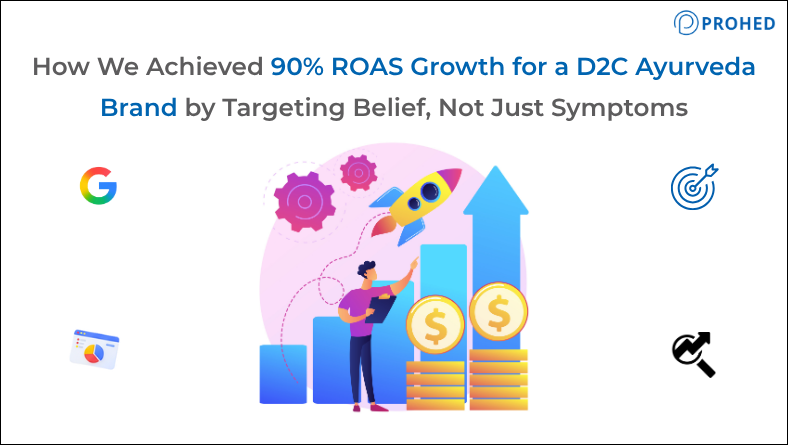
TL;DR: Prohed, a performance marketing agency based in Gurgaon, restructured the entire audience strategy for a D2C Ayurveda brand, shifting from symptom-based targeting to belief-based segmentation across Meta and Google. The campaign delivered 90% ROAS growth, 500% revenue increase, 400% more orders, and a 42% rise in average order value over one campaign cycle.
Most ayurveda brands make the same mistake. They run ads around symptoms, joint pain, hormonal imbalance, low energy, and wonder why the results plateau. The targeting looks right on paper. The creative is informative. The product genuinely works. And yet the ROAS stays flat, the cost per acquisition keeps climbing, and scaling feels impossible.
Prohed, a performance marketing agency based in Gurgaon, restructured the brand’s entire audience strategy, and what came out the other side was a campaign that didn’t just improve numbers. It changed how the brand understood its own customer.
The Real Problem Isn’t the Product
The problem, more often than not, isn’t the product. It’s the positioning. Symptom-based targeting reaches people who are in pain. Belief-based targeting reaches people who have already decided how they want to heal. That’s a fundamentally different audience, and it converts very differently.
This is the story of how that shift in thinking produced 90% ROAS growth, a 500% increase in revenue, and 400% more orders for a D2C ayurveda brand that had the product, the heritage, and the formulations, but needed a smarter performance engine to unlock what was already there.
Key Results at a Glance
| Metric | Result |
|---|---|
| ROAS improvement | +90% |
| Revenue growth | +500% |
| Order volume growth | +400% |
| Average order value increase | +42% |
| User satisfaction rate | 87% within 4 to 6 weeks |
All figures drawn from live campaign data verified through Prohed’s reporting dashboard. Brand name withheld at client’s request.
The Market Context: Why Ayurveda D2C Is Both a Massive Opportunity and a Crowded Battlefield
India’s ayurveda and natural wellness market is growing at a pace few categories match. Currently valued at over INR 50,000 crore and growing steadily, according to data from the AYUSH Ministry and industry reports by IBEF, the D2C market for ayurvedic products has exploded in the last three years. Consumers are actively moving away from synthetic pharmaceuticals, seeking side-effect-free alternatives rooted in tradition and backed by science.
However, that same tailwind has brought in hundreds of new ayurveda brand entrants. Consequently, standing out on Meta and Google isn’t just about having good formulations anymore. It’s about reaching the right people with the right message at the right moment, which requires a level of audience intelligence that most brands in this category simply haven’t developed yet.
The D2C growth opportunity in Ayurveda is real. Nevertheless, capturing it requires thinking beyond category-level awareness campaigns and building a full-funnel performance marketing system built around how Ayurveda consumers actually make decisions.
The Brand Behind the Numbers
The ayurveda brand in this story wasn’t a startup. They carried a heritage dating back to 1889, a catalogue of 50+ formulations addressing everything from hormonal balance and reproductive health to joint care and weight management, and a manufacturing infrastructure certified to GMP standards.
Importantly, 87% of their users reported measurable results within four to six weeks of consistent use. That’s a credible proof point. The product worked. Furthermore, the brand had genuine authority in the Ayurveda-tech space, combining traditional knowledge with modern delivery formats that a younger, health-conscious D2C market would respond to.
The challenge wasn’t credibility or product quality. Instead, it was that the campaigns being run weren’t reaching the people most likely to convert. Ads were built around symptoms. Audiences were broad. The messaging treated every health-conscious consumer as interchangeable, which they’re not.
Belief-based targeting is an audience segmentation strategy that groups consumers by their healthcare philosophy, for example, “Ayurveda-first” rather than by symptoms or conditions. It typically produces higher ROAS and stronger long-term customer value in the D2C health category, because the buyer’s relationship with the brand is values-driven rather than need-driven.
The Problem With Symptom-Only Targeting in Ayurveda Marketing
Before explaining what changed, it’s worth unpacking why symptom-based health care marketing has a ceiling in the Ayurveda category specifically.
Symptom targeting reaches a large pool of people experiencing a problem. However, within that pool, there are several very different types of buyers:
- People who want the fastest pharmaceutical fix available
- People open to natural remedies but not specifically committed to Ayurveda
- People who actively choose ayurveda as their primary healthcare system, regardless of symptom
That third group is the one that converts consistently, spends more per order, and comes back repeatedly. They’re not just treating a symptom. They’re expressing a belief system. Moreover, they’re significantly easier to retain because their relationship with the brand is values-based, not need-based.
Reaching them, however, requires a completely different targeting and messaging approach than a standard symptom-led campaign delivers.
If you’re seeing the same pattern in your own Meta campaigns, our breakdown of why Meta Ads ROAS drops and how to fix it covers the mechanics in detail.
The Strategy: Three Shifts That Changed Everything
Shift 1: Segmenting by Belief, Not Just by Condition
The first and most consequential change was how the audience was structured.
Instead of building audiences around conditions like joint pain or hormonal issues, the targeting was rebuilt around how people think about healthcare. Two specific groups were identified and built out properly.
The first was what the team internally called “Ayurvedic prioritizers.” These are people who have already made up their mind about how they want to take care of themselves. These shoppers prioritize traditional medicine over a quick pill. They are the type to scrutinize every ingredient label on the bottle. Before putting anything into their bodies, they want to know exactly where it came from and how it was made. Reaching this group with symptom-led ads is actually a mismatch because they’ve already moved past that stage of the decision.
The second group was built around a broader identity: people who avoid artificial products across every area of their life, not just healthcare. For this audience, “100% Natural” and “Zero Chemical” aren’t just product claims. They’re statements that match how these people already see themselves. That alignment is what makes the ad feel relevant rather than interruptive.
Both groups converted at rates that symptom-targeting simply couldn’t produce. The reason is straightforward: they were already sold on the category. The brand just needed to show up in the right way.
Shift 2: Organic-Centric Positioning Across All Creative
The creative stopped leading with the problem and started leading with the belief.
Top-of-funnel ads were built around a single idea: Ayurveda is a science, not a wellness trend. Choosing it is a decision that more and more people are making consciously, not out of desperation. That framing positioned the brand very differently from competitors running “suffering from X? try this” ads.
The heritage angle came in here too. A brand with roots going back to 1889 has something genuinely worth saying. Rather than burying that in a footer, it became a core part of the creative. It told people: this isn’t a startup riding a trend. This has been here, and it works.
In the middle of the funnel, the proof points took over. The GMP certification and the fact that 87% of users see measurable results within four to six weeks were brought forward. By this stage, people were already considering the brand. What they needed was confidence, not inspiration.
At the bottom of the funnel, ads got very specific. Each audience segment saw products matched to their exact health goal, not a general catalogue. The right product reaching the right person at the right time made a visible difference in conversion rates.
Shift 3: Lifestyle-Led Funnels Beyond the Doctor’s Office
This was the shift that opened up the biggest new audience pool.
Beyond health goals, campaigns were built around how people want to live, not just what they want to fix. Preventative wellness, physical energy, mental clarity, cleaner living. These aren’t niche interests. They represent a very large and growing group of consumers who are building Ayurveda into their daily routine because it fits their lifestyle, not because they have a specific complaint.
Reaching this audience meant the brand wasn’t just competing in the “fix my problem” category. It was now showing up in the far larger “help me live better” category. That’s a different conversation, and it reaches a different kind of buyer.
The impact on average order value was significant too. Lifestyle buyers don’t buy one product for one symptom. They buy across formulations because they’re building a routine. That behaviour is a big part of why average order value grew by 42% across the campaign period.
Platform Strategy: Google and Meta Working Together
The campaign ran across both Google and Meta, and the two platforms were used deliberately for different purposes rather than running the same messaging on both.
- On Meta, the focus was awareness and consideration. Belief-based creative reached cold audiences through interest and behavioral targeting. Video content performed particularly well at the top of funnel, building the brand’s philosophy before introducing specific formulations. Retargeting sequences then moved warm audiences, those who had engaged with content or visited specific product pages, toward conversion with formulation-specific ads.
- On Google, the focus was intent capture. Search campaigns were built around the specific queries that high-intent Ayurveda consumers use when they’re ready to buy, searches that reflect both the condition and the preference for natural solutions. Shopping campaigns ran alongside search to capture browsing behavior among qualified audiences.
Together, the two platforms created a cross-channel system where Meta built belief and Google captured the purchase moment that belief created. Neither platform was working in isolation.
For brands in the D2C and e-commerce space, our guide to top ecommerce marketing agencies in Delhi NCR covers how the wider agency landscape approaches this.
The Results: What Belief-Based Targeting Actually Delivered
Results didn’t arrive overnight, and that’s worth being honest about. The first few weeks were largely about efficiency improvements as the new audience architecture settled and the algorithm began optimizing against higher-quality signals.
By the end of the first full campaign cycle, the number that stood out most was a 90% increase in ROAS compared to the previous campaign period.
That improvement didn’t come from increasing the budget. It came from reaching the right people with the right message at the right moment. When the audience is genuinely aligned with what the brand stands for, the platform doesn’t have to work as hard to find buyers. The buyers are already there.
What happened to revenue, order volume, and average order value across the same period is documented in full detail in the case study. The ROAS improvement is the headline, but the other numbers tell an equally compelling story about what changes when audience strategy is built around belief rather than symptoms.
Curious About the Full Story?
The 90% ROAS improvement is just one part of what this campaign delivered. The full picture, the revenue growth timeline, the order volume trajectory, the AOV shift, and exactly how the audience architecture and creative strategy were built, is documented in the dedicated Purely Yours case study.
If you’re running a D2C growth strategy for an ayurveda brand or any health and wellness business and the campaigns feel like they’ve hit a ceiling, this case study is worth fifteen minutes of your time.
Read the Full Purely Yours Case Study
Why This Approach Works Specifically for Ayurveda D2C Brands
The d2c marketing dynamics in the Ayurveda category are genuinely different from most other consumer health segments, and understanding those differences is what makes or breaks campaign performance.
- Trust is the primary purchase driver: Unlike pharmaceutical purchases where efficacy is assumed, Ayurveda buyers are making a values-based choice. They need to trust the brand’s philosophy, ingredients, and heritage before they trust the product. Consequently, top-of-funnel creative that builds that trust infrastructure converts cold audiences far more efficiently than symptom-led ads that skip straight to the product.
- The repeat purchase rate is the real business model: An ayurveda brand that acquires a customer who genuinely believes in the system, not just the product, has a fundamentally different LTV than one that acquired someone looking for a quick fix. Furthermore, belief-based buyers are far less price-sensitive and far more resistant to competitor switching.
- Health care marketing in Ayurveda requires category education: Many high-intent buyers in this segment are still learning about specific formulations and their benefits. Therefore, middle-of-funnel content that educates rather than just persuades is disproportionately effective in driving conversion.
How Prohed Approaches Ayurveda and D2C Growth Marketing
At Prohed, d2c marketing for health and wellness brands is built around the same belief-based segmentation strategy that produced these results. Campaigns are not structured around what a consumer needs to fix, they’re structured around who that consumer is and how they’ve chosen to take care of themselves.
The audience intelligence work that goes into the first stage of any engagement is the foundation everything else builds on. Without understanding the belief system behind the purchase decision, even well-produced creative and well-funded campaigns will plateau.
Beyond performance marketing, Prohed’s full service mix covers SEO, Search Engine Marketing (SEM), Social Media Marketing, B2C Lead Generation, E-commerce Marketing, and App Install campaigns, all built to work together rather than as separate activities running in parallel.
If your ayurveda brand or wellness D2C business is spending on ads but not seeing the ROAS or revenue growth the product deserves, the issue is almost certainly the audience strategy, not the creative, the budget, or the platform.
Ready to Build a Performance Engine for Your Ayurveda Brand?
The 90% ROAS improvement and 500% revenue growth in this story came from one fundamental insight: Ayurveda consumers don’t just want relief. They want to be understood.
Build campaigns around that understanding, and the numbers follow.
If you’re looking for a Performance Marketing Agency in India or anywhere in India that understands the specific dynamics of ayurveda and wellness D2C growth, Prohed is the conversation worth having first.
FAQs
1. Why is ROAS often low for Ayurveda brands despite strong products?
Most Ayurveda campaigns make the mistake of targeting symptoms rather than deep-seated belief systems. This casts a wide net over audiences with very low intent, which only serves to drain your budget and keep ROAS flat no matter how good the product is. When you chase everyone, you end up resonating with no one.
2. What is belief-based targeting in D2C health care marketing?
It means finding the specific people who have already decided that Ayurveda is better than allopathic medicine. Instead of just targeting “back pain,” you reach the person who values natural wellness as a lifestyle. These specific audiences are far more likely to convert quickly and usually spend much more on every single order.
3. How long does it take to see ROAS improvement with audience restructuring?
You’ll usually start seeing the efficiency settle in within the first two or three weeks of the shift. However, the real, meaningful jump in ROAS typically arrives after a full month of data. This gives the algorithm enough time to learn from these higher-quality signals and optimize your spend properly.
4. Should an Ayurveda brand use Meta Ads or Google Ads?
The truth is you need both, but you have to use them for very different jobs. Meta is brilliant for building trust and educating people who didn’t know they needed you yet. Google then steps in to capture that high-intent search right when they are ready to buy. Used together, they cover the entire journey perfectly.
5. What makes D2C Ayurveda marketing different from regular health care marketing?
Trust and philosophy actually drive the sale much more than a list of ingredients ever will. Buyers in this space are making a choice based on their personal values, not just looking for a quick fix. Because of this, creative that tells a brand story almost always outperforms ads that just yell about features.
6. How important is average order value in Ayurveda D2C growth?
It’s arguably the most important metric because lifestyle-led buyers rarely just buy one bottle. These customers are looking for a complete wellness routine, which means they’ll purchase across multiple categories. Boosting your AOV through bundles is often a much faster way to scale than just chasing new clicks all day.
7. Can performance marketing work for heritage Ayurveda brands?
Absolutely, and in fact, having a real heritage is like having a massive head start. Trust is the hardest thing to build in this category, and a legacy brand already has it in spades. The only trick is translating that old-school authority into modern, punchy creative that clicks with a younger, health-conscious crowd.
8. What platforms does Prohed use for Ayurveda D2C campaigns?
We primarily lean on Google and Meta, but we treat them as one connected ecosystem rather than separate silos. The exact split of your budget depends on how crowded your niche is and how fast you want to grow. We focus on where your specific audience is actually spending their time and attention.
Schedule a Free Strategy Call with PROHED Today