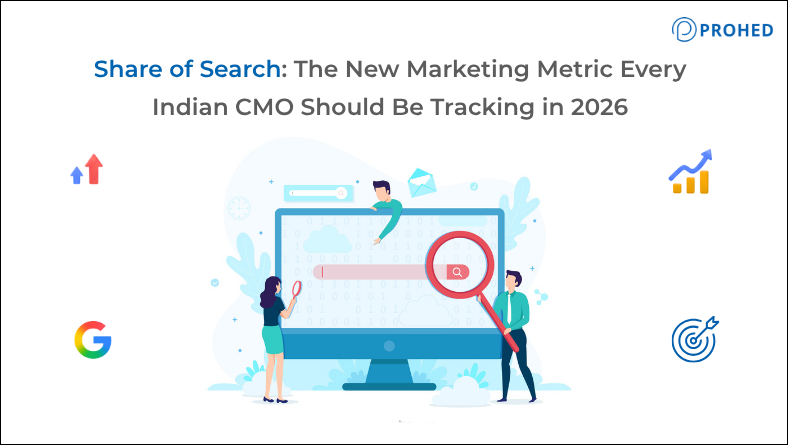
Most marketing metrics tell you what already happened. Share of search tells you what’s about to. It measures the proportion of branded search volume your brand captures relative to all competitors in your category. When your share of search grows, market share typically follows, often by six to twelve months. At Prohed, a performance marketing agency in Gurgaon, we track share of search as a leading indicator across D2C, EdTech, and healthcare brands because it surfaces what revenue reports miss until it’s too late.
Most Indian CMOs are tracking the same set of numbers they’ve always tracked. CAC, ROAS, CTR, conversion rate. These are useful. However, they all share one common limitation: they measure what’s already happened. By the time a decline shows up in revenue, the underlying shift in brand momentum has been building for months.
Share of search is different. It’s a forward-looking marketing metric that measures how often people are actively searching for your brand compared to your competitors. And in 2026, with AI-generated answers reshaping how search volume is distributed, it’s become one of the most important signals available to any marketing team.
The brands that track it are catching competitive shifts early. The ones that don’t are finding out about those shifts when it’s already expensive to reverse them.
What Share of Search Actually Measures
To calculate share of search, you divide your brand’s total branded search volume by the combined branded search volume of all major competitors in your category.
The formula is straightforward. If your brand receives 40,000 branded searches per month, and the total branded searches across your category add up to 200,000, your share of search is 20%.
What makes this metric genuinely useful is not the number itself. It’s the direction of travel. A share of search that’s growing steadily is one of the strongest signals available that brand awareness is building and that future revenue growth is likely to follow. Conversely, a share of search that’s declining, even while current revenue looks stable, is an early warning that a competitor is gaining ground in the minds of potential customers before that shift shows up in actual sales data.
Research by Les Binet, one of the most cited voices in marketing effectiveness, has consistently shown that share of search correlates strongly with market share across categories including automotive, retail, and FMCG. Furthermore, the correlation tends to hold with a lead time of roughly six to twelve months. In practical terms, that means share of search is one of the few marketing metrics to track that genuinely gives you time to respond before the revenue impact arrives.
Why This Metric Matters More for Indian Brands Right Now
India’s search market is changing faster than nearly any other market on the planet. Google search in India peaked at more than 100 billion queries per year in 2024 – thanks in part to cheap data, exploding smartphone coverage and increasing digital literacy among residents of Tier 2 and Tier 3 cities. And now AI-generated responses are popping up in an increasing share of those searches, changing the way in which a brand’s presence is shared.
In that environment, share of search becomes even more significant for a few specific reasons.
First, branded search keywords in Indian markets are growing rapidly as more categories shift from offline purchase behaviour to online research before buying. A consumer in Lucknow researching a health supplement brand, a fleet manager in Coimbatore looking up a logistics software solution, a first-time investor in Nagpur searching for a wealth management platform: all of these are search moments that create share of search data. Tracking that data reveals which brands are winning the research phase before the transaction even happens.
Second, AI answer engines like Perplexity, Google’s AI Overviews, and ChatGPT are beginning to influence which brands surface in category-level searches. Brands with a higher share of search tend to carry stronger topical authority signals. This makes search engines more likely to cite them in AI-generated answers. Consequently, these metrics directly connect a brand’s share of search to its AI search visibility, rather than keeping them separate.
Third, most Indian CMOs are still evaluating brand health through awareness surveys and unaided recall studies. These are slow, expensive, and infrequent. You can monitor share of search weekly in real time using standard search tools, as a freely accessible signal. This eliminates the need to wait for a research agency to send back a quarterly brand study.
The Prohed Share of Search Tracking Framework
At Prohed, we’ve built share of search monitoring into our standard marketing strategy reporting for brands where brand building and performance marketing run in parallel. The Prohed Share of Search Tracking Framework operates across three steps.
Step 1: Define Your Competitor Set Accurately
The first step is identifying which brands actually compete for search attention in your specific category. This is not always the same as your commercial competitor list. Sometimes a content brand, a media outlet, or a new-to-market D2C brand is capturing a growing share of category search volume without yet competing on price or distribution.
Use search volume data from tools like Google Search Console, Google Trends, and Semrush to build a complete picture of branded search across your category. Include any brand that a potential customer might search for when they’re in the consideration stage for your product or service. That list forms your denominator.
Step 2: Track Weekly, Not Monthly
Share of search moves gradually under normal conditions. However, when a competitor runs a significant campaign, launches a new product, or gets featured in a major press outlet, the movement can be sharp and fast. Monthly tracking misses these inflection points. Weekly tracking catches them early enough to respond.
Google Trends allows direct comparison of branded search keywords across up to five competitors at once and is therefore a practical starting point for weekly share of search monitoring. For more granular data, particularly at the regional level across Indian states and cities, Semrush and Ahrefs provide branded search volume estimates that you can track over time.
Additionally, tracking at the regional level matters for Indian brands. A competitor gaining share of search specifically in Maharashtra or Karnataka may signal a localised campaign or distribution push that’s worth watching even if national-level numbers haven’t moved yet.
Step 3: Connect Share of Search to Campaign Activity
The most actionable use of share of search data is connecting it to your own marketing activity. When a brand campaign goes live, share of search should respond. If it doesn’t, that’s a signal worth investigating. Either the campaign isn’t generating the brand awareness it was designed to, or it’s reaching an audience that isn’t reflected in search behaviour.
Conversely, when share of search grows without a corresponding campaign, that’s worth understanding too. Organic word of mouth, press coverage, influencer activity, or a competitor’s campaign inadvertently expanding the category can all drive unexplained share of search movement. Identifying the cause turns the data into actionable intelligence rather than just a number on a dashboard.
Related Read: 10 Best AI Marketing Tools for CMOs to Make Smarter Marketing Decisions
Share of Search as a Modern Marketing KPI: How to Present It to Leadership
One of the practical challenges with modern marketing metrics is translating them into language that resonates with founders and boards. These stakeholders typically evaluate marketing through revenue and ROAS alone.
Share of search is actually well-suited to that conversation because the correlation with future market share makes intuitive sense to most business leaders. If more people are searching for your brand compared to competitors, it’s reasonable to expect that more people will buy from you in the coming months. The metric therefore bridges the gap between brand investment and commercial outcome in a way that pure awareness metrics struggle to do.
Furthermore, presenting share of search trends alongside revenue data over time tends to demonstrate the lead indicator relationship visually. When leaders can see that share of search grew six months before revenue grew, the metric earns credibility quickly. After that, a decline in share of search becomes a legitimate board-level conversation rather than a marketing team concern that doesn’t make it past the quarterly review.
This is precisely why share of search belongs on the marketing KPIs to track list for any Indian CMO who is trying to make the case for sustained brand investment alongside performance marketing activity.
What Else to Track Alongside Share of Search
- Share of search is a powerful metric. However, it works best as part of a broader set of modern marketing metrics for CMOs rather than in isolation. The following metrics complement it well and together provide a complete picture of brand and performance health.
- Brand share of voice across paid and earned media tells you how much of the total category conversation your brand is participating in, beyond just search. It’s a useful complement to share of search because it captures channels where search behaviour hasn’t yet caught up with brand exposure.
- Direct traffic trends in Google Analytics are a strong secondary signal for brand health. When share of search grows, direct traffic typically grows alongside it as more people begin typing your brand name or URL directly into their browser rather than discovering you through a search query.
- Branded search CTR from Google Search Console tells you whether the people searching for your brand are actually clicking through to your site. A high share of search with a low branded CTR points to a brand visibility problem on the search results page itself, whether from a weak meta title, a missing site links extension, or a competitor running branded paid campaigns against your name.
Together, these metrics give a CMO a genuinely complete view of brand momentum. Furthermore, each one is measurable without expensive research studies, using tools that most marketing teams already have access to.
How Prohed Integrates Share of Search Into Client Strategy
At Prohed, share of search monitoring is built into our broader marketing agency services for brands where both brand equity and performance efficiency matter. In practice, this means tracking competitor branded search volume weekly, connecting that data to campaign activity, flagging early shifts in category dynamics, and using the insights to inform content strategy, modern marketing strategies, and paid media allocation simultaneously.
This kind of integrated approach is what separates brands that respond to competitive shifts proactively from those that discover them in a revenue report three quarters later.
Beyond share of search tracking, Prohed’s full range of services includes SEO, Performance Marketing, Social Media Marketing, Search Engine Marketing, App Marketing, and E-commerce Marketing. Each service is built to contribute to the same brand and revenue outcomes rather than operating as a standalone activity.
Conclusion
Most marketing metrics to measure success look backward. They tell you what your last campaign delivered, what last quarter’s ROAS looked like, and where conversions came from. That information matters. However, it doesn’t tell you where your brand is headed.
Share of search does. It captures brand momentum in real time, predicts market share movement months ahead of revenue data, and gives marketing teams a way to demonstrate the commercial value of brand investment without waiting for a quarterly study.
For Indian CMOs, this metric should be part of the weekly dashboard for brands in highly competitive, fast-moving categories, alongside ROAS, CAC, and conversion rate. The brands that are currently getting that discipline, won’t be easy to displace over the next, two to three years.
If your team needs support building a marketing strategy that integrates brand measurement with performance marketing outcomes, Prohed works as a full-service digital marketing agency in Gurgaon for brands that want both. We combine brand tracking, SEO, content, and paid media into one connected growth system, because in 2026, the brands winning on both fronts are the ones that treat them as the same conversation.
Frequently Asked Questions
1. What is share of search and how is it calculated?
Share of search measures the proportion of branded search volume your brand captures relative to all competitors in your category. It’s calculated by dividing your monthly branded search volume by the total branded search volume across all key competitors. A rising share of search typically predicts rising market share within six to twelve months.
2. Why is share of search considered a leading marketing metric?
Unlike revenue or ROAS, which reflect past performance, share of search reflects current brand momentum and predicts future commercial outcomes. Brands with growing share of search tend to see revenue growth follow within two to four quarters, making it one of the most forward-looking marketing metrics available to CMOs.
3. What tools can be used to track share of search in India?
Google Trends is the most accessible starting point, allowing direct branded keyword comparisons across up to five competitors. For more granular data, Semrush and Ahrefs provide monthly branded search volume estimates by region. Google Search Console adds branded CTR data that complements share of search tracking.
4. How often should share of search be monitored?
Weekly monitoring is needed. Monthly measurements will miss short-term spikes resulting from competitor actions, media coverage, or influencer activity. Marketing teams need the lead time provided by weekly monitoring to react to competitive changes before they impact revenue.
5. How does share of search relate to AI search visibility?
Brands with a higher share of search tend to carry stronger topical authority signals. This makes search engines more likely to cite them in AI-generated answers on platforms like Perplexity and Google AI Overviews. As AI answers deliver a larger share of search results, they increasingly connect a brand’s share of search to its AI search visibility.
6. Can share of search replace traditional brand tracking studies?
Not entirely, but it significantly reduces dependence on them. Share of search provides real-time brand momentum data at no additional cost using tools most teams already have. Traditional studies add depth on perception and emotional association. Used together, they give a more complete picture than either provides alone.
7. How does share of search connect to paid media strategy?
When a brand campaign goes live, share of search should increase. If it doesn’t, the campaign may not be driving genuine brand awareness or may be reaching the wrong audience. Conversely, unexplained share of search growth can signal organic momentum worth amplifying through paid media before a competitor responds.
8. How does Prohed help brands track and grow share of search?
Prohed builds share of search monitoring into client reporting for brands where brand equity and performance efficiency both matter. This includes weekly competitor search volume tracking, connection of search data to campaign activity, regional breakdowns for Indian markets, and integration with SEO and content strategy to grow branded search volume over time.
Want to know where your brand stands in share of search against your top competitors? Prohed can run a category share of search audit and show you exactly where the gaps are.
Schedule a Free Strategy Call with PROHED Today