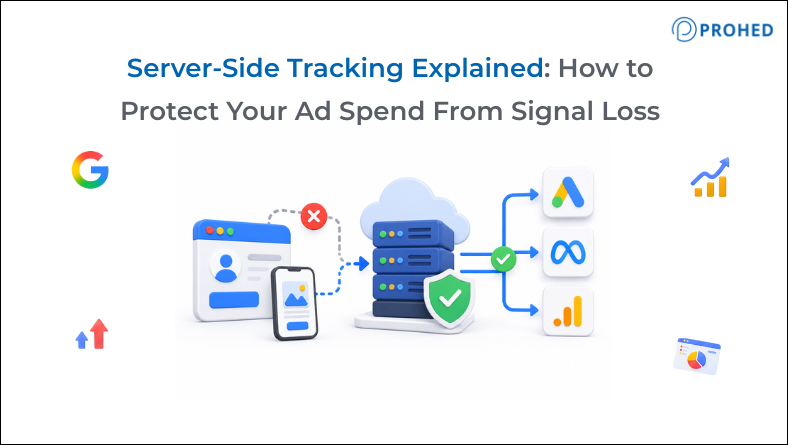
Server-side tracking is the practice of sending conversion and event data to ad platforms from your own server rather than directly from a visitor’s browser. Instead of relying on a browser pixel that privacy tools can block, reject, or strip, your conversion signal travels through infrastructure you control before reaching Google Ads or Meta. At PROHED, a performance marketing agency in Gurgaon, we implement server side conversion tracking for clients across D2C, EdTech, and healthcare because the signal loss happening at the browser level is no longer a marginal issue. For many accounts, it’s quietly costing 15 to 40% of measurable conversions.
Your Google Ads dashboard shows 80 conversions this month.
Your CRM shows 120 sales.
That gap isn’t a reporting quirk. It’s signal loss, and it’s getting worse every year as browsers tighten privacy restrictions, ad blockers become standard, and cookie consent rejection rates climb.
The campaigns running on Smart Bidding are making decisions based on 80 conversions when the reality is 120. Consequently, the algorithm is underbidding, misallocating budget, and optimising toward an incomplete version of your customer.
Server-side tracking closes that gap. And in 2026, for any brand spending meaningfully on paid media, it’s no longer an optional upgrade.
Why Signal Loss Is Getting Worse
Client-side tracking, the standard browser pixel setup most accounts still use, sends conversion data directly from the user’s browser to Google or Meta. That path is increasingly unreliable.
Several things strip signal before it arrives:
- Safari’s Intelligent Tracking Prevention (ITP) limits cookie lifespans to 7 days and sometimes 24 hours, breaking attribution for users who research before buying
- Ad blockers actively block pixel requests before they fire
- Cookie consent rejections in consent management popups prevent any tracking from running for that visitor
- iOS privacy changes limit cross-app and cross-site attribution
- Bot-flagged JavaScript causes some pixel events to be discarded at the platform level
Each of these acts as a filter. By the time a conversion signal reaches Google or Meta, a meaningful share of real conversions have already been stripped out. Furthermore, this isn’t happening equally across all audiences. Safari users, privacy-conscious segments, and Tier 1 city audiences are disproportionately affected, which means the signal loss is concentrated in often the most valuable parts of a customer base.
How Server-Side Tracking Actually Works
Rather than sending data from the browser to the ad platform directly, server side conversion tracking routes events through a server you control first.
The flow looks like this:
Browser event fires → Your server receives it → Your server sends it to Google/Meta
Because the data travels server to server on the final leg, it bypasses most of the browser-level restrictions that strip client-side signals. The conversion still needs consent to be collected. However, once collected, the transmission to the ad platform is far more reliable.
For google ads server side tracking, this works through Google’s Enhanced Conversions and the Google Tag Manager server-side container. For Meta, it works through the Conversions API (CAPI). Both platforms now actively recommend server-side as the baseline setup for accounts relying on automated bidding.
What Changes When Server-Side Is Live
This is the part most marketers underestimate before implementation.
- Conversion volume increases: Typical lift after a clean implementation is 10 to 25% more attributed conversions in Meta and 5 to 15% more in Google Ads. These aren’t new conversions. They’re real purchases and leads that were already happening but weren’t being counted.
- Reported CPA drops and ROAS improves: More attributed conversions at the same spend mathematically improves both metrics. The numbers aren’t inflated. They’re more accurate than before.
- Smart Bidding and Meta Advantage+ optimise better: Both platforms train their bid algorithms on conversion data quality. When the data is more complete, the algorithm finds better-converting audiences and allocates budget more efficiently. This improvement typically stabilises 2 to 6 weeks after implementation.
- The gap between platform-reported conversions and actual revenue shrinks: For brands where finance and marketing are reconciling different numbers each month, this is often the most immediately visible operational benefit.
Do You Actually Need Server-Side Tracking?
Not every account needs it immediately. The decision depends on spend level, platform mix, and traffic composition.
Situation | Recommendation |
Spending over ₹5 lakh/month across Google and Meta | Implement server-side tracking now. |
Running Smart Bidding (tCPA, tROAS) or Meta Advantage+ | High priority. These rely on conversion signal quality. |
Safari and Firefox make up over 25% of your traffic | Yes. ITP is actively stripping your attribution. |
EU traffic with consent banners | Yes. Rejection rates commonly run 30 to 60%. |
Spending under ₹1 lakh/month on a single platform | Lower priority. Cost may outweigh recovered signal. |
Pre-product-market fit with no automated bidding | Can wait. Focus on reach before measurement precision. |
The practical inflection point for most Indian brands is around ₹3 to 5 lakh per month in cross-platform paid spend. Below that, the setup cost often outweighs the recovery. Above it, recovered signal typically pays for the implementation within the first month through improved bid efficiency.
The PROHED Signal Recovery Framework
At PROHED, we approach server side conversion tracking implementation in four steps for client accounts.
Step 1: Audit the current signal gap: Compare platform-reported conversions against CRM or actual order data over 90 days. This quantifies the gap before any changes are made and gives a baseline for measuring recovery post-implementation.
Step 2: Implement the server-side container: For most clients, this involves setting up a server-side Google Tag Manager container and configuring google ads conversion tracking through Enhanced Conversions alongside Meta’s Conversions API. Both run in parallel with the existing pixel during a transition period.
Step 3: Set up event deduplication correctly: Running CAPI alongside the Meta Pixel during the transition means both may fire for the same event. Without proper event ID deduplication, conversions get double-counted, which corrupts CPA reporting and Smart Bidding inputs. This step is the most technically critical.
Step 4: Monitor for 6 to 8 weeks before evaluating performance: After implementation, bid algorithms need fresh training data. Performance may fluctuate during the first two to three weeks. After stabilisation, the efficiency improvement becomes measurable and consistent.
Let PROHED Fix Your Conversion Tracking
Signal loss is one of those problems that doesn’t announce itself loudly. It shows up as slowly climbing CPAs, unexplained drops in attributed conversions, and growing gaps between what the ad platforms report and what the business actually records.
At PROHED, google ads conversion tracking setup and server-side tracking implementation sit within our broader Performance Marketing, B2C Lead Generation, B2B Lead Generation, and E-commerce Marketing work.
Clean conversion data isn’t a technical nice-to-have. It’s the foundation that every automated bidding decision, every budget allocation, and every performance report is built on. Among top digital marketing companies in India, the ones consistently delivering strong ROAS for clients are the ones that treat measurement infrastructure with the same rigour as creative and media strategy.
As a leading performance marketing agency, Prohed builds tracking infrastructure for D2C, EdTech, and healthcare brands. This infrastructure empowers ad platforms to do what they’re designed for: finding the right customers at the right cost using complete data.
Conclusion
Server-side tracking isn’t a future-proofing exercise. For brands running automated bidding strategies in 2026, it’s the infrastructure that makes those strategies work properly.
The signal loss happening at the browser level is real, measurable, and fixable. Recovering it improves CPA, improves ROAS, and gives Smart Bidding the complete data it needs to make better decisions. The brands addressing this now will compound that advantage over every competitor still optimising on incomplete numbers.
If your account has a gap between platform-reported conversions and actual business outcomes, that gap is the cost of not having server side conversion tracking in place.
Frequently Asked Questions
1. What is server-side tracking and how does it differ from standard pixel tracking?
Server-side tracking routes conversion data through your own server before sending it to ad platforms, bypassing browser-level restrictions like ad blockers, Safari ITP, and consent rejections. Standard pixel tracking sends data directly from the user’s browser, making it vulnerable to all of those filters.
2. How much signal loss is typical without server-side tracking?
Research and operator data consistently point to 15 to 40% of conversions being lost before reaching ad platforms through client-side tracking. The exact figure depends on traffic composition, consent rejection rates, and the proportion of Safari and Firefox users in the audience.
3. Does server-side tracking work with Google Ads Smart Bidding?
Yes, and it improves it. Smart Bidding trains on conversion data quality. When server-side Enhanced Conversions accurately attributes more conversions, the algorithm finds better-converting audiences and allocates budget more efficiently. Typical efficiency improvement is 5 to 15% within 6 weeks of a clean implementation.
4. Is server-side tracking GDPR compliant?
Yes, when implemented correctly. Server-side tracking is a transmission mechanism, not a consent bypass. Data must still be collected with proper consent. If a user has rejected analytics or advertising cookies, server-side cannot legally forward their data. A Consent Management Platform is required alongside the server-side setup.
5. How long does it take to see results after implementing server-side tracking?
Conversion volume typically increases within the first 2 weeks as recovered signal starts flowing through. Bid algorithm improvements take 4 to 6 weeks as platforms retrain on the new data. Evaluate performance over a 60 to 90 day window rather than within the first few days of implementation.
6. Should I still run the Meta Pixel after setting up CAPI?
Yes, during the transition period at minimum. Meta recommends running Pixel and CAPI in parallel for at least 30 days to validate event deduplication. Getting deduplication right is critical. Without it, conversions get double-counted, which corrupts CPA data and Smart Bidding inputs.
7. What is the Google Conversions API and how does it relate to server-side tracking?
The Google Conversions API is Google’s server-to-server conversion sending mechanism, used alongside Enhanced Conversions. It functions similarly to Meta’s CAPI by sending conversion data directly from your server to Google Ads, bypassing the browser-level signal loss that affects standard gtag and Google Tag Manager pixel setups.
Is your Google Ads or Meta account missing conversions due to browser-level signal loss? PROHED can audit your current tracking setup and implement server-side conversion tracking that recovers the data your campaigns need to perform.
Schedule a Free Strategy Call with PROHED Today