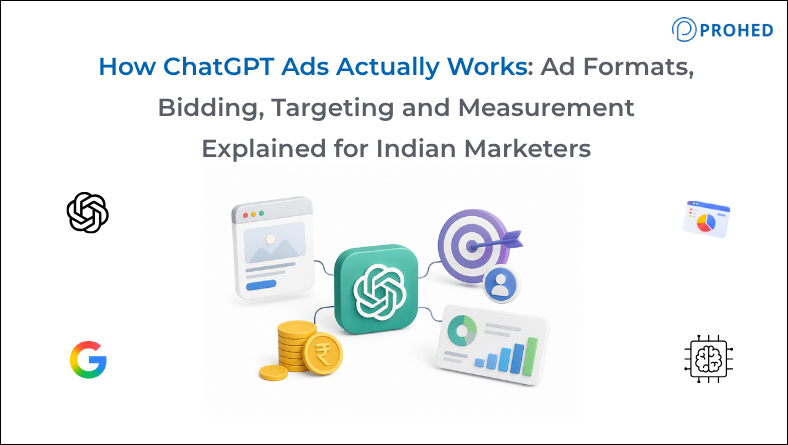
ChatGPT Ads are sponsored placements appearing below AI-generated responses, matching the context of a user’s prompt rather than a keyword. When someone asks ChatGPT for a product recommendation or category comparison, a relevant brand ad appears alongside the answer. At PROHED, a performance marketing agency in Gurgaon, we’re tracking this closely because 63% of ChatGPT’s 800 million monthly users use it for research and discovery, a consideration moment no other paid ad platform has reached until now.
Shifts are happening in how consumers find brands and it’s keeping pace faster than most marketing teams are.
Where once the honest query began in a search box on the front page of Google, now the conversation starts in ChatGPT. Instead of searching “what’s the best project management tool for a 20-person team” or “which D2C skincare brand is good for oily skin”, users are starting a conversation. And until now, there was no way for brands to be present at all.
What the Ad Format Actually Looks Like
The ad unit itself is simple. It appears below the ChatGPT response in a clearly labeled “Sponsored” box. Each unit contains:
- A single square image (1×1 format)
- A headline
- A short description
- A click-through link to the brand’s website
The placement is below the AI’s answer, not inside it. ChatGPT generates its response first, and the ad appears after, contextually relevant to what was just discussed.
This matters for expectation-setting. The ad doesn’t interrupt the answer or replace it. It sits alongside it, visible to users who are still in an active research mindset after reading the response. That’s a fundamentally different intent environment from a banner ad on a content site or a display placement on an app.
How Targeting Actually Works: Simpler Than You’d Expect
This is where ChatGPT Ads differ most significantly from every other paid ad platform Indian marketers are familiar with.
There is no audience targeting. Lacks demographic overlays, interest segmentation, and precise geographic targeting beyond broad regional settings.
Targeting is entirely contextual. The ad matches the user’s prompt, not a profile built from their browsing history. If a user asks ChatGPT about performance marketing agencies, a brand ad from a marketing agency can appear. If they ask about skincare for sensitive skin, a skincare brand’s ad can appear. The match is purely based on prompt relevance.
What’s available vs what’s not:
Targeting Type | Available in ChatGPT Ads |
Prompt-contextual targeting | Yes |
Geographic targeting | Limited, broad country/region only |
Demographic overlay | No |
Interest-based segments | No |
Retargeting / custom audiences | No |
Keyword bidding | No |
For Indian brands accustomed to precise audience control in Meta or Google, this feels blunt. And it is, for now. However, the trade-off is that the user is in an active consideration mindset. Someone whose prompt triggers your ad was just discussing your product category with an AI. That’s a signal quality no demographic filter can replicate.
How Bidding and Pricing Works
OpenAI runs an opaque relevancy model with a proto-auction structure. In practice, this creates a variable pricing environment based on how competitive a prompt category is.
Observed CPM ranges globally:
Scenario | Estimated CPM |
Niche prompt, low competition | $15 |
Competitive prompt, category leader | $60 |
Average across tested accounts | $25 to $40 |
The lesson from early testing by agencies globally is that niche prompt alignment rewards precision. The more tightly a creative maps to the specific prompt context, the better the cost efficiency. Broad brand ads competing for generic prompts pay significantly more per thousand impressions.
On bidding methodology: CPM bidding consistently outperforms CPC bidding in early tests. The auction mechanics are still maturing, and CPC pricing in an opaque system produces unpredictable cost-per-click outcomes. Running CPM and measuring the downstream click quality independently produces more interpretable results.
The Three Ways to Buy ChatGPT Ads
There are currently three routes into the platform, and the right one depends entirely on budget and objective.
- Criteo (Commerce Focus):
Commerce-oriented. Accepts product feeds, making it well-suited for D2C and retail brands that can stand up thousands of product ads simultaneously from a catalogue. Recommended minimum: $50,000 per month. - StackAdapt:
Broader programmatic capability. Adds some geo-targeting options and campaign incentives. Also recommends approximately $50,000 per month as a starting point. - Direct with OpenAI:
Maximum control and priority access. Minimum commitment: $250,000 per month.
Which route makes sense for Indian marketers:
Budget Level | Recommended Route | Suitable For |
Below $50k/month | Wait or observe | Most Indian SMBs |
$50k to $100k/month | Criteo or StackAdapt | D2C, ecommerce, BFSI |
Above $250k/month | Direct OpenAI | Enterprise, large-scale brand advertisers |
The honest answer for most Indian brands right now is that the entry cost is high relative to what’s currently measurable. Consequently, the right strategy for most is structured observation while running GEO content optimisation to earn organic ChatGPT citations, rather than paid placement.
Measurement: The Biggest Gap Right Now
Measurement is where ChatGPT Ads are most immature, and Indian marketers should understand this clearly before allocating budget.
Currently, what’s available is:
- Impressions
- Clicks
- Click-through rate
What’s not available yet: direct conversion optimisation, audience signal data, attribution beyond the click, or ROAS reporting at the placement level.
This means the evaluation framework has to be built before spending begins. The right question to answer isn’t “what did the ChatGPT Ad convert?” It’s “do users who click through from ChatGPT behave differently on site compared to users from Google, Meta, or other paid ads channels?”
Site behaviour analysis after the click, specifically engagement depth, pages per session, and downstream conversion rate, is the measurement approach that produces actionable insight in the current environment.
Related Read: How to Rank on ChatGPT: A Step-by-Step Guide to AI Search Visibility in 2026
Build the measurement framework first. Then set the budget.
Should Indian Brands Test ChatGPT Ads Right Now?
The honest framework:
Situation | Recommendation |
Monthly digital budget above ₹40 lakh | Consider a structured 90-day test via Criteo or StackAdapt |
Enterprise brand with large awareness budget | Explore direct OpenAI partnership |
Mid-size D2C or B2B brand | Focus on GEO content to earn organic ChatGPT citations first |
Brand with no conversion tracking infrastructure | Fix tracking before testing any new paid channel |
Category with high consideration-phase research | High potential; prompt alignment is strong for research-heavy categories |
The format is not ready to replace Google search ads or Meta’s paid ads in a performance marketing mix. However, it reaches a consideration moment that those channels don’t capture, and the brands building fluency with it now will have a meaningful advantage when audience targeting, conversion optimisation, and ROAS reporting mature, which the trajectory suggests will happen within 12 to 18 months.
Among digital marketing agencies in Gurugram, the agencies helping clients evaluate this format systematically, rather than either dismissing it or over-investing prematurely, are the ones building genuinely useful early data.
At PROHED, our ads agency work across Performance Marketing, SEO and GEO Strategy, Social Media Marketing, and B2B Lead Generation now includes a specific GEO track for brands that want to build organic presence in ChatGPT before committing to paid ChatGPT Ads budgets. As a performance marketing agency in India, we track where consideration is moving, not just where it currently sits.
Conclusion
ChatGPT Ads are a real, live, and growing channel. The format is simple: a contextual sponsored placement below AI responses. The targeting is prompt-based and blunt by current standards. The measurement is clicks and impressions without conversion optimisation. And the entry cost is high.
However, the opportunity is specific: 800 million monthly users, 63% using the platform for research and discovery, and a consideration mindset that no other paid ad platform currently reaches. Brands that build their measurement framework, align creative tightly to prompt context, and test systematically rather than speculatively will be significantly better positioned when the format matures.
Frequently Asked Questions
1. What are ChatGPT Ads and how do they appear?
ChatGPT Ads are sponsored placements that appear below AI-generated responses in ChatGPT, labeled as “Sponsored.” Each unit contains a square image, headline, short description, and a link to the brand’s website. They appear after the AI answer, contextually relevant to what the user just asked.
2. How does targeting work in ChatGPT Ads?
Targeting is entirely contextual and based on the user’s prompt. There is no audience demographic targeting, interest segments, or retargeting available yet. The ad appears when the user’s prompt matches the brand’s category, making creative relevance to specific prompts the primary targeting lever.
3. What does it cost to advertise on ChatGPT?
CPMs range from approximately $15 for niche, low-competition prompts to $60 for competitive categories. Average CPMs in early tests sit between $25 and $40. Entry budgets through third-party partners like Criteo and StackAdapt start at approximately $50,000 per month. Direct OpenAI deals require a minimum of $250,000 per month.
4. What can be measured in ChatGPT Ads currently?
Currently, impressions, clicks, and click-through rate are available. Conversion optimisation, ROAS reporting, and audience data are not yet supported. Measurement requires building a site-side evaluation framework to assess whether ChatGPT click-through users convert at higher rates than users from other channels.
5. Should Indian brands test ChatGPT Ads in 2026?
Brands with monthly digital budgets above ₹40 lakh and a clear consideration-phase product category should evaluate a structured test. Smaller brands are better served by optimising content for organic ChatGPT citations through GEO strategy before committing to paid budgets at current entry minimums.
6. Is CPM or CPC bidding better for ChatGPT Ads?
CPM bidding consistently outperforms CPC bidding based on current testing data. The auction mechanics are still opaque, making CPC cost prediction unreliable. Running CPM and measuring post-click site behaviour separately produces more interpretable and actionable performance data.
Is your brand visible where your potential customers are researching in 2026? PROHED can build an AI search visibility strategy that earns organic ChatGPT citations now and evaluates paid ChatGPT Ads when the timing and budget make sense.
Schedule a Free Strategy Call with PROHED Today