If you run Local Services Ads for a plumbing, HVAC, or home services business, you’ve probably already gotten an email from Google about this, or you’re about to. Short answer: no, Google isn’t killing Local Services Ads. It’s folding them into Performance Max, giving you a new, specialised PMax campaign type built around the same pay-per-lead model you’re already used to. At PROHED, we’ve been tracking this rollout closely for our home services and local business clients, because a migration like this, even a smooth one, can quietly mess with your lead flow if nobody’s watching it happen. Here’s what’s actually changing, what isn’t, and what you should do about it.
The Local Services Ads to Performance Max Google Update, Explained
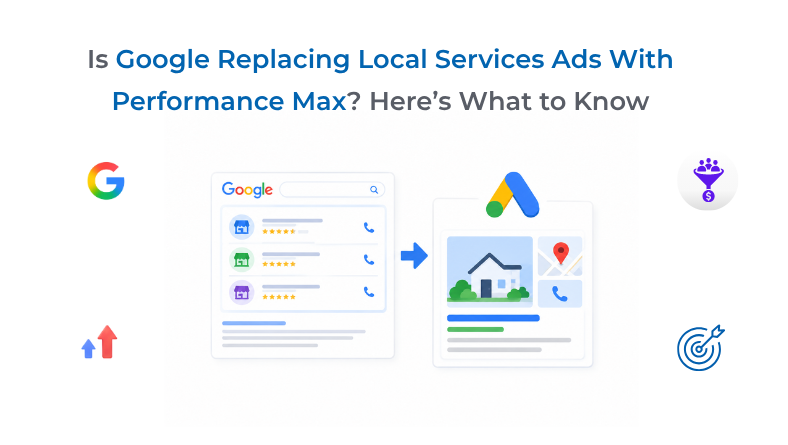
Google is moving Local Services Ads out of its own standalone dashboard and into the regular Google Ads platform. Instead of managing LSA separately from your Search and Display campaigns, everything lives in one place going forward.
The vehicle for this is a new Performance Max campaign type built specifically for pay-per-lead goals, distinct from a regular PMax campaign. It’s easy to see that headline and assume Google’s just merging Local Services Ads into standard Performance Max the way it merged Smart Shopping into PMax a few years back. That’s not quite it. This is its own flavour of PMax, one that keeps the core LSA mechanics intact rather than throwing them out.
What’s Staying the Same With Your Google Local Service Ads
Before anyone panics, here’s what Google says isn’t changing:
- You still only pay for leads, not clicks. Calls, messages, whatever counts as a valid lead in your category, that’s still the billing model.
- Your ads still only show on Search and Maps. This isn’t expanding into YouTube, Gmail, or the Display Network the way a standard PMax campaign would.
- Targeting stays keywordless. You’re not suddenly managing a keyword list. It’s still driven by your service categories and areas.
- Your Google Verified badge carries over automatically if you’re already verified. No re-doing the paperwork.
That last point matters more than it might seem. A lot of home services businesses fought hard for that verification badge, and finding out it survives the move is genuinely one less thing to worry about.
What’s Changing in the New Performance Max Campaign for Local Services
Here’s where it gets a little more involved.
- Manual bidding goes away: If you’ve been setting a manual max cost-per-lead, that option disappears. Bidding shifts to standard Google Ads bidding strategies instead.
- Weekly budgets become daily budgets: Google takes your average weekly spend, divides it by seven, and that becomes your new daily budget. Your monthly cap doesn’t really change (they multiply the daily figure by roughly 30.4), but if you’re used to thinking in weekly terms, this is a mental shift worth making early.
- Vertical-level Target CPA gets flattened: If you were running separate bid targets for, say, plumbing versus HVAC inside one account, that granularity goes away in favour of one blended campaign-level target, unless you split those verticals into separate campaigns.
- BBB callouts are being retired: If you were leaning on Better Business Bureau callouts as a trust signal, you’ll need to swap those for other structured callouts, business hours, specialties, payment methods, that kind of thing.
- Historical performance reports don’t automatically transfer: This is the one that trips people up. Your leads and customer contact history do carry over fine. Your old performance data, past spend, clicks, weekly reports, doesn’t move with you. If you want that history, screenshot or export it before your migration date.
Local Services Ads to PMax Campaign Migration Timeline
Google’s rolling this out in phases rather than flipping a switch for everyone at once:
| Phase | Who’s Affected |
|---|---|
| Starting August 2026 | Select US home and storefront service advertisers (plumbing, HVAC, electrical, appliance repair, house cleaning, lawn care, roofing, pest control, moving) |
| Later in 2026 | Broader advertiser groups, including service-area businesses and accounts with custom bidding setups |
| 2027 | Non-US accounts and remaining business categories not yet migrated |
If your business is outside the US, you’ve got some runway before this reaches you, but it’s coming, so it’s worth understanding now rather than scrambling later.
Why This Google Update Matters Beyond Local Services Ads
Here’s the bigger pattern worth paying attention to, and it’s the real reason this update deserves attention beyond the businesses directly affected right now.
Google’s been consolidating campaign types into Performance Max for a few years, Smart Shopping folded in first, then a chunk of Display and Discovery inventory followed. LSA joining that list tells you where Google’s product direction is headed: fewer standalone tools, more automated, unified campaign types managed through one platform with Google’s algorithm making more of the day-to-day decisions.
For a digital marketing agency managing multiple campaign types for a client, that consolidation cuts both ways. On one hand, unified reporting across Search, PMax, and now pay-per-lead campaigns genuinely makes cross-channel analysis easier. On the other, it means less manual control over bidding specifics, which is exactly the kind of thing that benefits from someone actively watching performance during the transition rather than assuming the automated migration just works itself out.
How Local Service Businesses Should Prepare for the PMax Transition
A few practical steps, regardless of when your migration date lands:
- Export or screenshot your current LSA performance reports. Don’t wait for the migration notice, do this now while you still have easy access.
- Check your Google Business Profile accuracy. Since your business name, address, and hours now sync one-way from your Business Profile into Google Ads, any inconsistency there becomes an inconsistency in your ad campaign too.
- Decide whether to split verticals into separate campaigns. If you rely on different bid targets across categories, plan that structure before migration day forces a flattened default on you.
- Watch your account closely for the two weeks after migration. Google’s own guidance notes performance can take time to stabilise post-transition, so don’t judge results against old benchmarks in week one.
- Set up structured callouts now if you’ve been relying on BBB callouts, so you’re not scrambling to replace that trust signal after the fact.
How PROHED Digital Solutions in Gurgaon Approaches This Transition
Platform migrations like this are exactly where we spend the most time with local and home services clients right now, since an automated transition doesn’t always mean an invisible one. We’re auditing pay-per-lead campaign structures ahead of client migration dates, making sure Google Business Profile data is clean before the sync kicks in, and setting up separate campaign structures where a client genuinely needs vertical-specific bidding preserved.
As a marketing agency in Gurgaon working across home services, real estate, and local business categories, our take on this update is fairly simple: the fundamentals of pay-per-lead advertising aren’t changing, but the mechanics underneath them are, and that’s exactly the kind of change that rewards close attention over the next few months.
Conclusion
Local Services Ads isn’t disappearing, but the way you manage it is changing pretty significantly, from a standalone dashboard to a specialized Performance Max campaign living inside standard Google Ads. The pay-per-lead model, the Search and Maps-only placement, and your verification status all survive the move intact. What doesn’t survive automatically is your bidding granularity, your historical reporting, and, if you’re not paying attention, potentially a few weeks of lead flow while the transition settles. Get ahead of your migration date rather than waiting for it to happen to you.
FAQs
1. Is Google shutting down Local Services Ads?
No, Local Services Ads isn’t being discontinued. It’s being migrated into a specialised Performance Max campaign type that keeps the pay-per-lead billing model, just managed through the regular Google Ads platform instead of a separate dashboard.
2. When is my business going to be migrated?
It depends on your category and location. US home and storefront service businesses in categories like plumbing, HVAC, and electrical start migrating from August 2026, with broader groups following later in the year and non-US accounts moving in 2027.
3. Will I still only pay for leads instead of clicks?
Yes, this is one of the parts of the model that Google’s explicitly keeping unchanged. Standard Performance Max campaigns charge per click, but this specialised pay-per-lead PMax version continues charging only for valid leads like calls and messages.
4. Do I lose my Google Verified badge in the migration?
No, if your business was already verified under Local Services Ads, that verified status and badge transfer over automatically. You shouldn’t need to redo insurance or license verification because of this migration alone.
5. Will my past leads and performance data carry over?
Your customer lead history, including contact details and message threads, transfers automatically. Your performance reports, past spend, clicks, and campaign-level metrics do not transfer automatically, so save or screenshot them before your migration date.
6. Can I still set a manual cost-per-lead after migrating?
No, manual bidding is being deprecated as part of this transition. You’ll need to shift to standard Google Ads bidding strategies, which is a genuine change in how much granular bid control you have compared to the old LSA dashboard.
7. What happens to my weekly budget?
Google automatically converts your average weekly budget into a daily budget by dividing it by seven. Your overall monthly spend cap stays roughly the same, calculated using an average of 30.4 days per month, so total spend shouldn’t shift dramatically even though the budgeting unit does.
8. Should I worry about a drop in leads during migration?
Some fluctuation is normal, and Google notes it can take up to two weeks for performance to stabilize after your account transitions. It’s worth watching your numbers closely during that window rather than assuming something’s broken if results dip briefly.
Not sure how this Local Services Ads to Performance Max transition affects your account specifically?Talk to PROHED digital solutions in Gurgaon about auditing your campaign ahead of migration.
Schedule a Free Strategy Call with PROHED Today