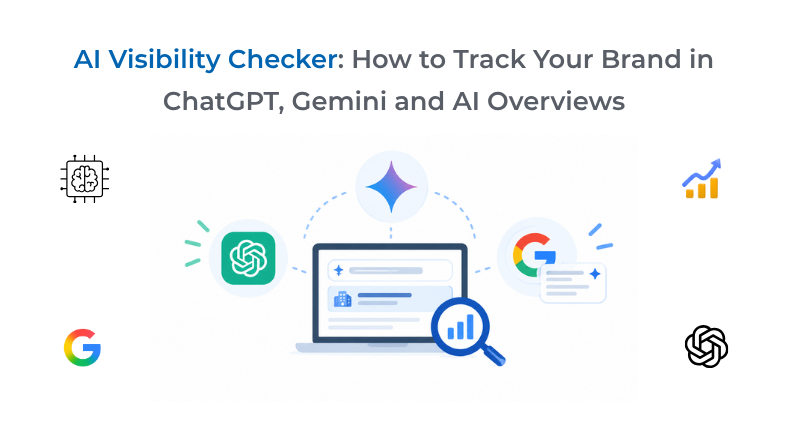
Ask ChatGPT for the best brand in your category and see whether your name comes up. If it doesn’t, none of your dashboards would have warned you. An AI visibility checker shows whether ChatGPT, Gemini and Google AI Overviews mention, cite or recommend your brand when people ask questions in your space. You can run one by hand with a fixed set of prompts, or automate it with a tool. At PROHED, a performance marketing agency in Gurgaon, we track this next to rankings and paid results, because a brand can sit at position one on Google and still never get named in an AI answer.
Why Rankings and Analytics Can’t Show Your AI Visibility
Traditional reporting misses this for three reasons:
- There’s no fixed position: The same prompt can name different brands on different runs.
- Nobody has to click: An AI answer can recommend you without sending a single visit.
- Analytics gives a partial picture: Referrals from chatgpt.com show up in GA4, but some AI visits land in direct traffic, and Search Console doesn’t give a clean AI-only view.
Yet people rely on these answers. One 2025 global survey found that 62% of consumers trust AI tools to guide brand discovery. Measuring your presence there is no longer optional.
The Metrics That Matter for LLM Visibility Tracking
Start with these seven. Skip anything you can’t turn into a decision.
| Metric | What it tells you | How to calculate |
|---|---|---|
| Mention rate (AI visibility) | How often you’re named | Prompts naming you ÷ total prompts |
| Citation rate | How often your site is linked as a source | Answers citing your domain ÷ total answers |
| AI share of voice | Your slice against competitors | Your mentions ÷ all brand mentions in the same prompts |
| Brand mention sentiment | Whether the tone helps or hurts | Tally positive, neutral, negative |
| Prominence | First name in the answer or buried | Average position within answers |
| Prompt coverage | Which buying stages you show up in | Stages with a mention ÷ total stages |
| AI referral conversions | Whether it pays off | Sessions and conversions from AI referrers |
A mention and a citation are different things. Being named is awareness. Being cited means the model trusted your page as evidence. You can have one without the other.
Prompt Tracking: Build Your List Before You Buy a Tool
Your prompt list decides whether the data means anything. Aim for 30 to 50 prompts, written the way customers actually talk. Real chatgpt prompts beat clever ones, so mine sales calls, Search Console queries and People Also Ask boxes.
Split them into four buckets:
- Discovery: “best protein powder under ₹2,000”
- Comparison: “Brand A vs Brand B for sensitive skin”
- Problem-led: “how do I reduce cart abandonment on Shopify”
- Brand: “is [your brand] worth it”
Add local context where it matters, like a city or rupee budget. Answers shift a lot with it.
How to Track Brand Mentions in ChatGPT Manually
This is the free version of a ChatGPT visibility tracker, and it’s a fine place to start.
- Open a Temporary Chat so past conversations don’t skew the answer.
- Run each prompt three times. One run proves nothing.
- Log whether you were mentioned, cited, and how you were described.
- Note which sources the answer linked to.
- Repeat monthly with the same prompts, and repeat on Gemini and Google AI Overviews too.
It’s tedious past 30 prompts, which is when a tool starts paying for itself.
Tools for AI Search Analytics
| Tool | Best for | Worth knowing |
|---|---|---|
| Semrush AI Visibility Toolkit | Teams already on Semrush | Tracks visibility score, mentions, citations, share of voice and prompts |
| Ahrefs Brand Radar | Market and citation research | Reported around $199 a month for one AI platform, $699 for all |
| Otterly AI | Small teams starting out | Cheaper, covers prompt tracking and share of voice |
| Profound | Frequent refresh needs | Updates far more often than monthly tools |
| Manual checks, HubSpot AEO Grader, Ahrefs’ free checker | Getting a baseline | Fine for patterns, thin for serious reporting |
Check current pricing before you commit, since it moves fast. Two cautions apply to nearly every tool. Some confuse brand names with common words, so a brand called “Later” gets polluted data. And some refresh chatbot data only monthly, which is slow when answers change constantly. Spot-check any tool’s numbers by hand.
A GEO Reporting Template You Can Copy
Keep a simple prompt log in a spreadsheet with four columns: the prompt, the platform, whether you were mentioned, and whether you were cited. Then roll it up into one monthly scorecard like this:
| Metric | Last month | This month | If it drops, do this |
|---|---|---|---|
| Mention rate | Check which prompts stopped naming you and update the pages that answer them | ||
| Citation rate | Add clear facts, structured data and sources to your key pages | ||
| AI share of voice | See which sources the AI cites for competitors and earn coverage there | ||
| Sentiment (% positive) | Trace negative tone back to reviews or outdated pages and fix the source | ||
| AI referral conversions | Review landing pages, since the traffic is arriving but not converting |
Fill it in once a month using the same prompts. The last column is what makes it useful, because every number comes with a next step and nobody has to guess what to do with it.
What to Do With the Numbers
- Mentioned but rarely cited: strengthen the pages models would pull from, with clear facts, structured data and clean product feeds. Our guide to getting found on ChatGPT Shopping covers the technical side.
- Competitor owns share of voice: look at which sources the AI cites for them, then earn coverage on those same sites.
- Strong in ChatGPT, missing in AI Overviews: that’s usually a classic search gap. Our piece on AEO vs SEO helps with prioritising.
- Negative sentiment: fix the source, usually reviews or outdated pages, not the AI.
- Want to buy visibility instead: ads are a separate channel. See how ChatGPT ads work and how they compare in ChatGPT Ads vs Google Ads. For the organic route, read how to rank on ChatGPT.
How PROHED Approaches AI Visibility Reporting
We fold GEO reporting into the same monthly review as SEO and paid, so one team sees how each channel affects the other. AI answers tend to lean on brands that already have trusted, well-ranked pages, so organic strength is the base layer. With Khoya Mithai, a D2C food brand, our SEO work drove 115% higher organic traffic and about 60% better rankings within six months. That’s the kind of foundation AI visibility builds on.
Conclusion
You can’t improve what you can’t see, and AI answers are invisible to most reporting stacks. Start small: 30 prompts, three runs each, one spreadsheet. Track mention rate, citation rate and share of voice, and add a tool once the manual routine gets heavy. Do it monthly and the patterns show up fast.
FAQs
1. What is an AI visibility checker?
It’s a manual process or software that tests whether AI platforms like ChatGPT, Gemini and AI Overviews mention or cite your brand for relevant prompts. The output is usually mention rate, citation rate and share of voice. Think of it as rank tracking for a world where there’s no fixed ranking.
2. How do I track brand mentions in ChatGPT?
Run a fixed list of customer-style prompts in a Temporary Chat, three times each, and log whether your brand appears and how it’s described. Repeat monthly, or use a tool like Semrush or Ahrefs once the list grows. Keep the prompts identical every month, otherwise you can’t tell whether a change is real or just a wording difference.
3. What’s the difference between a mention and a citation?
A mention means the AI names your brand in its answer. A citation means it links your page as a source, which is a stronger trust signal. Tracking both matters because you can be cited without being named, or named without any link back to you.
4. How often should I check AI visibility?
Monthly works for most brands, with weekly checks around launches or big campaigns. Answers shift constantly, so compare trends rather than single runs. If you only check once a quarter, a drop can go unnoticed for months.
5. What is AI share of voice?
It’s your share of all brand mentions across a fixed prompt set, compared with competitors. If you’re named 20 times out of 100 total brand mentions, your share is 20%. It’s the easiest number to show a leadership team, since it puts your visibility next to the brands you’re actually competing with.
6. Do I need a paid tool, or are free checks enough?
Free manual checks are enough to set a baseline and spot patterns. Paid tools help once you’re tracking dozens of prompts across several platforms. A sensible route is to start manually for two or three months, then buy a tool only when the spreadsheet becomes the bottleneck.
7. Why does ChatGPT give different answers to the same prompt?
Language models generate each answer fresh, and personalisation, location and wording all nudge the result. That’s why one run tells you little and repeated runs matter. Running each prompt three to five times gives you a more honest picture of how often you actually appear.
8. Can Google Analytics show my AI visibility?
Only partly. GA4 can show referral visits from sources like chatgpt.com, but it can’t show mentions that never led to a click, and some AI visits get counted as direct. Use it to measure the traffic and conversions AI sends you, and rely on prompt tracking to measure everything that happens before the click.
Want to know where your brand stands in AI answers right now? Talk to PROHED for an AI visibility audit built around your category, competitors and prompts.
Schedule a Free Strategy Call with PROHED Today