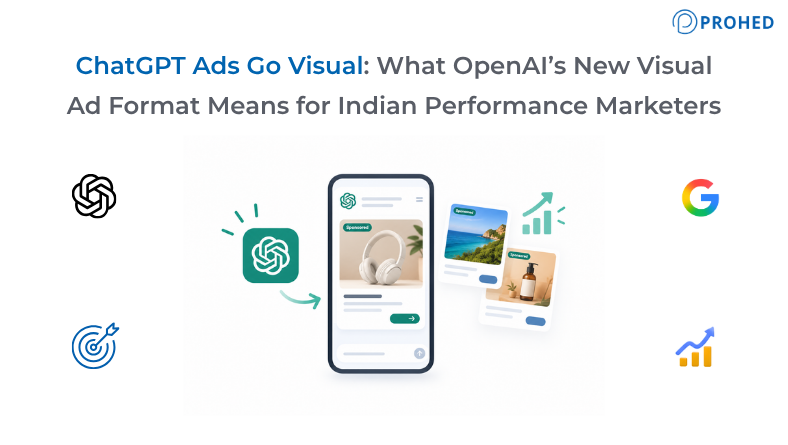
ChatGPT ads are adding a visual format that shows product imagery alongside images users generate. For Indian performance marketers, it’s a new paid channel to prepare for now and test carefully. PROHED, a performance marketing agency in Gurgaon, explains how.
A few weeks ago, a ChatGPT ad was a small labelled card under a text answer. On 5 October, OpenAI said it will test image-led ads during image generation. That’s a different creative job, and a different moment in the buyer’s head.
We’ve already covered formats, bidding and buying routes and how the platform compares with Google. This piece covers what’s new, what’s confirmed for India, and how to prepare.
Key takeaways
- OpenAI announced the visual format on 5 October 2026. Testing starts later this month in the US with an initial group of advertisers.
- It’s aimed at Free and Go users, labelled, kept separate from the generated image, and OpenAI says it doesn’t influence answers.
- Sponsored ads and self-service Ads Manager reached India in August. No date has been given for the visual format.
- Preparation costs little: assets, product feeds and tracking. Judge any test on incrementality, not last-click.
What Are ChatGPT Visual Ads, and What Did OpenAI Announce?
OpenAI describes the format as a way to help people imagine how products could fit into their lives, using images of product inspiration, product usage or the experiences a service makes possible. The first test runs during image generation, so someone asking for a room mock-up or an outfit idea could see a relevant brand beside the result.
OpenAI also says ChatGPT reaches 1.2 billion people weekly. That’s the company’s own figure, and it describes the whole platform, not the audience for this one format.
ChatGPT Ads in India 2026: What’s Live and What’s Still a US Test
| Item | Status |
|---|---|
| Sponsored ads in ChatGPT for Indian advertisers | Live since August, with self-service Ads Manager |
| Visual ad format | US test only, starting later in October |
| Visual format in India | No date announced |
| Targeting, creative specs and pricing for visuals | Not published |
| Who sees ads | Free and Go users. Paid plans such as Plus and Enterprise stay ad-free |
So this is a preview, not something to buy tomorrow. Don’t build a campaign for a format you can’t book. Do the groundwork, because that part is cheap.
ChatGPT Audience Targeting and Safeguards: What OpenAI Has Said
OpenAI lists product feeds, platform and geographic targeting, and custom audiences among its Ads Manager capabilities. Its Ads page also talks about richer context signals beyond keywords. Nothing specific has been published on how visual ads will be targeted.
On safety, OpenAI says placement guardrails keep ads out of emotionally vulnerable or sensitive conversations. Brands can use Negative Phrases for their own exclusions, and DoubleVerify and Integral Ad Science are piloting independent suitability checks without seeing private chats.
Some commentators question whether someone generating an image is shopping at all, as The Register reported. It’s a fair doubt, and a good reason to test before scaling.
Which Products Suit Visual ChatGPT Advertising?
OpenAI’s own wording points to inspiration, usage and experience. Categories where buyers picture the outcome before buying look like the natural fit.
| Category | Visual angle that fits | Watch out for |
|---|---|---|
| Jewellery and accessories | Styling for an occasion | Price and gold-rate claims |
| Home decor and furniture | Product inside a styled room | Stock and delivery promises |
| Fashion | Outfit in context | Size and fit accuracy |
| Hair and skin care | Routine and visible results | Compliance on claims |
| Weddings, education, long-decision services | The experience itself | Trust proof on the landing page |
Low-ticket commodity products look like a weaker fit to us. That’s our judgement, not data, so test before ruling anything out. Our jewellery ads strategy shows how we think about one visual category.
How to Prepare Creatives and an OpenAI Product Feed for Visual Ads
- Build a real image library. Products in use, lifestyle moments, and a few crops of each. Generic stock images will look out of place in a format built around showing how things get used.
- Clean your product feed. Titles, prices, availability and images should match your site. Feed hygiene for ChatGPT Shopping helps both organic and paid.
- Match the landing page to the image. If the ad shows a styled room, the click should land on that room’s products.
- Set up tracking now. Pixel, Conversions API and consistent UTMs.
- Sort consent early. If you plan custom audiences from customer lists, check your consent flows against our DPDP guide for marketers.
How to Run a ChatGPT Ads Test Without Risking Your Core Budget
- Write the question first: “Does ChatGPT bring new customers at a cost we’d accept?” beats “let’s try it.”
- Cap the spend at an amount you can afford to lose, and leave Google and Meta budgets alone.
- Pick one product line: A narrow test is easier to read.
- Keep a control region: Use geographic targeting to run ads in one region and hold back a similar one.
- Run it for three to four weeks, long enough to get past the noise of a new channel.
- Compare fairly: Judge results against your Meta cold-traffic campaigns using the same conversion event.
- Set the decision rule before launch: scale, hold or stop.
ChatGPT Advertising ROI: Measuring Beyond Last-Click
Last-click will undercount this channel, since people often see an ad and search your brand later. OpenAI is adding integrations with Hightouch, Tealium and LiveRamp for sending conversion data, plus attribution partners such as AppsFlyer, Triple Whale, Adjust, DV Rockerbox and Northbeam. For causal impact it’s exploring geo-based experiments with Haus, Measured and WorkMagic, and calls this work early-stage.
OpenAI also shared early partner results. DV Rockerbox reported WeightWatchers’ attributed cost per acquisition at 15.3% below its blended paid-search benchmark. Triple Whale reported that 93% of Portland Leather’s visitors from the ads were new. These are vendor-reported figures from selected advertisers, none of them Indian and none from the visual format.
Track four things:
- Cost per new customer
- Share of new customers
- Branded search lift
- Assisted conversions
ChatGPT Ads vs Google Ads and Meta Ads: Where Paid Media Beyond Google Fits
Google captures people who already know what to search for. Meta builds interest in a feed. ChatGPT reaches people while they research or imagine, with narrower inventory and measurement that’s still maturing. We’d treat it as an incremental test channel, not a replacement for either.
How PROHED Approaches AI Advertising Platforms in India
We protect the core first. Google and Meta keep their budgets, and any new channel gets a capped test, a control region and a decision date. We work with visual, high-consideration brands such as Devi Diamonds, a lab-grown jewellery brand, and Amaris, a fine jewellery brand. They’re the type of category likely to suit this format, though we haven’t published ChatGPT ad results for them.
Conclusion
Visual ads make ChatGPT a place to show products, not only mention them. The sensible play for Indian advertisers is preparation now and a small, measured test once the format reaches India. Get the assets, feed and tracking ready, and let a control region tell you whether the channel is incremental.
FAQs
1. What are ChatGPT visual ads and how do they work?
They’re labelled, image-led ads shown during image generation in ChatGPT, featuring a product or service in use. OpenAI says they stay separate from the generated image and don’t influence answers.
2. Are ChatGPT ads available for Indian advertisers in 2026?
Sponsored ads have been live in India since August, with self-service access through Ads Manager. The visual format starts as a US test, and no India date has been announced.
3. How do ChatGPT ads compare to Google Ads and Meta Ads?
Google captures searched intent, and Meta builds interest through feeds. ChatGPT reaches people mid-research with narrower inventory, so it works best as an incremental test.
4. What types of products perform best on ChatGPT advertising?
Visual, considered purchases look like the best fit, such as jewellery, decor, fashion and long-decision services. There’s no public performance data on the visual format yet, so test your own category.
5. How do I measure ROI from ChatGPT ad campaigns?
Use a control region and compare new customers, branded search and assisted conversions, not last-click alone. OpenAI’s named attribution and incrementality partners can help.
6. Who sees ChatGPT ads?
OpenAI says ads appear for Free and Go users, while paid plans stay ad-free. Placement guardrails also keep ads away from sensitive conversations.
7. Do ChatGPT ads influence the answers it gives?
OpenAI says they don’t. Ads are labelled and kept separate from answers and from generated images.
Want a ChatGPT ads test plan built around your catalogue? Plan it with PROHED and we’ll set up the creative brief, control region and success criteria.
Schedule a Free Strategy Call with PROHED Today