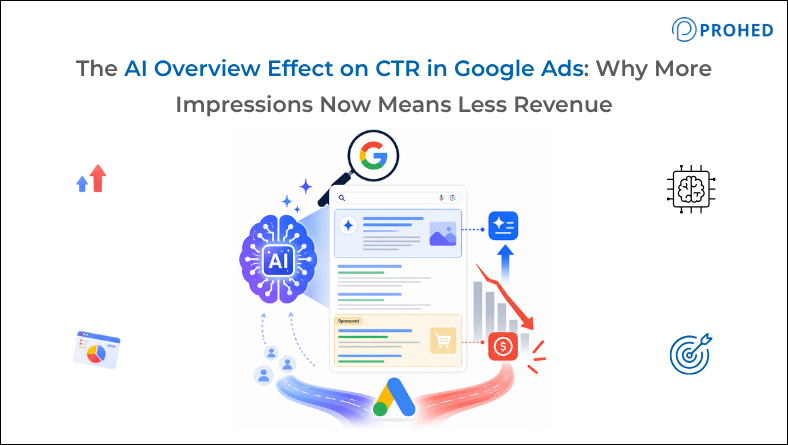
CTR in Google Ads is the percentage of times your ad gets clicked after being shown. It’s one of the most direct signals of whether your campaign is actually working. But in 2026, a growing number of advertisers are watching impressions climb while clicks stay flat or fall. The reason is AI Overviews, Google’s AI-generated answer blocks that now appear above both organic results and paid ads on millions of queries. At Prohed, a performance marketing agency in Gurgaon, we’re seeing this pattern across client accounts in D2C, EdTech, and healthcare, and the fix requires rethinking more than just ad copy.
Your Google Ads dashboard looks fine. Impressions are up. The campaign is reaching more people than ever.
But clicks are down. Revenue is flat. And nobody in the room can explain why.
This is the AI Overview effect, and it’s quietly reshaping the economics of paid search for Indian advertisers right now.
The problem isn’t your targeting. It isn’t your creative. It’s what’s sitting above your ad on the results page, answering the user’s question before they ever see your link.
What AI Overviews Actually Do to the Search Page
When a user searches something on Google today, there’s a decent chance they never scroll past the first block of content. That block, in many cases, is now an AI Overview: a synthesised, AI-generated answer pulled from multiple sources and displayed prominently at the very top of the page.
Everything else, including Google Ads, organic results, and featured snippets, gets pushed further down.
The data on what this does to click-through rate is stark. BrightEdge research found that Google search impressions rose nearly 49% in the year following AI Overviews’ launch. In that same period, click-through rates dropped close to 30%.
More visibility. Fewer clicks. That’s the AI Overview effect in one line.
For advertisers paying per click, impressions going up while clicks go down isn’t neutral. It’s a signal that the search page has fundamentally changed what users do after they search. And CTR in Google Ads, as a result, can no longer be read the same way it was twelve months ago.
The Prohed AI Visibility Impact Framework
At Prohed, we’ve built a structured way to diagnose and respond to this shift. The Prohed AI Visibility Impact Framework looks at three things: where impressions are being absorbed, what query types are most affected, and where ad spend is still producing genuine clicks worth paying for.
Across accounts managed by Prohed in 2025-26, campaigns running on broad or informational query targeting consistently showed the sharpest google ads CTR decline after AI Overviews appeared on those query clusters. Meanwhile, campaigns tightly structured around high-commercial-intent, transactional searches held their click-through rate far more steadily.
The takeaway is not that paid search is broken. It’s that the query types worth targeting with paid spend have narrowed, and the accounts optimised for that reality are outperforming the ones still running 2023-era campaign structures.
Why This Affects Some Campaigns Much More Than Others
Not every query triggers an AI Overview. And not every impression drop carries the same revenue consequence. Understanding the difference is where the real work begins.
1. Informational queries get hit hardest
Questions like “what is performance marketing,” “how does retargeting work,” or “best time to run ads” are exactly the kind of queries AI Overviews are built to answer. A user searching these gets a full, structured response without needing to click anything. Consequently, any ad showing on these queries is fighting for attention on a page where the user’s question has already been resolved.
2. Transactional queries are far more resilient
Searches with clear commercial intent, such as “performance marketing agency in Gurgaon” or “buy protein supplements online,” are less likely to generate an AI Overview because they signal a need to act, not just to know. Users on these searches are closer to a decision. Therefore, they’re more likely to click through to a specific result that can help them take the next step.
3. The AI Mode Effect compounds this further
Google’s AI Mode, rolled out in 2025, takes the Overview concept further by converting the entire search experience into a conversational interface. In AI Mode, the search results page itself can disappear, replaced by a dialogue-based answer session. For advertisers, this means ad click opportunities on certain query types are shrinking at both the Overview layer and the results page layer simultaneously.
What’s Happening to Ad Spend Efficiency Right Now
Here’s the part that should concern any advertiser running PPC Google Ads at scale.
When CTR in Google Ads drops on impression-heavy campaigns, the cost-per-click can actually hold steady or increase. Why? Because the users who do click become a smaller, self-selected group of high-intent visitors. The algorithm, optimising toward conversions, starts spending more to reach them.
This isn’t necessarily bad. Higher intent often means better conversion rates downstream. However, it does mean that the impression volume metric, which many campaigns use as a proxy for brand reach, is now even less useful than it used to be as a performance signal.
Additionally, AI Google Ads placements inside AI Overviews themselves are still in early rollout. Google has confirmed that sponsored results are beginning to appear within AI Overview blocks on certain queries. However, these placements don’t behave like standard search ads, and their CTR dynamics are different from anything in the historical benchmark data advertisers have been optimising against.
The short version: benchmarks built before mid-2025 are increasingly unreliable reference points for what good performance looks like now.
Related Read: AI Max Is Now Replacing Dynamic Search Ads From September 2026
5 Ad Optimization Moves That Actually Work in This Environment
1. Audit Which Queries Are Triggering AI Overviews on Your Account
Pull your search term report and cross-reference it against queries where AI Overviews are now appearing. You must check this manually or through a crawl tool, since Google Search Console doesn’t yet separate AI Overview impressions from standard impressions cleanly.
Once you know which query clusters are AI Overview-heavy, you can make an informed decision: exclude them from paid campaigns, shift budget toward transactional alternatives, or accept lower CTR on those terms because the brand visibility still has value in your specific funnel.
Doing this audit first matters. Making budget decisions without it is essentially optimising blind.
2. Shift Budget Toward High-Commercial-Intent Keywords
Informational queries are increasingly expensive places to chase clicks when AI Overviews are absorbing the attention. Transactional and navigational queries, by contrast, are still producing google ads CTR that justifies the spend.
Specifically, this means tightening match types on broad-intent keywords, building tighter ad groups around bottom-of-funnel search intent, and deliberately choosing which queries earn your paid budget versus which ones you better serve through organic content or GEO-optimized blog articles.
For Indian brands, this also means looking at regional intent signals. Queries with city-level or use-case specificity, such as “D2C growth marketing Gurgaon” or “app install campaign India,” show far more resilience to the AI Overview effect than generic category-level queries.
3. Rewrite Ad Copy Around What AI Overviews Cannot Give
An AI Overview answers a question. It can’t offer a specific price, a limited-time deal, a product variant in stock right now, or a brand promise backed by a specific guarantee.
These are the elements you need in your Google Ads guide for creative strategy right now. Honestly, ad headlines and descriptions that only you can write and that start with specificity, urgency, or a differentiator the AI block cannot replicate are consistently beating generic, content-heavy copy in the current environment.
Think “Free audit in 48 hours for EdTech brands” rather than “Learn about performance marketing services.” The first gives a user a reason to click that no AI-generated summary can replace.
4. Separate Brand Campaigns and Protect Them Aggressively
Brand keyword campaigns are currently the most protected territory in ads Google Ads from the AI Overview effect. A user searching your brand name has already made a directional decision. They want you specifically.
Consequently, brand campaigns should be kept entirely separate from broader search campaigns, protected with exact match, and monitored for any drop in branded click-through rate that might signal a competitor running branded bidding against your terms.
Any account that hasn’t separated branded and non-branded campaigns properly is mixing two very different traffic signals and making optimisation significantly harder.
5. Use CTR as a Diagnostic Signal, Not a Success Metric
This is perhaps the most important mindset shift. CTR in Google Ads has always been an imperfect proxy for performance. In the current environment, it’s even less useful as a standalone success metric because AI Overviews can suppress CTR on queries where the brand impression still has real awareness value.
Instead, use CTR as a diagnostic. A google ads CTR drop on a specific query cluster signals where AI Overviews are active and where ad spend needs to be reconsidered. Pair it with conversion rate and CPA data to understand whether the clicks you are getting are still producing the right outcome.
Reporting only on CTR without this additional layer now leads teams toward the wrong decisions, cutting spend on campaigns that are still converting well from a smaller, higher-intent click pool, while retaining spend on impression-heavy campaigns where the click is increasingly unlikely to happen at all.
How Prohed Approaches This Across Client Accounts
At Prohed, ad optimization in the current environment sits at the intersection of paid search strategy and content architecture. We audit campaigns for AI Overview exposure on their core query sets. Next, we shift budget allocation accordingly. Finally, we write creative briefs around the specific things an AI-generated summary block cannot deliver: urgency, specificity, proof, and a direct next step.
This work connects naturally to our broader service mix. SEO companies in Gurgaon that only optimise for traditional search rankings are already finding that some of their best-performing organic pages are now seeing reduced CTR from AI Overviews as well. Prohed addresses this across both paid and organic channels together, through Performance Marketing, SEO and GEO strategy, Social Media Marketing, and E-commerce Marketing, because the AI Overview effect doesn’t stop at the paid search boundary.
Related Read: The Complete Guide to AI Search Optimization for Indian Brands in 2026: GEO, AEO, LLM Seeding and Beyond
Conclusion
More impressions with fewer clicks isn’t a data anomaly to explain away. It’s the new default behaviour of a search page that now answers questions before users need to click anything.
For Indian advertisers, the response isn’t to panic about AI Overviews or to reduce Google Ads investment across the board. It’s to be significantly more deliberate about which queries deserve paid budget, what the ad copy needs to offer that AI can’t replicate, and how CTR in Google Ads is read and acted on as a signal rather than a headline metric.
The accounts that adjust their thinking now will find that the available click pool, while smaller, converts better. The ones that don’t will keep watching their impression numbers climb while revenue quietly stalls.
Prohed works with brands across India as a growth marketing agency that builds paid search strategy around exactly these shifts. As one of the best performance marketing agencies in India, we help D2C, EdTech, and healthcare brands navigate platform changes like this one without losing conversion momentum in the process. If your google ads CTR has been drifting without a clear explanation, this is probably where the audit needs to start.
Frequently Asked Questions
1. What is CTR in Google Ads and why is it dropping in 2026?
In Google Ads, CTR is the percentage of ad impressions that lead to a click. In 2026 it’s falling on a lot of queries because AI Overviews are directly answering the question the user has at the top of the search page, meaning there’s no need to click through any result below it, including paid.
2. What are AI Overviews and how do they affect paid search performance?
AI Overviews are Google’s AI-generated answer blocks that appear above organic results and ads on many queries. They absorb user attention before the user reads the page below. This suppresses the click-through rate without reducing the impression count, creating a disconnect between visibility and actual traffic.
3. Which query types are most affected by the AI Overview CTR drop?
Informational and research-intent queries are hit hardest, since AI Overviews are built to answer them directly. Transactional and navigational queries, where the user needs to take a specific action, are significantly more resilient and continue to produce stronger google ads CTR.
4. Should advertisers reduce Google Ads spend because of AI Overviews?
Not necessarily. The smarter response is to shift budget away from informational query clusters where AI Overviews are absorbing clicks, and toward high-commercial-intent searches where users are ready to act. Blanket spend reduction misses the nuance of which parts of the account are still performing well.
5. What makes ad copy more effective in an AI Overview environment?
Ad copy that leads with specificity the AI block cannot replicate: a concrete offer, a time-sensitive deal, a guarantee, or a clear next step. Generic, information-heavy headlines compete directly with what AI Overviews already provide. Specific, action-oriented copy gives users a reason to click that the AI summary cannot fulfil.
6. How is the AI Mode Effect different from AI Overviews?
AI Mode converts the entire search experience into a conversational interface, replacing the results page itself on some queries. This eliminates standard ad placements entirely on those searches, destroying the click opportunity at the page level rather than just pushing it further down the page.
7. Can CTR in Google Ads still be used as a performance metric?
Yes, but not as a standalone success metric. CTR is now better used as a diagnostic signal to identify where AI Overviews are active and where ad spend decisions need to be revisited. Pairing it with conversion rate and CPA data gives a much more accurate picture of what’s actually working.
8. How does Prohed help brands manage the AI Overview effect on paid search?
Prohed audits campaigns for AI Overview exposure on core query clusters, shifts budget toward transactional intent searches, and rebuilds ad creative around differentiated, specific messaging that AI summaries cannot replicate. This work is integrated across paid search, SEO, and content strategy so that both paid and organic channels adapt to the changing search landscape together.
Is your Google Ads CTR dropping while impressions stay high? Prohed can audit your account, identify where AI Overviews are affecting performance, and rebuild your search strategy around the queries still worth paying for.
Schedule a Free Strategy Call with PROHED Today