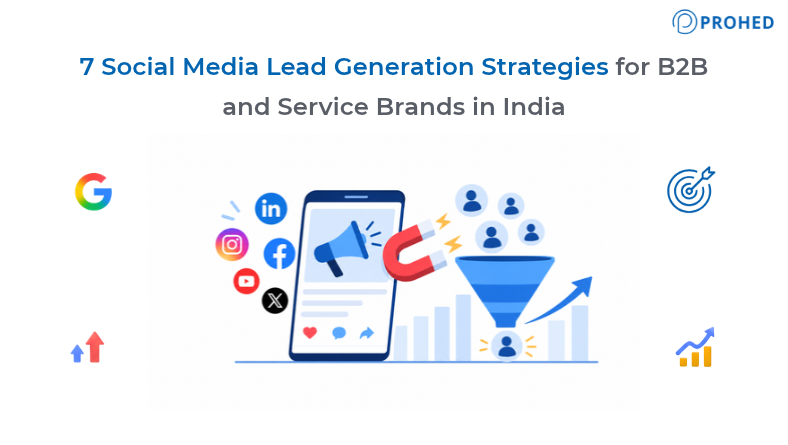
Social media lead generation means getting someone on LinkedIn, Instagram or Meta to share their details or start a chat, because you offered something worth the trade. For B2B and service brands in India, the version that works pairs one clear offer with a form or DM flow, plus a CRM that shows sales where each lead came from. We’re PROHED, a performance marketing agency, and our scorecard is simple: do the salespeople actually want to make those calls?
Reach is rarely the problem. Follow-up is. A post does well, six people comment, two send a DM, and then nothing happens for three days. By then the lead has probably spoken to someone else. These seven strategies are meant to plug that leak.
Pick the Platform First
Every network can produce leads. Whether it will for you depends on who signs the cheque, and how long they take to sign it.
Platform | Best suited for | What a lead usually looks like |
|---|---|---|
B2B services, SaaS, consulting, staffing | A DM, a lead gen form, a webinar sign-up | |
Clinics, salons, interior design, coaching, real estate | A DM, a story reply, a WhatsApp tap | |
Facebook and Meta network | Education, finance, local services | An instant form or a click-to-WhatsApp chat |
YouTube | High-consideration services | A demo request or a consultation booking |
Still unsure? Ask your sales team where their best clients first heard of you. That answer is worth more than any benchmark deck.
1. Start LinkedIn Lead Generation With a Person
Honestly, most company pages are noticeboards. People scroll past them. A founder, a partner or a senior practitioner posting under their own name gets replies.
So fix the profile first. The headline should say who you help, not what your designation is. Then write about the stuff your buyers moan about over chai: the vendor who vanished after onboarding, the compliance rule that changed last quarter, the report nobody reads. Comment on target accounts’ posts before you send them a connection request. Two useful comments make that request feel less like a pitch.
Carousels and document posts work well as a bridge. End one with “want the full checklist? DM me” and you’ve started a conversation for free. Because these posts also show up in LinkedIn’s own search, our guide to LinkedIn content search visibility is worth a read next.
2. Make Lead Magnets Small and Useful
A brochure isn’t a lead magnet. It’s a favour you’re asking for.
The best lead magnets fix one small problem in about five minutes and make the buyer curious about the bigger job behind it.
Business type | Lead magnet that tends to work |
|---|---|
B2B software | ROI calculator or vendor comparison checklist |
Consulting and finance | Short audit template or compliance checklist |
Real estate | Locality guide with price movement notes |
Clinics and wellness | Pre-consultation checklist |
Agencies | Sample report or a recorded teardown |
Before building anything, ask yourself whether you’d bother downloading it. If the answer is a shrug, so will your buyer.
3. Use Lead Forms, With a Little Friction
Native lead forms on LinkedIn and Meta open with contact details already filled in. On a phone, that’s lovely. It’s also why they attract accidental taps along with genuine interest.
We usually tweak four things:
- One qualifying question, such as team size, budget range or start date.
- The higher-intent form type on Meta, which adds a review step before submitting.
- A clear line on what happens next, whether that’s a call tomorrow or a PDF in the inbox.
- An instant confirmation, so the lead hears from you while the interest is warm.
Some offers need more room to explain themselves. For those, test a landing page against the form for a couple of weeks and compare cost per qualified lead, not cost per lead. Our CRO team usually handles the page side of that test.
4. Show Social Proof Where Doubt Creeps In
People buying services can’t try the thing first. They’re betting on a team. That’s why social proof matters so much, and why timing matters just as much.
Put it where the hesitation happens: a pinned post with a named client result, a short client clip inside an ad, a case study carousel, the thank-you page after a form. Give the result and the timeframe. “Great service” persuades nobody, whereas a specific outcome gives the reader something to check. And only use claims you can back up.
5. Retarget the People Who Almost Said Yes
Most visitors don’t enquire the first time. Retargeting gets you a second look while they still remember you.
The warmest audiences are video viewers, profile engagers, people who opened a lead form and walked away, and visitors to your service pages. Show them something helpful first, then proof, then an offer. A consultation or audit works well as that last step.
Exclude existing leads and customers, otherwise you’re paying to annoy them. Keep an eye on frequency too. Meta Ads and LinkedIn matched audiences handle all of this, and we often run the two together.
6. Keep DM Automation Polite
DM automation can speed up the first reply. It can also make your brand sound like a spam folder, so go gently.
The flow we trust is short. A post invites people to comment with a keyword. An automated message sends the resource and asks one question. The moment the buyer mentions price, scope or timing, a human takes over.
Skip bulk messages to cold contacts, and stick to each platform’s rules on automated messaging. WhatsApp belongs in this mix as well, since plenty of Indian buyers would rather message than fill a form.
7. Connect Every Lead to a CRM and Reply Fast
A lead stuck in a platform inbox is a lead you might lose. Link your forms and DMs to the CRM using native integrations, webhooks or something like Zapier. Send the source, campaign and form name along, so sales knows which effort paid off.
Then comes speed. Reply within minutes if you can, and move the contact into a follow-up sequence. We cover that part in our post on lead nurturing strategies.
How to Judge Lead Quality?
Cost per lead looks brilliant in a report. It can also hide a pile of junk. What matters is what happens after someone fills the form.
Metric | What it tells you |
|---|---|
Lead-to-qualified rate | Whether the audience and offer fit |
Cost per qualified lead | What useful enquiries really cost |
Speed to first response | How sales handles incoming demand |
Lead-to-close rate by campaign | Which campaigns make money |
Sales feedback | The truth behind the numbers |
Share these with sales every week and ask what they’re hearing on calls. For supporting indicators, see our article on social media metrics that show your strategy is working.
How PROHED Approaches Social Media Lead Generation?
We treat social as one funnel. Organic content builds trust. Meta Ads and LinkedIn campaigns bring volume. CRO fixes the leaks on the page, and CRM tracking shows what sales did next. That’s why our digital marketing services across Performance Marketing, Meta Ads, Social Media Marketing and CRO are built to work together.
Our Pearson case study shows what we’re aiming for: 45% higher qualified leads and 2.5X registrations. Fewer junk enquiries, more conversations worth having.
Conclusion
Good social media lead generation isn’t one clever trick. It’s a few ordinary things done properly: the right platform, a useful offer, a form with some filter, visible proof, patient retargeting, careful DMs and a CRM that never drops a lead. Pick two or three of these marketing strategies, check quality weekly, and add more once they work.
FAQs
1. Which social platform is best for lead generation in India?
There’s no single winner. LinkedIn usually leads for B2B services, while Instagram and Meta suit clinics, education and real estate. Go where your buyers already hang out.
2. How do B2B brands generate leads on LinkedIn without ads?
Put founders and experts out front. Tidy up their profiles, post about real buyer problems, engage with target accounts and offer a resource by DM. It takes a few months, so be patient.
3. How do you measure lead quality from social media?
Track lead-to-qualified rate, cost per qualified lead, response speed and closed revenue by campaign. Then ask sales what they think. Their answer often explains what the dashboard can’t.
4. Can Instagram generate leads for service businesses?
Yes, especially where trust and visuals matter. Reels, Stories and DMs all work. Give people one clear next step, like a WhatsApp link or a booking form.
5. How do you connect social leads to a CRM?
Use native integrations, webhooks or an automation tool to push form and DM data into the CRM. Always capture source, campaign and form name.
6. How long does social media lead generation take to show results?
Paid campaigns can bring leads in days, though tuning takes a few weeks. Organic work, especially on LinkedIn, usually needs a few months.
7. Should service brands use lead forms or landing pages?
Forms suit quick, low-commitment offers. Landing pages suit offers that need explaining. Test both against cost per qualified lead.
Want social media lead generation your sales team will thank you for? Book a free performance strategy session with PROHED and let’s map your funnel.
Schedule a Free Strategy Call with PROHED Today