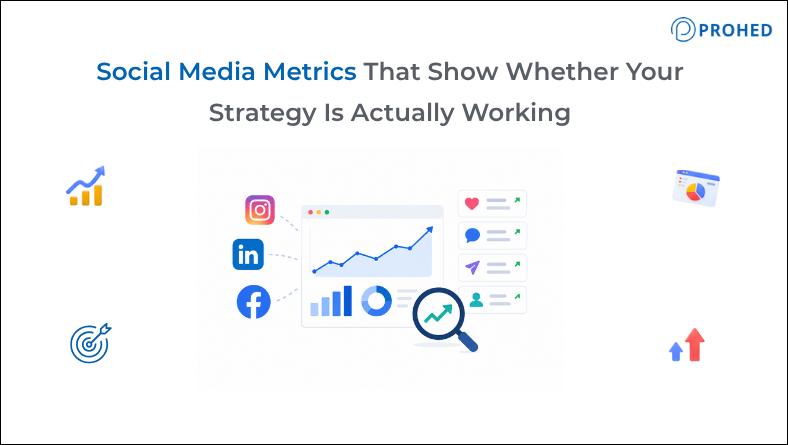
Here’s a quick gut check: how many followers does your brand’s Instagram have right now? Most social media managers know that number cold. Ask what share of last month’s engagement came from actual followers versus random reach, and you’ll get a much longer pause. Social media metrics are supposed to tell you whether your content is reaching and actually moving the right people, not just whether the numbers look decent on a monthly slide. At PROHED, a social media marketing company in Gurgaon, we spend more time pulling brands off vanity metrics than building new campaigns from scratch. Most accounts are already chasing the wrong number, and nobody’s told them yet.
Quick note before we get into it: this is about organic and overall channel measurement, whether your social presence is doing its job. If you’re specifically trying to diagnose why a paid video ad is bleeding budget, we’ve got a separate framework for that built around hook rate and hold rate, worth a read if that’s your actual problem.
Why Follower Count and Likes Don’t Really Tell You Much
Follower count can grow for reasons that have nothing to do with your strategy working. A giveaway. A follow-for-follow push. One post that happened to catch a trending sound. None of that means anything shifted in how people actually feel about your brand. Likes are even flimsier, honestly, since tapping a heart costs someone almost nothing and barely correlates with whether they’d ever buy from you.
That’s not to say these numbers are useless. They’re just incomplete, and treating them like the scoreboard trains your whole team to chase the wrong behaviour without realising it.
A few reasons this bites brands later:
- Follower growth says nothing about quality. Ten thousand people who scroll past everything you post are worth less than two thousand who actually stop and comment.
- A like is the laziest action a platform lets someone take. Comments, saves, shares, those cost more effort, and they predict what someone does next far better.
- Neither number ties back to revenue, which is, at the end of the day, the whole point of doing this.
The Social Media KPIs Actually Worth Your Time
Social media KPIs should map to where someone sits in your funnel, not to whichever numbers are easiest to screenshot from a native dashboard.
| Metric | What It Tells You | Funnel Stage |
|---|---|---|
| Reach vs impressions | Unique people who saw it vs total views, repeats included | Awareness |
| Engagement rate | How much your audience actually interacts | Consideration |
| Save and share rate | A quality signal, since both require real intent | Consideration |
| Click-through rate | Whether content pushes people off-platform | Intent |
| Conversion rate from social | Whether that traffic finishes the job | Conversion |
| Share of voice | Your brand’s visibility next to competitors’ | Brand health |
| CAC (paid social) | What it actually costs to land a customer here | Efficiency |
People mix up reach and impressions constantly, and it’s an easy mistake to make. Reach is unique eyeballs. Impressions count every view, repeats and all. If your impressions are climbing but reach is flat, the same small pocket of people is just seeing your stuff over and over. That’s a targeting problem dressed up as a content problem.
Getting Real About Engagement Metrics
Social media engagement metrics tend to get flattened into one number, but really they’re a stack of signals, and they don’t carry equal weight.
Engagement rate usually gets calculated as total engagements over reach or followers, times 100. The exact formula shifts a bit by platform and whether you’re measuring per post or account-wide. Honestly, which formula you pick matters less than picking one and sticking with it so your month-to-month comparisons actually mean something.
Not every engagement pulls its weight equally, though. A comment beats a like because someone had to stop, think, and type actual words. A share beats a comment, since the person is putting their own name behind your content in front of their own audience, which is a bigger ask than it sounds. Saves are the quiet MVP here, especially on Instagram, because a save usually means “I’ll come back to this later,” which is a much stronger signal than a passive scroll-by tap.
A few ways to read engagement properly:
- Look at the ratio of comments to likes, not just the raw total. More comments proportionally usually means the post actually sparked a conversation, not just a reflexive tap.
- Track saves and shares on their own, separate from likes. These two predict buying intent and organic reach far better than a like ever will.
- Break engagement down by content type. A carousel, a reel, and a plain static post rarely behave the same way, and averaging them together just hides which format is genuinely working.
So What’s a Good Engagement Rate, Actually?
There’s no single magic number, since it swings a lot by platform, industry, and how big your account already is. Rough benchmarks, for what they’re worth:
| Platform | Typical Range | Strong Performance |
|---|---|---|
| 1% – 3% | 4%+ | |
| 0.5% – 1.5% | 2%+ | |
| 2% – 4% | 5%+ | |
| X (Twitter) | 0.5% – 1% | 1.5%+ |
Smaller accounts often show inflated engagement rates, and it’s not because they’re doing anything smarter. A bigger slice of their early followers are genuinely invested. As an account grows, that rate usually softens, and that’s not automatically a red flag. It’s often just the audience getting broader than the core group that showed up early and cared the most.
Turning Analytics Into Actual Decisions
Social media analytics only earns its keep once it changes what you do next. A lot of monthly reports stop at “here’s what happened” and never quite get to “here’s what we’re changing because of it.”
A few habits worth building in:
Track performance by content pillar, not just post by post. If your educational content keeps beating your promotional stuff on engagement, that’s a nudge to shift your mix, not a line item to shrug at in a slide deck.
Connect social traffic to real conversions, not just clicks. Strong click-through with weak on-site conversion usually means the landing page or the offer is the problem, not the social content that got them there.
Watch engagement rate trends over weeks, not single posts. One post going unexpectedly viral throws off the average and buries what’s actually happening underneath it.
Check your share of voice against competitors every so often, since your own numbers in a vacuum won’t tell you if you’re gaining ground or quietly losing it. We’ve written separately about using share of search as a brand-health signal for CMOs, which pairs nicely with this kind of competitive check.
How to Actually Calculate Social Media ROI
This is where most teams get stuck, mostly because social media tends to do its heaviest lifting earlier in the journey than the final conversion moment.
The basic formula: (revenue attributed to social minus cost of social efforts) divided by cost, times 100.
Attribution is the hard part. Someone sees your Instagram post, forgets about it for three weeks, then finally converts by Googling your brand name directly. Technically, search gets the credit. Social did the actual work of planting the seed. That’s why looking at assisted conversions and multi-touch attribution, not just whatever channel got the last click, gives you a far more honest read.
For paid social specifically, cost per acquisition and ROAS are easier and cleaner to pin down, since the spend and the attribution window are both tighter.
How PROHED Thinks About Measuring This
We build reporting around funnel stage instead of dumping every available metric into one dashboard, because not everything matters equally at every point. Awareness campaigns get judged on reach and share of voice. Consideration-stage content gets judged on the quality of engagement, comments, saves, shares, not raw volume. For paid social, we track CAC against blended CAC across every channel, so social’s real contribution doesn’t get buried inside its own little silo.
As a social media marketing company in Gurgaon working across D2C, FMCG, and B2B accounts, the pattern we run into constantly is a brand with a great follower count and genuinely weak business outcomes, because nobody ever sat down and asked which numbers were the ones that mattered.
Conclusion
A social media metric only deserves a spot in your report if it changes a decision. Follower count and likes are easy to pull and mostly hollow on their own. Engagement quality, funnel-stage tracking, and a real line back to revenue are what actually tell you whether the strategy’s working or just looking busy. Build your reporting around what you’ll do differently once you see the number, not around whatever’s easiest to screenshot, and the whole exercise starts producing answers instead of just prettier charts.
FAQs
1. What are the most important social media metrics?
Engagement rate, reach, conversion rate, and share of voice usually matter most, though the right mix really depends on your funnel stage and goals. A brand chasing awareness should lean on reach and share of voice, while one chasing sales should watch conversion rate and CAC much more closely.
2. How do you measure social media performance?
Map each metric to a funnel stage, awareness, consideration, conversion, instead of tracking everything at equal weight. Judge performance by trends over time rather than single posts, since one viral piece of content will happily distort your whole month if you let it.
3. What is a good social media engagement rate?
It shifts a lot by platform. Instagram typically runs higher than Facebook or X, and LinkedIn often posts the strongest numbers for B2B content. As a rough rule of thumb, anything above 3% on Instagram or 4% on LinkedIn is genuinely solid.
4. Which social media KPI is most important?
Honestly, there’s no single universal answer here, it depends entirely on what the account is actually trying to do. For most brands, engagement quality (comments, saves, shares) paired with clean conversion tracking gives the most useful picture.
5. How do you calculate social media ROI?
Revenue attributed to social minus the cost of social efforts, divided by cost, times 100, that’s the basic formula. The tricky part is attribution, since social often plants the seed well before the final converting click, so multi-touch attribution beats last-click data every time here.
6. Why does my follower count grow but engagement stay flat?
This usually happens when growth comes from broad-reach tricks like giveaways or paid follower pushes rather than genuine interest in the content. Worth pulling your recent follower sources and comparing engagement before and after any spike, just to see if the growth was actually worth anything.
7. How often should social media metrics be reviewed?
Weekly works well for spotting content-level patterns and platform quirks, monthly is better for catching a genuine trend shift. Don’t make big strategic calls off one week of data, normal noise can masquerade as a trend if you’re not careful.
8. Do vanity metrics like likes matter at all?
They’re not entirely useless, but they shouldn’t be your headline number since they take almost no effort from the viewer and barely predict purchase intent. Treat them as a directional signal alongside stronger metrics like comments, saves, and shares, not as proof of anything on their own.
Not sure which social media metrics actually matter for your brand? Talk to PROHED, a leading digital marketing agency in India for growth, about building a measurement framework tied to real business outcomes.
Schedule a Free Strategy Call with PROHED Today