Here’s something that surprises a lot of marketing teams when they first encounter it: the SEO strategies that worked beautifully for a 20-page website will actively fail when applied to a 20,000-page one. Not just underperform, actually make things worse. Duplicate content issues multiply. Crawl budgets get wasted. Pages that should be ranking sit invisible in Google’s index while nobody notices for months.
That’s the enterprise SEO problem in a nutshell. And it’s why the conversation around enterprise SEO services has shifted so significantly in the last couple of years. Bigger isn’t just more of the same. It’s an entirely different game.
Enterprise SEO vs. Standard SEO: At a Glance
Feature | Standard SEO | Enterprise SEO |
Site Size | Small to mid-sized (under 1k pages) | Massive (10k to 1M+ pages) |
Decision Speed | Fast (One owner or small team) | Complex (Legal, Dev, and Brand layers) |
Technical Focus | Plugin tweaks and basic fixes | Crawl budget and template-level coding |
Content Goal | Regular blog updates | Global governance and programmatic scaling |
Reporting | Keyword rankings and traffic | Revenue attribution and segment health |
Is your site too big for your current strategy?
When you reach a certain scale, “traditional” SEO advice becomes a liability. We specialize in untangling enterprise-level complexity to turn massive sites into massive revenue engines.
Schedule a Free Enterprise Strategy Audit with PROHED Today
So, What Actually Is Enterprise SEO?
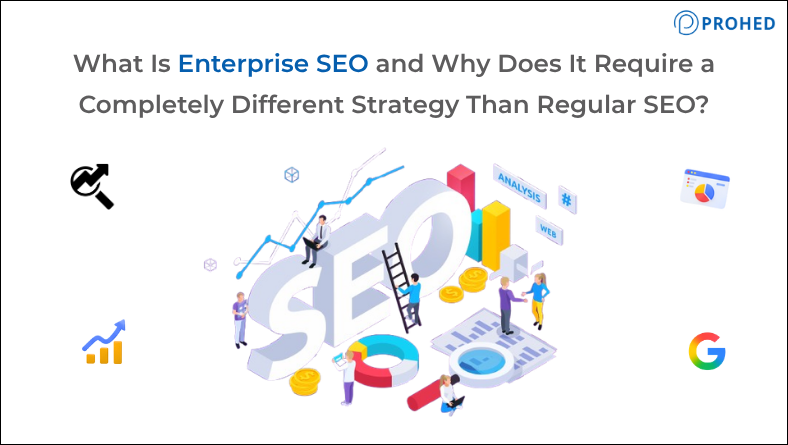
Enterprise SEO is search engine optimization managed at scale, across large websites with thousands or hundreds of thousands of pages, multiple product lines, regional or international markets, and internal teams that all have a say in how the site is run.
That last part matters more than most people expect. It’s not just about page count. A mid-sized company with 500 pages and a single decision-maker can move faster and more effectively than a large enterprise with 50,000 pages and six departments who need to sign off before anything goes live.
But the definition only tells half the story. The real difference between enterprise SEO and regular SEO isn’t just the size of the website. It’s the complexity of everything surrounding it.
Think about what a typical SEO campaign looks like for a small or mid-sized business:
- One website, one team, relatively fast decision-making
- A handful of target keywords and a manageable content calendar
- Changes to the site can be made and tested within days
Now scale that up. A large enterprise might have:
- Multiple websites across different regions and languages
- Thousands of product or service pages being updated constantly
- Development cycles that take weeks or months to implement a single SEO change
- Legal, compliance, and brand teams reviewing every piece of content before it goes live
The strategy, tools, processes, and team structures required to manage SEO at that level are fundamentally different from what traditional SEO demands. That’s not an opinion, it’s just math.
Where Regular SEO Ends and Enterprise SEO Begins
A lot of companies figure out they’ve crossed into enterprise SEO territory the hard way. Things that used to work stop working. Rankings drop across entire categories of pages. A technical issue on one template quietly breaks thousands of URLs simultaneously, and nobody catches it for weeks.
Here’s how the two approaches genuinely differ:
Scale of Technical SEO
In a standard SEO setup, fixing a technical glitch is a Tuesday afternoon task, you update a plugin, tweak a page, and you’re done. But in the enterprise world, that same “glitch” is likely hard-coded into a template used by 50,000 different pages. You don’t just “fix” it. You have to open a developer ticket, fight for prioritization in the next sprint, pass through QA, and then cross your fingers during a staged rollout to ensure you haven’t accidentally taken down the whole site.
At this level, the headaches are just bigger:
- Crawl Budget Burn: Google isn’t going to hang out on your site all day. It has a limit. If your site is cluttered with thin, duplicate, or useless URLs, the crawlers waste their energy there and never even reach your high-value pages. Usually, nobody even realizes there’s a problem until an entire category of rankings starts to tank.
- Architectural Mess: Large sites grow like old houses, add a product line here, a new category there, and suddenly your internal linking is a disaster. What was once a clean hierarchy becomes a labyrinth that confuses both your customers and Google.
- The Duplicate Content Trap: This snowballs fast. Between filtered URLs, pagination, and location pages, you can end up with thousands of identical pages fighting each other for the same spot in search results because someone forgot a canonical tag.
Content at Scale
Managing content for a large enterprise isn’t really a content problem. It’s a coordination problem.
Think about what’s actually involved: hundreds of contributors across different teams and markets, each with slightly different interpretations of the brand voice. Thousands of existing pages that need to stay accurate and relevant as products change. New pages being created constantly, often without any SEO input until after they’re already live.
Done without structure, this turns into chaos fast. Done well, it becomes one of the biggest organic traffic advantages a large brand can have. The shift at enterprise level tends to move in a few specific directions:
- Content Governance: This is about building a “north star” for your team. Instead of fixing bad content after it’s live, you bake SEO and brand standards directly into the creation process.
- Smart Programmatic Scaling: You don’t write 500 location pages from scratch. You use intelligent templates to roll out service-area or product variation pages at scale, cutting out the endless cycle of individual briefs and approvals.
- Schema for Machines: We use structured data to give search engines a “cheat sheet” for your site. Instead of letting Google guess what your content is about, we give it clear, machine-readable signals.
- Aggressive Auditing: We constantly hunt for “zombie content” pages that are outdated, cannibalizing your better work, or stuck on page three of Google when they should be at the top.
Authority and Link Building
Building backlinks for a small business is relatively straightforward. For an enterprise, the challenge shifts. The domain typically already has strong authority, so the work becomes protecting it, distributing it effectively across internal pages, and building links at a scale and speed that matches the site’s size.
Internal linking strategy, in particular, becomes enormously important at the enterprise level. A strong page buried five clicks deep from the homepage might as well not exist. Getting link equity flowing to the right pages, at scale, across a complex architecture, is one of the things that separates a good enterprise SEO agency from one that’s just applying small-business tactics to a large site.
Also Read: 5 Best SEO Agency in Gurgaon Options for Scaling Your Business in 2026
The Stakeholder Problem Nobody Talks About Enough
Here’s something that rarely makes it into enterprise SEO guides but is one of the biggest practical challenges: getting things done inside a large organization is genuinely hard.
An SEO recommendation at a small company might be implemented the same week it’s made. At an enterprise, that same recommendation might go through a marketing review, a legal review, a UX review, and three rounds of developer prioritization before it sees the light of day, if it ever does.
This is why enterprise SEO services aren’t just about technical expertise. They’re about:
- Stakeholder communication – translating SEO priorities into business impact language that gets buy-in from leadership
- Process building – creating systems so that SEO considerations are baked into content workflows, site launches, and product updates from the start
- Cross-team collaboration – working alongside developers, designers, product managers, and legal teams without creating bottlenecks or friction
An enterprise SEO agency that doesn’t understand organizational dynamics will produce brilliant recommendations that never get implemented. And unimplemented recommendations drive exactly zero results.
Tools and Measurement Are a Different World Too
If you try to run a 500,000-page site through a standard keyword tracker, it’s going to crash. Standard tools are great for SMBs, but they aren’t built for the sheer data volume of a global brand.
At this level, you’re looking at platforms like Botify, Conductor, or the high-end enterprise tiers of Semrush. These aren’t just “more expensive” versions of the basic tools; they are built for massive crawl budgets and cross-team collaboration. They let you monitor Core Web Vitals across fifty different page templates simultaneously, something that’s impossible to do manually.
Measurement frameworks also need to be rethought. At an enterprise level, tracking “keyword rankings” as the primary success metric misses most of what actually matters. Instead, enterprise SEO solutions tend to focus on:
- Organic traffic by segment – how different site sections and page types are performing, not just the site as a whole
- Crawl coverage and indexation rates – what percentage of important pages are actually being indexed
- Content performance over time – which pages are gaining or losing organic visibility across quarters
- Revenue attribution from organic – tying SEO performance directly to business outcomes, not just traffic numbers
Why Prohed Approaches Enterprise SEO Differently
Most agencies that claim to offer enterprise SEO services are applying the same playbook they use for smaller clients, just with a bigger invoice. The deliverables look similar. The reporting looks similar. The results, unfortunately, also tend to look similar, which is to say, underwhelming for the scale of the challenge.
At Prohed, the approach to enterprise-level SEO is built around a few things that most agencies skip:
Connected to performance, not isolated from it
SEO at Prohed isn’t treated as a standalone channel. It’s mapped against paid search campaigns, content strategy, and conversion data, so organic and paid are working toward the same business goals, not competing for credit.
Real-time visibility, not monthly PDFs
Enterprise clients get access to a live dashboard where organic performance, crawl health, and content metrics are visible at any point. When something breaks across a template, and at enterprise scale, things do break, it gets caught fast, not discovered three weeks later in a report.
Stakeholder-ready communication
SEO recommendations are presented in terms that resonate with business leadership, traffic impact, revenue potential, competitive positioning, not just technical checklists that get deprioritized in the next sprint.
Beyond SEO, Prohed’s service mix covers Performance Marketing, Search Engine Marketing (SEM), Social Media Marketing, B2B and B2C Lead Generation, E-commerce Marketing, and App Install campaigns, all built to work together rather than in silos.
Is Enterprise SEO Right for Your Business?
Not every growing company needs enterprise SEO solutions right away. But there are a few clear signals that the standard approach has stopped being enough:
- Your website has more than 10,000 pages and technical issues are multiplying faster than they’re being fixed
- Rankings are inconsistent across different site sections with no clear explanation
- SEO recommendations regularly get deprioritized by development or product teams
- You’re operating in multiple markets or languages and organic performance varies wildly between them
- Competitor sites are outranking you despite weaker backlink profiles, which often points to superior technical infrastructure
If any of those sound familiar, the issue probably isn’t the quality of your keywords or content. It’s the system around how SEO is being managed.
Wrapping Up
Enterprise SEO and regular SEO share the same underlying principles, relevance, authority, technical health, user experience. But the execution, the tools, the team structures, and the organizational dynamics involved are genuinely different at scale.
Getting it right requires more than a bigger budget applied to the same approach. It requires a strategy built specifically for the complexity, the pace, and the internal realities of a large organization.
If you’re looking for an SEO Agency in India that understands enterprise-level search strategy, and can connect it to paid performance, content, and lead generation, Prohed is a conversation worth having. Book a free strategy session and let’s look at what’s actually holding your organic growth back.
Frequently Asked Questions
1. When do I actually need Enterprise SEO?
There’s no magic number, but if you’ve passed 10,000 pages or have multiple teams touching the website, your old “manual” processes are likely already breaking.
2. How long until I see a return?
Expect a 6 to 12-month horizon. Between long developer sprint cycles and the sheer time it takes Google to re-crawl a massive site, organic growth at this scale is a slow-turning ship.
3. What is the #1 mistake companies make?
Thinking that what worked for their small site will work here. Standard tactics like manual link outreach or aggressive keyword stuffing backfire spectacularly when you try to apply them across a million URLs.
4. Does this help my paid ads (SEM)?
Absolutely. Your paid data tells you which keywords actually convert, which saves the SEO team months of guesswork. Conversely, strong organic rankings can lower your overall ad spend by picking up high-intent traffic for “free.”
Schedule a Free Strategy Call with PROHED Today
Schedule a Free Strategy Call with PROHED Today