Ranking on Google used to be about having the right keywords on the right page. That logic still holds to some extent. But in 2026, the brands consistently sitting at the top of search results, and getting cited inside ChatGPT, Perplexity, and Google’s AI Overviews, are not just optimising individual pages. They are building something bigger.
That something is topical authority in SEO.
It is the difference between a brand that ranks for a few competitive keywords and a brand that owns an entire subject in the eyes of search engines, AI systems, and the people searching within it. One approach produces occasional rankings. The other produces compounding organic visibility that becomes genuinely hard for competitors to displace.
This guide covers exactly what topical authority is, why it matters more in 2026 than at any previous point, and how to build it systematically for your brand or your clients.
What Is Topical Authority in SEO?
Think of this as Google’s way of deciding if you’re a trusted expert or just someone who occasionally chimes in. Rather than judging pages in isolation, search engines look at your entire domain to see if you’ve covered a subject with real breadth and depth.
It’s like asking for medical advice: you’d trust a practicing doctor more than a friend who just reads health blogs. Search engines use the same logic. By publishing a cluster of deeply interlinked articles covering every angle of a subject, you prove you truly understand the field, rather than just chasing a few high-volume keywords.
Google’s Search Quality Evaluator Guidelines assess this through E-E-A-T (Experience, Expertise, Authoritativeness, and Trustworthiness). You bake these signals into your site by consistently expanding your coverage over time. Crucially, you earn this reputation at the site level, one great article won’t cut it, but a solid network of them will..
Topical Authority vs Domain Authority
People mix these two up constantly, and that confusion often sends SEO budgets down the wrong path. Here is the distinction that actually matters:
- Domain Authority (The “Outside” Metric): This is a score from third-party tools like Moz or Ahrefs that estimates your ranking power based mostly on your backlinks. While it’s a helpful benchmark, it’s an “outside guess” Google doesn’t actually use DA as a ranking factor. You can have a high DA and still fail to rank for specific topics if your content is thin
- Topical Authority (The “Actual” Ranking Factor): This is your brand’s real-world expertise in action. Google evaluates your credibility by looking at how your pages connect and how much genuine insight exists across a subject. A brand with fewer backlinks but high topical authority, meaning incredibly thorough, interlinked niche content, can absolutely outrank a giant competitor with a much higher DA score
Brands that focus solely on link-building while ignoring content structure usually hit a ceiling. On the flip side, brands that prioritize comprehensive coverage see their rankings climb across entire categories. If your budget is tight, focus on depth first, it’s the most effective way to break into competitive spaces and build a moat around your brand.
Why Topical Authority Matters More in 2026 Than Ever Before
Several shifts in how Google and AI systems evaluate content have made topical authority more important than at any previous point.
Google’s Helpful Content System Rewards Depth
After several “Helpful Content” updates over the last few years, Google has made its stance pretty clear. The days of ranking with thin, keyword-stuffed articles are essentially over.
According to Semrush’s “State of Search 2024” report (semrush.com/research), websites with well-structured topical coverage saw 27% stronger ranking resilience during the August 2024 Google core update compared to sites relying on thin, disconnected content. Meanwhile, Google’s own Search Quality Evaluator Guidelines, publicly available at google.com/search/howsearchworks/how-search-works/rigorous-testing, explicitly state that E-E-A-T signals are a core factor in how content quality is assessed. Sites that built genuine topical depth held their ground. Sites that did not kept getting hit.
The pattern has been consistent across every major update since. Sites that genuinely own their topic tend to survive and recover. Sites that are chasing keywords without building real depth keep getting caught out.
AI Search Systems Cite Authoritative Sources
ChatGPT, Perplexity, and Google’s AI Overviews do not generate answers from nothing. They draw from the web’s most credible, well-indexed, frequently cited content. Brands with genuine topical authority in their space are significantly more likely to be cited in AI-generated answers than brands with isolated, disconnected content, regardless of how well any individual page ranks.
This connection between topical authority and LLM citations is one of the most important reasons to invest in building it now rather than waiting. The brands establishing comprehensive topical coverage today are building the kind of credibility that AI systems will draw from for the next several years.
According to BrightEdge’s 2024 AI Search Research report, brands with established topical authority in their subject area appeared in Google AI Overviews at a rate approximately 3x higher than brands with comparable domain authority but thinner topical coverage. The research, available at brightedge.com/research-reports, tracked AI Overview appearances across 10,000 keywords and found content depth to be the single strongest predictor of AI citation frequency.
Google’s algorithm has consistently rewarded topical depth across every major core update since 2022. Sites demonstrating comprehensive subject coverage with clear internal linking structures have gained ground in rankings. Sites relying on isolated keyword targeting without a coherent topic architecture have consistently lost it. This pattern has been so reliable that SEO professionals now treat topical depth as one of the most “algorithm-proof” investments available.
Sites demonstrating comprehensive subject coverage, with clear internal linking structures and genuinely expert content, have gained ground. Sites relying on isolated keyword targeting without a coherent topic architecture have consistently lost it.
The Topic Cluster Framework: How Topical Authority Is Actually Built
A topic cluster is not complicated once you see it laid out. It has three parts that work together.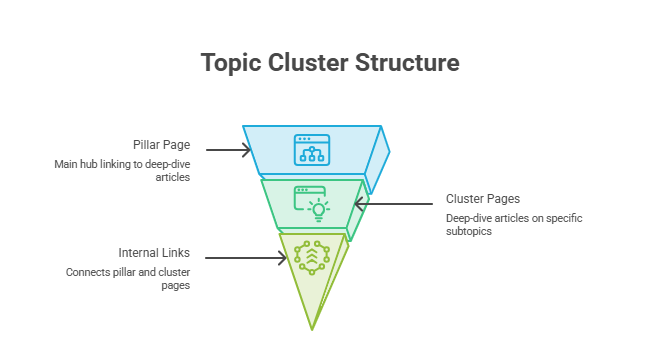
- The pillar page is the main hub. It covers a broad topic at a high level, links out to all the related deep-dive articles sitting underneath it, and acts as the most authoritative page on that subject on your entire site.
- Cluster pages are those deeper articles. Each one focuses on a specific subtopic related to the main pillar subject. Every cluster page links back to the pillar, and the pillar links out to each of them in return.
- Internal links are what hold the whole thing together. They show Google how your content relates to each other, which pages carry the most weight on which subjects, and that your site has genuine, connected depth on the topic rather than a bunch of isolated articles pointing nowhere.
When this structure is built properly across a subject, the message to Google is clear. This site has covered this topic seriously, from multiple angles, with real substance behind it. That is how topical authority gets built over time.
A Practical Example
A D2C skincare brand building topical authority around “skincare for Indian skin” might structure it like this:
Pillar page: The Complete Guide to Skincare for Indian Skin
Cluster pages:
- Best moisturizers for Indian skin types
- How humidity affects skincare routines in India
- Hyperpigmentation treatment for Indian skin tones
- Sunscreen guide for Indian climate conditions
- Common skincare mistakes Indian women make
- How to build a skincare routine on a budget in India
- Ingredients to avoid for sensitive Indian skin
Each cluster page links back to the pillar. The pillar links out to each cluster. Over time, as this content network earns traffic, engagement, and backlinks, Google’s understanding of this brand as a credible authority on skincare for Indian skin deepens, and rankings improve across the entire cluster, not just on individual target keywords.
The Content Audit Step Most Brands Skip
Before building new topic clusters, it is worth doing something most brands skip entirely: auditing what already exists on the site.
Many brands discover during an audit that they already have content covering parts of a topic, but that content is disconnected, inconsistently interlinked, and not structured around any coherent cluster architecture. Strengthening and connecting existing content is often faster and more impactful than producing entirely new content.
A practical content audit for topical authority involves four things:
- Mapping existing content to topic clusters: Which articles you have already published fit naturally into which cluster? What gaps are immediately visible?
- Identifying cannibalisation: Are multiple pages targeting the same or very similar keywords? Cannibalising pages split ranking signals and weaken both. Consolidating or redirecting them often produces a meaningful ranking improvement.
- Assessing content depth: Does each existing article genuinely cover its subtopic thoroughly, or does it skim the surface? Thin cluster pages weaken the overall topical signal even when the pillar page is strong.
- Auditing internal links: Are existing related articles linked to each other in a way that makes the topic relationship clear? Most sites have significant internal linking gaps that are straightforward to fix once identified.
A strong SEO content strategy always starts with understanding what exists before deciding what to create.
Building Your Topic Cluster: A Step-by-Step Process
Once the audit is complete, building a topic cluster follows a consistent sequence regardless of industry or niche.
Step 1: Pick Your Core Topics Carefully
Not every topic is worth going deep on. The sweet spot sits where three things overlap: what your audience actually searches for, what your brand genuinely knows well, and where ranking is realistic given your current site strength.
Starting with two or three tightly focused topics and going deep on each one will almost always produce better results than spreading thin content across ten topics at once. Depth first, then breadth. That is the order that works.
Step 2: Map Out All the Subtopics
For each core topic, think about every angle a genuinely curious person might want to explore. Google’s “People Also Ask” boxes, keyword tools, and competitor gap analysis are all useful for surfacing subtopics you might not have thought of.
A simple test for each potential cluster page: if someone searched specifically for this subtopic, would they find this article genuinely helpful, or would they need to keep looking? If the answer is the second one, that is a gap worth filling.
Step 3: Write the Pillar Page First
The pillar page sets the whole framework. It should cover the core topic broadly, signal which subtopics get deeper treatment in separate articles, and be genuinely useful even as a standalone piece. For brands already managing large sites with enterprise SEO services, a pillar page often already exists in some form and just needs restructuring to align with a proper cluster architecture.
Step 4: Publish Cluster Pages Consistently Over Time
Dropping all your cluster articles at once is less effective than publishing them steadily over several weeks or months. Regular publishing tells Google your site is an actively maintained resource on the subject rather than a one-time content push.
Each cluster page should go deep on its specific angle, link back to the pillar naturally, and connect to other cluster pages where it genuinely makes sense. Forcing internal links for the sake of it creates a messy structure that confuses more than it helps. For brands scaling cluster content at volume, programmatic SEO can speed up production without sacrificing quality on individual pages.
Step 5: Build External Authority Around the Topic
The internal architecture gives you the structure. External signals are what validate the authority in Google’s eyes. Earning backlinks from credible, relevant sites within your topic space tells Google other people in that space consider your content worth citing.
Digital PR, guest contributions to relevant publications, and appearing in industry roundups all help here. For local brands, citations in regional media and local SEO signals work alongside the broader topic authority build.