When leads stop converting, your pipeline has a leak. While lead generation gets the credit, breakdowns usually happen in nurturing, timing, or qualification. At Prohed, a Gurgaon-based performance marketing agency, we’ve diagnosed this consistent pattern across D2C, EdTech, real estate, and healthcare brands.
You’re generating leads. The campaigns are running. The forms are being filled. And yet, somehow, the revenue isn’t following. The sales team says the leads are cold. Marketing says the leads are qualified. And both teams end up pointing fingers at each other while the pipeline quietly stalls.
Here’s the thing, most of the time, neither team is entirely wrong. The problem isn’t the volume of leads. It’s what happens to them after they come in.
At Prohed, a performance marketing agency in Gurgaon, we’ve seen this conversion gap play out across D2C brands, EdTech platforms, and high-ticket service categories throughout 2025-26. Across clients where lead-to-sale conversion was the primary goal, the fix was rarely about generating more business leads. Almost always, it was about understanding exactly where in the journey the existing leads were dropping off, and fixing that specific stage.
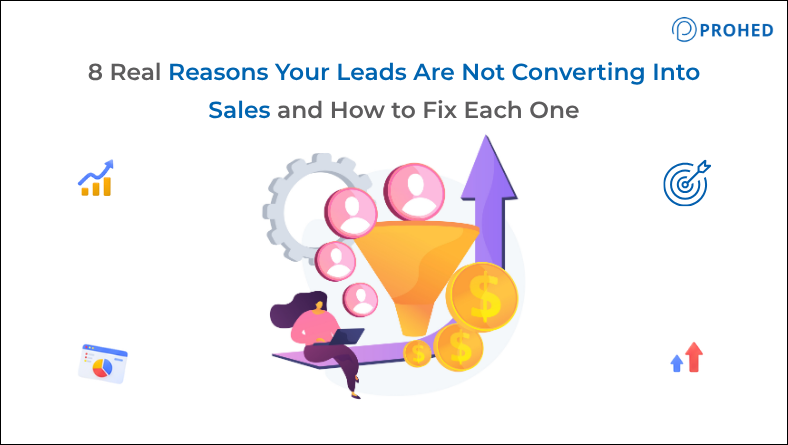
Here are the eight most common reasons leads stop converting, and what to actually do about each one.
1. Your Lead Qualification Is Happening Too Late
The most common conversion problem isn’t a sales problem. It’s a qualification problem disguised as one.
When you build the top of your funnel around sheer volume, using broad audiences, low-friction forms, and generic CTAs, you attract leads that vary wildly in intent, budget, and timing. Sales leads that look strong on paper turn out to be early-stage researchers, price-sensitive browsers, or people who filled in a form without really understanding what they were enquiring about.
The fix is to move qualification upstream. Build intent signals into the lead capture itself. Ask one or two qualifying questions in the form. Use landing pages that filter by specificity, someone who reads a detailed product page before converting is a very different lead from someone who clicked a broad awareness ad.
Furthermore, consider scoring your marketing leads before they reach the sales team. A lead who has visited three pages, downloaded a guide, and clicked a pricing CTA is significantly warmer than one who filled a form after a single ad impression. Both count as leads in the dashboard. Only one is genuinely sales-ready.
2. The Follow-Up Is Too Slow
Speed matters more than most brands realise. Research consistently shows that the probability of connecting with a lead drops dramatically after the first five minutes following a form fill. By the time someone from the sales team calls two days later, the prospect has moved on, researched competitors, or simply lost the urgency they had when they first raised their hand.
This is especially true in high-consideration categories like EdTech, real estate, and healthcare, where the buyer’s intent window is narrow. Additionally, in India specifically, WhatsApp follow-up converts significantly better than email for most B2C categories. A lead that doesn’t open an email will often respond to a WhatsApp message within minutes.
The fix here is structural. Build an automated first-touch response that goes out within five minutes of a form fill, even just a confirmation and a WhatsApp message that opens a conversation. Then route the lead to a salesperson within the hour. The goal is to catch the prospect while their intent is still live.
3. The Sales Team and Marketing Team Are Working From Different Definitions
If your marketing team says “anyone who fills in the form is a marketing qualified lead,” and your sales says “a good sales lead is someone who is ready to buy in the next 30 days with the right budget,” you’re not speaking the same language. As a result, marketing keeps passing along the kind of leads that sales has a hard time working, and sales keeps grumbling about the quality while your pipeline remains largely untouched.
The cure is a shared definition of a qualified lead that both teams commit to before any campaign launches. What signals make a lead? What information needs to be captured before the lead can be passed to sales? How long does the sales team have to response once a qualified lead comes in? You may find the answer to these quesions simple, but it must be written down and followed.
4. Your Nurture Sequence Is Either Missing or Generic
Not every lead is ready to make a purchase as soon as they convert. Most of the leads you find in any pipeline are in a consideration stage: they know they have a problem, they’ve identified your brand as the potential solution, but they haven’t made a decision yet. Without structured nurture content, these leads will go cold.
The cure is to create specific lead nurture content based on the stage each lead is in of the buyer’s journey. An early-stage lead who filled in a form after reading a blog post needs educational content to build trust and answer questions. A warm lead who’s requested pricing needs proof, case studies, testimonials, specific results.
And in D2C clients we manage at Prohed, lead nurture sequences that are segmented by intent stage consistently outperform the single-sequence approach of “use one email for all leads.” Even a generic three-email sequence around the specific reason the lead came in converts drastically better than a generic newsletter drip.
5. The Offer Doesn’t Match What the Lead Actually Wants
Sometimes the issue isn’t the lead quality or the follow-up speed. Sometimes the offer being presented in the sales conversation doesn’t match what the creative ads communicated in the first place.
If a lead came in because they saw an ad about solving a specific problem, say, reducing return rates for a D2C brand, and the sales conversation opens with a general agency pitch, the disconnect is immediate. The lead signed up for one conversation and is being given a different one. Trust erodes quickly in that gap.
The fix is message consistency across the entire journey. The promise in the ad should match the landing page. The landing page should match the lead capture form. The form confirmation should match the first sales conversation. This alignment is sometimes called “message match,” and it’s one of the highest-leverage fixes available for improving lead-to-sale conversion without spending more on acquisition.
6. Your Digital Marketing Leads Are Coming From the Wrong Channels
Not all channels generate leads with equal conversion intent. Digital marketing leads from Google Search, where someone has actively typed a query, tend to convert at significantly higher rates than leads from broad Meta awareness campaigns, where someone passively scrolled into your funnel.
This doesn’t mean Meta is wrong for lead generation, it’s powerful at building pipeline volume and warming audiences. However, it does mean that the conversion expectation, the follow-up sequence, and the sales approach should be different depending on where a lead originated.
A lead from a “lab grown diamond jewellery Gurugram” Google Search query is expressing high intent in a very specific moment. A lead from a broad Instagram ad shown to women aged 25-40 interested in jewellery is at a much earlier stage of consideration. Treating them identically in the CRM is one of the most common reasons sales teams report that “digital marketing leads don’t convert.”
The fix is channel-level lead tagging in your CRM. Know where every lead came from, and build different nurture paths and sales scripts for different source types.
Related read: How a D2C brand went from near-invisible online to ranking on page one for high-intent local searches
7. The Lead Volume Is There but the Lead Value Isn’t Being Tracked
This is a measurement problem that becomes a strategy problem over time.
Most teams track cost per lead as the primary metric for how to generate leads for business efficiently. However, cost per lead tells you nothing about lead quality. A ₹150 lead that never converts costs infinitely more than a ₹600 lead that closes a ₹50,000 deal.
When lead value isn’t being tracked downstream, that is, when the CRM data on conversion rate and deal size isn’t being fed back to the media team, campaigns keep optimising for volume at the expense of quality. Consequently, the agency reports strong CPL numbers, sales reports poor conversion rates, and nobody connects the two because they’re looking at different systems.
Closed-loop reporting fixes this problem. By funneling revenue data from your CRM back to your campaign management system, you can optimize campaigns toward leads that actually close rather than leads that merely fill out a form. This is precisely what Prohed’s ad account audit and consultation process is built to identify and fix.
8. You’re Trying to Generate Sales Leads Without a Clear Customer Journey
This is the root cause behind many of the other seven problems.
When a brand’s approach to lead generation is essentially “run ads, capture forms, call leads,” there’s no designed journey for the prospect to move through. They’re either ready to buy and convert, or they’re not ready and they drop. There’s no infrastructure to catch, warm, and advance the leads that are genuinely interested but not yet decided.
Building a real customer journey means mapping what a prospect experiences at every stage, from the first ad impression, through the lead capture, through the nurture sequence, to the sales conversation, to the close. Each stage should have a specific goal, specific content, and specific signals that tell you whether the prospect is advancing or dropping.
How to Fix Your Conversion Problem Without Rebuilding Everything
The good news is that fixing a conversion problem rarely requires starting over. In most cases, two or three targeted interventions make the biggest difference.
Start by identifying where in the journey your leads are actually dropping. Is it at the first follow-up call? After the first email? After the pricing conversation? The drop-off point tells you what to fix first.
Then look at your lead source data. Are the leads coming from high-intent search queries or from broad awareness campaigns? Is your sales team equipped with different scripts for different lead types?
Finally, build even a simple nurture sequence for leads that don’t convert immediately. A three-touch sequence, problem acknowledgment, proof of results, and a specific offer, can recover a significant percentage of leads that would otherwise go cold.
Related read: What Is MER and Why Every D2C Brand Needs to Track Marketing Efficiency
Where Prohed Comes In
At Prohed, we don’t just run campaigns to generate leads. We build the full acquisition and conversion system, from the first ad impression to the closed deal.
That means your B2C lead generation campaigns are built with qualification logic at the top of the funnel. Your Search Engine Marketing is structured to capture high-intent queries. Your Social Media Marketing is building audiences that are warmed before they’re asked to convert. And your SEO is creating the organic trust signals that make every paid lead more likely to close.
If your pipeline has volume but the revenue isn’t following, that’s exactly the problem Prohed is built to diagnose and fix. Among the top lead generation companies in India, Prohed’s approach consistently separates itself by treating conversion rate as a campaign metric from day one, not an afterthought once the leads are already in the CRM.
Frequently Asked Questions
1. Why are my leads not converting?
Leads often fail to convert for a few major reasons: teams follow up too slowly, marketing brings underqualified leads into the top of the funnel, sales conversations fail to match the value promised in the ads, and companies neglect to nurture leads who aren’t ready to buy right away. That’s why most conversion issues are solvable without creating more leads and why you need to find a way to solve the problem with your existing leads.
2. What is a marketing qualified lead?
Depends on your business, but a marketing qualified lead is a prospect who’s displayed enough intent signals that they’re ready for sales to do the heavy lifting. Marketing and sales usually come to an agreement on a definition before campaign launches that includes any combination of pages visited, content they downloaded, source of the lead, and their answers to qualifying questions asked in the lead capture form.
3. How can you get sales leads that really convert?
To generate sales leads with higher conversion rates, you need intent-first targeting. You reach people who are already in a decision-making mode, not just anyone who could potentially be interested in the master upcoming for a long time. Google Search campaigns capture active intent. Meta campaigns with mid-funnel content warm passive audiences before they’re asked to convert. Taken together, with channel-appropriate nurture paths they regularly outpace either channel on its own.
4. How long should lead nurturing take?
It varies per category and the average sales cycle. For D2C products between three and seven day nurture is enough time. For higher-ticket categories such as real estate, EdTech, or premium services a nurture sequence of 2-4 weeks, using touchpoints such as WhatsApp, email, and retargeting ad is appropriate. The key signal to monitor is engagement, not time.
5. How does a marketing lead differ from a sales lead?
A marketing lead is any prospect captured via a marketing campaign, regardless of their intent level or buying readiness. A sales lead is a prospect that has been qualified against a set of criteria, budget, intent, timing, and is ready for a sales conversation. Getting the marketing lead to the sales lead is what the nurture sequence is designed to handle.
6. Why do digital marketing leads convert at lower rates than referrals?
Referral leads have social proof and inherent trust built into the funnel. They’ve heard about the brand through a social connection, so their baseline confidence isn’t as low. Digital marketing leads often have to be warmed up using content, proof, and explicit and repetitive communication before they can get to the same level of readiness. The solution is to incorporate that trust aspect into the nurture sequence.
7. How do you fix a lead generation funnel that has volume but low conversion?
Start by identifying the specific drop-off point, where in the journey are leads going cold? Then look at the message consistency between your ads and your sales conversations. Add a qualifying layer at lead capture. Build a segmented nurture sequence. And make sure your CRM data on conversion rates is feeding back to your campaign optimisation so that future campaigns are optimising toward quality, not just volume.
8. What role does speed of follow-up play in lead conversion?
It plays a very significant role. Studies consistently show that lead conversion rates drop sharply after the first hour following a form fill, and even more so after 24 hours. In India’s B2C context, WhatsApp-based first-touch responses within five minutes of lead capture are among the highest-leverage interventions available for improving conversion rates without any change to targeting or creative.
9. How does Prohed approach the lead conversion problem?
Prohed builds the full acquisition and conversion system, not just the ad campaigns. That includes qualification logic at the top of the funnel, channel-specific nurture sequences, closed-loop reporting that feeds CRM conversion data back to campaign optimisation, and an ad account audit process that identifies exactly where in the funnel leads are dropping. The goal is always revenue, not just pipeline volume.
10. What is closed-loop reporting and why does it matter for lead generation?
Through closed-loop reporting, systems feed data on converted customers back to marketing and campaign teams. This data allows teams to optimize future campaigns toward leads that close rather than leads that merely fill out forms. Without it, campaigns keep optimising for CPL while conversion rate stays low. With it, the quality of leads improves over time because the system learns what a real buyer looks like before they convert.
Schedule a Free Strategy Call with PROHED Today