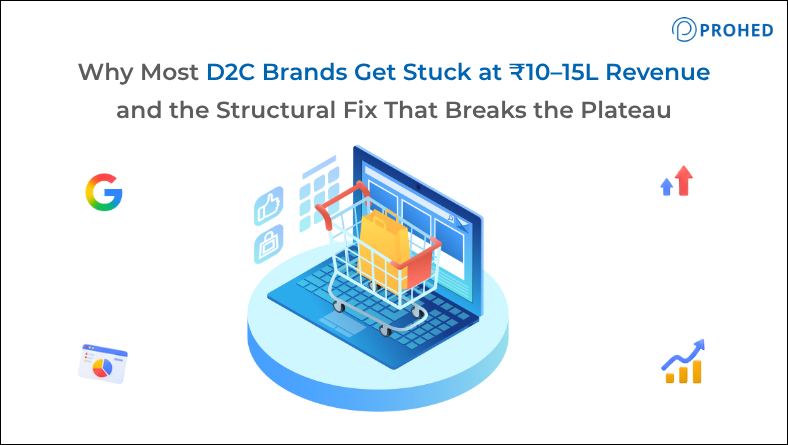
What is the ₹10–15L revenue plateau in D2C? It’s the growth ceiling that most direct-to-consumer brands in India hit after their initial traction phase, a point where the same strategies that drove early revenue stop working, and simply spending more on ads no longer moves the needle. At Prohed, a performance marketing agency in Gurgaon, this is one of the most common patterns seen across D2C brands India-wide, and it’s almost never a product problem. It’s a structural one.
Getting a D2C brand to ₹10 lakhs a month feels like a win. And honestly, it is. It means the product works, the market exists, and someone figured out how to reach early buyers. That’s genuinely hard, and most brands never even get there.
But then something strange happens. The brand keeps spending. The ads keep running. The team keeps working. And the revenue just stops growing. Some months it ticks up to ₹12L. Some months it slips back to ₹9L. The ceiling feels real, even if no one can quite explain why it’s there.
At Prohed, we see this all the time with Indian D2C brands trying to scale up. When a brand gets stuck at ₹10–15L, the problem is simple: what got them here won’t get them there. Instead of trying something new for the next level, they just keep doing the same old things, only harder. And it completely stops their growth.
Here’s what’s really happening, and more importantly, how to fix it.
Why the ₹10–15L Ceiling Exists in the First Place
The early phase of D2C growth is largely a targeting and product-market fit game. You find an audience, you find a message that resonates, you run ads, and you sell. At low volumes, this works well because your warm audience is fresh, your creative is new, and the economics are forgiving enough to allow some inefficiency.
However, as you approach consistent ₹10–15L monthly revenue, several things start happening at the same time. Your warm audience begins to saturate. Because you’ve already captured the easiest buyers, customer acquisition costs start creeping up. Suddenly, the repeat purchase rate becomes critical to unit economics, but most brands at this stage haven’t built the infrastructure to drive it.
Furthermore, the brand strategy that worked at initial scale, essentially “target, convert, repeat” starts breaking down. It was never designed for retention, for building brand awareness strategy across channels, or for diversifying beyond a single acquisition platform. The result is a revenue band that feels like a plateau but is actually a structural ceiling.
The fix is not to spend more. The fix is to build differently.
The 5 Structural Shifts That Break the Plateau
Shift 1: Move From Acquisition-Only to a Full-Funnel Brand Strategy
What’s happening: Most D2C brands at the ₹10–15L stage are running what is functionally a one-step funnel. Someone sees an ad, clicks, and either buys or doesn’t. There’s no mid-funnel engagement, no brand awareness strategy building consideration over time, and no retargeting sequence designed to close undecided buyers.
The fix: Build all three funnel layers intentionally.
Top of funnel content builds brand recall and expands the pool of potential buyers beyond your current warm audience. Mid-funnel content, comparison guides, product education, testimonials, advances consideration for people who are interested but not yet convinced. Bottom-funnel retargeting then closes buyers who showed intent but didn’t convert on the first visit.
Additionally, this is where brand marketing starts paying compound returns. A buyer who has seen your brand across multiple touchpoints before clicking an ad converts at a meaningfully higher rate than someone seeing you for the first time. Over time, that improved conversion rate lowers your effective customer acquisition cost without any change to your targeting spend.
Shift 2: Build a Retention Engine Alongside Acquisition
What’s happening: At ₹10–15L monthly revenue, most D2C brands are spending almost everything on acquiring new customers and almost nothing on retaining them. This is understandable in the early phase. However, it becomes the single biggest structural drag on d2c strategy at this stage.
The math is simple. If your average order value is ₹800 and you’re acquiring customers at ₹500 each, the first purchase barely breaks even. The second purchase from the same customer is nearly pure margin. Therefore, a brand with a 30% repeat purchase rate is fundamentally more profitable than one with a 10% rate at the same revenue number, and has significantly more capital available to reinvest in growth.
The fix: Build retention infrastructure in parallel with paid acquisition.
That means a structured WhatsApp and email post-purchase sequence that brings customers back before they forget you. It means a loyalty or reorder incentive that makes the second purchase feel like an obvious next step. It also means paying real attention to the product experience, packaging, unboxing, and the first-use moment all drive repeat purchase decisions in ways that no ad ever can.
Gynoveda, an Ayurvedic women’s health brand managed by Prohed, is a direct example of this shift in action. The brand’s challenge was that consumer education was critical to conversion, buyers needed to trust the product deeply before committing. Prohed built a cohort-based strategy that identified specific health concerns, segmented buyers accordingly, and deployed highly personalised follow-up sequences to each segment. The result was a 5x increase in ROAS, 70% growth in web revenue, and a 60% jump in repeat orders on the same product range. Retention infrastructure, not more acquisition spend, was what moved those numbers.
Read the full Gynoveda case study here.
Shift 3: Fix the Unit Economics Before Scaling Budget
What’s happening: This is the mistake that keeps most D2C brands India-wide trapped the longest. They see their campaigns generating revenue, so they increase the budget. But the underlying unit economics, the relationship between customer acquisition cost, average order value, and lifetime value, haven’t actually been optimised. Consequently, scaling budget only scales the problem.
The fix: Get three numbers right before increasing spend.
First, your true customer acquisition cost, including creative production, agency fees, and platform spend, not just the ad spend line alone. Second, your average order value and whether it can be increased through bundling, upselling, or minimum order mechanics. Third, your repeat purchase rate and average lifetime value across the first six months of a customer’s relationship with the brand.
If those three numbers make the unit economics work, scaling budget makes sense. If they don’t, scaling will accelerate losses rather than growth. This is precisely why Marketing Efficiency Ratio matters so much at this stage, it gives a holistic view of whether overall marketing investment is efficient, rather than optimising individual channels in isolation.
Related read: What Is MER and Why Every D2C Brand Needs to Track It
Shift 4: Diversify Beyond a Single Acquisition Channel
What’s happening: Most D2C brands at the ₹10–15L stage are dependent on one channel. Usually Meta. Sometimes Google. Rarely both, and almost never with any meaningful organic or SEO contribution to the overall d2c strategy.
Single-channel dependency is a structural risk. When Meta’s algorithm changes, when CPMs spike during festival season, or when your primary audience saturates, there’s no backup. Revenue drops, and the only lever available is to cut spend and wait.
The fix: Build a second meaningful acquisition channel before you need it.
For most D2C brands, this means starting SEO and content marketing in parallel with paid campaigns, building organic traffic that gradually reduces cost-per-customer from paid channels over time. Even a modest organic contribution of 15–20% of total traffic meaningfully changes the economics of the overall acquisition model.
A D2C wellness brand managed by Prohed that had been running exclusively on Meta started building Google Search and SEO contribution simultaneously. Within two quarters, the combined channel model had reduced overall customer acquisition cost by 28% compared to the Meta-only period, not because Meta got cheaper, but because organic and search were now sharing the load.
Shift 5: Name Your Brand Strategy and Build Toward It
What’s happening: D2C brands that stay stuck in the ₹10–15L band tend to define themselves primarily by their product category and price point. They know what they sell. They’re less clear on why their specific buyer should choose them over the alternatives.
Vague positioning makes creative harder to produce, word-of-mouth less likely, and the brand more vulnerable to competitors who compete on price. Meanwhile, D2C brands India-wide that break past the ₹15L ceiling almost always have a named, clear positioning that the whole team can articulate consistently.
The fix: Get specific about three things.
Who is this brand specifically for, not “women aged 25-40” but “women in their late 20s managing hormonal health who want science-backed natural options.” What does the brand consistently communicate that competitors don’t own. And what does the brand experience feel like across every touchpoint, ads, packaging, social, and customer service.
Named positioning doesn’t require a rebrand. Often it just requires deciding what the brand stands for and making sure that decision is reflected consistently across every channel. Once that clarity exists, creative production gets faster, messaging gets sharper, and customer trust builds more quickly because the brand feels coherent rather than generic.
The Pattern That Appears Repeatedly Across Prohed’s D2C Clients
The D2C brands that break the ₹15L ceiling quickly share a few consistent characteristics.
They fix unit economics before scaling the budget, ensuring the foundation is solid. Next, retention infrastructure is built in the exact same quarter that acquisition scales up. Finally, they kick off SEO early enough so that organic traffic contributes meaningfully within six to twelve months. And they define their brand strategy clearly enough that creative production and channel strategy have a consistent direction to work from.
The brands that stay stuck, on the other hand, tend to treat each of these as a “future problem” something to address once revenue is higher. The challenge is that revenue doesn’t get higher without addressing them first. That’s the nature of the structural ceiling.
Where Prohed Fits Into This
At Prohed, the work with D2C brands India-wide is built specifically around this structural shift from early traction to sustained scaling.
That means e-commerce performance marketing built on full-funnel logic rather than single-step acquisition. It means SEO and content that builds organic contribution alongside paid performance. It means Social Media Marketing that builds brand awareness at the top of the funnel while performance campaigns close buyers at the bottom. And it means B2C lead generation structured around lead quality rather than just volume.
Prohed’s ad account audit and consultation process is specifically designed to identify the structural bottleneck in an existing account, whether that’s unit economics, creative fatigue, channel dependency, or a retention gap, and produce a prioritised fix rather than a generic recommendation.
If your D2C brand is stuck in the ₹10–15L band and you’re looking for a digital marketing agency that understands the structural reasons why, and has a clear plan to break through, Prohed is worth a conversation.
Frequently Asked Questions
Why do most D2C brands plateau at ₹10–15L monthly revenue?
The plateau happens because the growth strategy built for the ₹0–10L phase stops working at scale. Warm audiences saturate, customer acquisition costs rise, and a single-channel acquisition model without retention infrastructure hits its natural ceiling. The fix is structural, it requires changing how the brand is built, not just spending more on ads.
What is a D2C brand strategy and why does it matter at this stage?
A D2C brand strategy is the defined set of decisions about who the brand is for, what it stands for, and how it communicates consistently across every touchpoint. It matters at the ₹10–15L stage specifically because vague positioning makes creative harder to produce, word-of-mouth less likely, and the brand more vulnerable to competitor pressure on price.
How do D2C brands in India improve poor repeat purchase rates?
The most effective interventions are a structured post-purchase WhatsApp or email sequence, a meaningful reorder incentive, and real attention to the product experience itself. Packaging and first-use experience are significant drivers of repeat purchase decisions that most brands underinvest in relative to their paid acquisition spend.
When should a D2C brand start investing in SEO?
As early as possible, ideally from the ₹5–10L revenue stage. SEO and content take time to compound, so brands that start early benefit from organic traffic contributions during exactly the period when paid CAC is rising and efficiency gains from ad optimisation are slowing.
What is Marketing Efficiency Ratio and why do D2C brands need it?
Marketing Efficiency Ratio is a measure of total revenue generated relative to total marketing spend across all channels, not just one campaign or platform. It matters at the ₹10–15L stage because it gives a holistic view of whether the overall marketing investment is actually efficient, rather than optimising individual channels in isolation while missing the aggregate picture.
How does full-funnel brand marketing break the revenue plateau?
Full-funnel marketing works because it builds brand recall and consideration over time, not just at the moment of conversion intent. Buyers who have seen a brand across multiple touchpoints before clicking an ad convert at higher rates and are more likely to become repeat customers. Over time, that improved conversion efficiency lowers the effective customer acquisition cost without requiring more spend.
What are the biggest mistakes D2C brands make when trying to scale past ₹15L?
The three most common mistakes are scaling ad budget before fixing unit economics, running retention and acquisition as entirely separate functions with no integration, and remaining dependent on a single acquisition channel without building organic or second-channel contribution. Each of these can be fixed, but they need to be identified before spend is increased.
How long does it take to break the ₹10–15L plateau once structural changes are made?
It depends on the specific bottleneck and how aggressively the fixes are implemented. In Prohed’s experience across D2C clients, brands that address unit economics, retention infrastructure, and channel diversification in the same quarter typically see meaningful revenue movement within two to three months. Brands that address only one issue at a time tend to see slower progress.
Does Prohed work specifically with D2C brands at this revenue stage?
Yes. A significant portion of Prohed’s D2C client base consists of brands in the ₹8–25L monthly revenue range working through exactly this scaling challenge. The work typically involves an ad account audit to identify the primary structural bottleneck, followed by a phased plan covering paid performance, retention infrastructure, and organic channel development.
Schedule a Free Strategy Call with PROHED Today