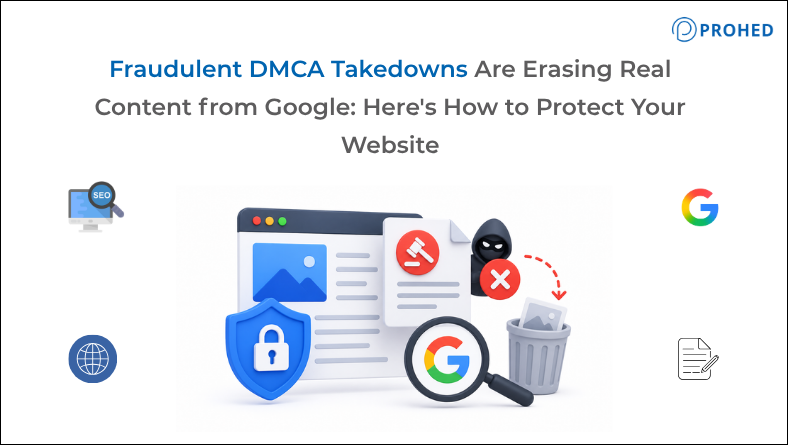
A DMCA takedown is a formal US copyright complaint instructing Google to remove specific URLs from search results. While designed to protect original creators, it is increasingly weaponized by bad actors filing fake complaints to erase competitors and manipulate rankings. As a performance marketing agency in Gurgaon, Prohed tracks these threats closely, a single fraudulent complaint can wipe out a client’s top-performing page without warning.
Imagine building a page over months. Good content, strong backlinks, solid on page SEO. It’s ranking well. It’s driving traffic and leads.
Then one morning it’s gone from Google. Not because of an algorithm update. Not because of a technical error. Because someone filed a copyright complaint claiming your original work belongs to them, and Google acted on it before verifying anything.
This isn’t a hypothetical scenario. It’s happening to publishers, D2C brands, media outlets, and independent websites right now. And the most unsettling part is how little protection currently exists between a false complaint and a live page disappearing from search results.
How the DMCA Takedown System Works, and Why It’s Being Abused
The DMCA gives copyright holders a legal mechanism to request the removal of content that infringes on their work. When a complaint is filed with Google, the system is designed to act quickly in favour of the claimant.
Google’s transparency documentation admits the company cannot always verify requests or notify site owners before removing content. Consequently, Google can delist a page based on a single, completely fabricated complaint.
The burden then shifts entirely to the site owner. They must notice the removal, file a counter-notice, and wait through a statutory 10 to 14 business day period before Google acts on the dispute. During that entire window, the page remains invisible in SEO search results.
Furthermore, making a false claim carries very few immediate consequences for the filer. Filing a complaint costs nothing. The target of a false complaint, on the other hand, faces lost traffic, lost leads, lost revenue, and the time and effort of navigating a counter-notice process they probably didn’t know existed.
That asymmetry is precisely what makes fraudulent DMCA takedowns an attractive weapon for negative SEO.
What This Looks Like as a Negative SEO Attack
The pattern of abuse isn’t new, but it’s evolving in sophistication.
Originally, competitors submitted fake takedown notices claiming rivals copied obscure sources. They often cited unrelated, unverified URLs. Google receives millions of yearly DMCA requests, according to Lumen database records. This massive volume makes individual verification practically impossible.
More recently, documented cases have shown complaints citing completely unrelated content as the supposed original source. In one widely reported instance, a complaint citing a since-deleted forum post about an entirely different topic prompted Google to remove a journalism outlet’s original investigative piece. The connection between the claimed original and the targeted page was nonexistent.
What makes these fraudulent complaints effective is not their quality. It’s their speed. A false DMCA takedown can erase a page from google search marketing results within days. A successful counter-notice restores it weeks later. For any brand investing in SEO services and content as a lead generation channel, that gap carries a direct and measurable cost.
Who Is Most at Risk
Not every website faces equal exposure to this threat. However, certain categories of content and certain business situations carry meaningfully higher risk.
- Brands that publish investigative or opinion content are vulnerable because fraudulent takedowns are frequently used to suppress inconvenient reporting or criticism. If a brand’s content challenges a competitor’s practices or surfaces information someone wants removed from search, a false DMCA complaint becomes a tool of suppression rather than a copyright protection mechanism.
- High-ranking pages on competitive commercial keywords are attractive targets for competitors who want to close a ranking gap without doing the legitimate work of building better content. A page ranking in the top three positions for a competitive keyword is a more valuable target than one sitting on page four.
- Smaller publishers and brands without a public platform face a specific disadvantage. When a large media outlet loses a page to a fraudulent complaint, they have the reach to raise the issue publicly and expedite a resolution. A small D2C brand or independent content site doesn’t. Their page can remain missing for weeks without anyone outside the business noticing.
- Agencies and content teams managing multiple client properties are at risk of having a takedown go unnoticed across a large content portfolio. A single fake complaint against one client’s best-performing blog article might not surface in a weekly performance report until traffic has already fallen noticeably.
The PROHED DMCA Risk Monitoring Framework
At PROHED, we’ve built a practical monitoring approach into our SEO strategy work for clients with significant organic content investment. The PROHED DMCA Risk Monitoring Framework covers four areas.
Area 1: Active Search Monitoring for Your Key Pages
Search your own most important headlines and page URLs regularly in Google. When a page is removed due to a DMCA complaint, Google adds a notice at the bottom of the affected results page indicating that content was removed. This notice only appears if you actively search for the affected content.
This sounds simple. However, it’s a step most site owners never take until traffic data already shows a problem. For high-value content pages, weekly spot-checks take minutes and can catch a fraudulent removal days before it shows up in Search Console data.
Area 2: Search Console Impression Monitoring at the URL Level
A sudden drop in a single URL’s impressions or clicks in Google Search Console signals an immediate problem. Broad traffic declines have multiple causes. However, a sharp, isolated drop on one URL usually indicates removal rather than ranking shifts.
Brands should set up custom alerts or regularly review page-level impression data in Search Console. It is a vital monitoring habit. As a leading Gurgaon SEO company, Prohed includes this URL-level monitoring as a standard part of client reporting.
Area 3: Lumen Database Checks for Your Domain
The Lumen database archives DMCA takedown notices and allows domain-level searches. Anyone can search for notices that reference their domain name. Running this search monthly surfaces complaints that may have been filed without your knowledge, including ones Google hasn’t yet acted on that could result in future removals.
Additionally, Lumen records show who filed the complaint, what content was cited as the claimed original, and what URL was targeted. When a complaint cites an unrelated or implausible source, that information supports a counter-notice argument.
Area 4: Timestamped Content Documentation
This is the simplest and most underused protection available. For every significant piece of content published, maintain a timestamped record of the original draft, the publication date, and ideally a public archive record through a service like the Wayback Machine.
When you fight a fraudulent complaint, the counter-notice process requires you to provide evidence of original authorship. A public archive record with a clear publication date persuades Google far better than a private internal document, which a bad actor could claim you created after the fact.
Related Read: How D2C Brands Are Building a Full-Funnel Content Strategy With AI
What to Do If a Page Is Removed
Speed matters more than anything else at this stage.
- File a counter-notice immediately: Google’s DMCA help pages outline exactly what a counter-notice needs to include. The 10 to 14 business day restoration clock doesn’t start until Google receives the counter-notice. Every day spent deciding what to do is a day of continued invisibility on search.
- Include specific evidence of original authorship: Publication timestamps, Wayback Machine records, internal draft history, and any public references to your content that predate the complaint all strengthen the counter-notice. The goal is to make the falsity of the claim as clear as possible in the documentation.
- Search for the Lumen record: Pull the specific notice from the Lumen database and identify what content was cited as the supposed original. If the cited content is unrelated, from a different topic, from a source that didn’t exist at the time of your publication, or since deleted, document that explicitly in the counter-notice.
- Contact Google’s support if the page is commercially critical: Google does have mechanisms for expedited review in cases where a false takedown is causing significant harm. This isn’t a guaranteed fast-track, but raising the issue directly alongside a counter-notice gives the fastest possible path to restoration.
The Broader SEO Risk This Creates
A DMCA takedown targeting a high-performing page doesn’t only remove that page from search results during the dispute window. It can have downstream effects on an entire content cluster.
Internal links pointing to a removed page now lead to a URL that returns no search result. Any authority flowing through those internal links is disrupted. If the removed page was a pillar in a topical cluster, other pages within that cluster may see impression and ranking fluctuations while the pillar is missing.
This is why content removal through fraudulent DMCA complaints is genuinely damaging as a negative SEO attack beyond the direct traffic loss. It disrupts the content architecture that supporting pages depend on, creating compounding effects that take time to recover from even after the original page is restored.
For brands investing significantly in digital marketing services and organic content as a growth channel, understanding and monitoring this risk is as important as any other element of an seo strategy.
At PROHED, this monitoring work connects to our broader SEO, Performance Marketing, Content Strategy, and E-commerce Marketing services. A brand’s content is also a performance marketing asset, and threats to its search visibility are threats to revenue, not just rankings.
Conclusion
The DMCA takedown system was built to protect original creators. Increasingly, it’s being weaponised against them. A false complaint costs almost nothing to file and almost nothing to sustain during the dispute window. The site owner pays the price in lost traffic, lost leads, and the administrative burden of a counter-notice process they likely didn’t know was coming.
Don’t wait for a removal to happen. Build habits to catch fraudulent removals within days. Maintain documentation to simplify your counter-notice, and prepare your response plan before you need it.
If your brand is investing seriously in content as an organic growth channel and you haven’t yet added DMCA monitoring to your standard SEO workflow, now is the right time to start.
Prohed provides proactive SEO services in Gurgaon that go beyond rankings and traffic. We actively monitor and protect your content. As a trusted Gurgaon SEO company, Prohed builds strategies to protect what you have built, not just grow it.
Frequently Asked Questions
1. What is a DMCA takedown and how does it affect Google search rankings?
A DMCA takedown is a copyright violation complaint against a page that requests that Google delete a particular URL from search results. Once Google accepts the complaint, it immediately drops the page from search results, usually before you even receive a notification. The page stays down until you file a counter-notice and complete the dispute process, which normally takes at least 10 to 14 business days.
2. Can someone file a fake DMCA complaint against my website?
Yes. The DMCA system does not require Google to verify that a copyright claim is accurate before acting on it. Anyone can file a complaint citing your original content as copied from another source, even if that claim is entirely false. The burden of disputing the complaint falls on the site owner after the removal has already happened.
3. How would I know if a DMCA complaint has been filed against my website?
Test for DMCA removals using three practical methods:
- Check Google Search: Search for your own headlines. Look for a removal notice at the bottom.
- Analyze Search Console: Inspect individual URL impression data for a sudden, unexpected drop.
- Search Lumen: Query the Lumen database directly for your domain name to find filed complaints.
4. What should I do immediately if a page is removed from Google due to a DMCA complaint?
As soon as possible, file a counter-notice with Google. The clock to restore your page only starts once Google receives your counter-notice. Every day you delay extends the period your page stays invisible. To build a strong case, gather timestamped evidence of your original authorship, pull the Lumen record to identify what the claimant cited, and document any obvious errors in their alleged original content.
5. How long does it take for a page to be restored after filing a counter-notice?
For 10 to 14 business days after a valid counter-notice is filed you will have to wait, from the day the notice is received. Sometimes a direct message to Google’s support is in order as well if the removal is severely harming your business.
6. Can fraudulent DMCA takedowns affect more than just the targeted page?
Yes. If the removed page is a pillar in a content cluster, internal links from supporting pages now point to a URL with no search presence. Authority flowing through those internal links is disrupted. Supporting pages within the same topical cluster may see ranking fluctuations while the pillar page is missing, creating compounding SEO effects beyond the direct traffic loss.
7. What documentation should I maintain to defend against a fraudulent DMCA complaint?
Keep timestamped records of original drafts, publication dates, and public archive records through services like the Wayback Machine. Any public references to your content that predate a complaint, such as social media posts, press mentions, or backlinks with anchor text and dates, also serve as evidence of original authorship in a counter-notice.
8. Is fraudulent DMCA abuse a new tactic in negative SEO?
No. Copyright takedown abuse targeting search results has been documented since at least 2018. However, the tactic is evolving, with more sophisticated complaint patterns that cite unrelated or implausible sources as supposed originals. The scale of DMCA requests Google receives makes individual verification difficult, which is precisely what makes this tactic effective for bad actors.
Is your brand’s most valuable content protected against fraudulent DMCA takedowns? Prohed can audit your content monitoring setup and build a proactive protection framework into your SEO strategy before a false complaint costs you traffic and revenue.
Schedule a Free Strategy Call with PROHED Today