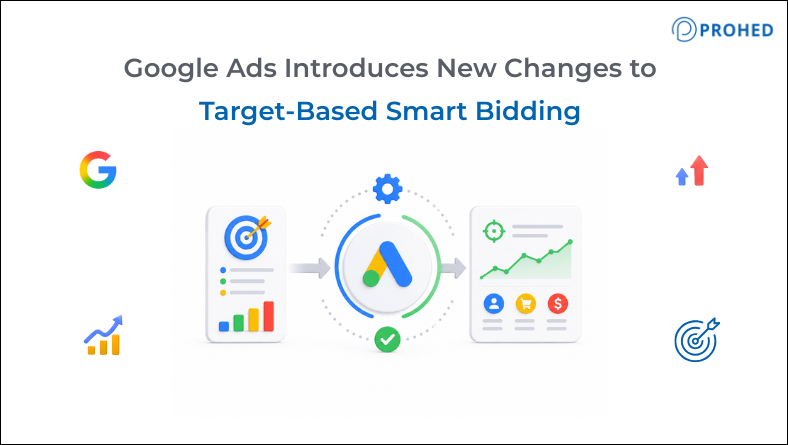
Google Ads is updating how target-based smart bidding works for campaigns that are “Limited by Budget.” From August 17, 2026, campaigns using Target CPA or Target ROAS that have historically overperformed their stated targets will now deliver closer to those targets. At PROHED, a performance marketing agency in Gurgaon, we’re flagging this as one of the more impactful google ads bidding changes of the year, because the accounts most affected are often the ones advertisers feel most confident about.
Here’s the scenario this update is built around.
You set a Target CPA of ₹500. The algorithm learns to deliver at ₹250. You notice the efficiency. You don’t change the target because everything looks fine.
After August 17, 2026, that changes. The system will optimise closer to the ₹500 target you actually set. If you haven’t updated the target to reflect actual performance, your cost per acquisition will rise toward the number you entered months ago.
This isn’t a penalty. It’s Google enforcing the target you set and never revisited.
Changes to Target-Based Bid Strategies
Before August 17, budget-constrained campaigns using Target CPA or Target ROAS would often overperform their stated targets. The algorithm delivered results that exceeded expectations, inflating reporting numbers while creating a hidden problem: actual delivery quietly drifted away from your stated targets.
After August 17, google ads bidding changes this in two specific ways.
- First, campaigns will optimise strictly toward the target entered in the account. If a Target CPA is ₹800 but recent delivery has been ₹400, the campaign will trend toward ₹800 after the update.
- Second, budget changes will produce more predictable results. Because the system now anchors consistently to the stated target, scaling should be more stable than the erratic performance swings that previously accompanied budget increases.
Affected campaign types include:
Campaign Type | Affected | What Changes |
Search | Yes | Will deliver closer to stated Target CPA or ROAS; overperformance against target will reduce |
Shopping | Yes | Efficient campaigns running below target CPA will trend toward stated target |
Performance Max | Yes | Traffic distribution across channels may also shift as algorithm tightens toward target |
Demand Gen | Yes | Channel traffic distribution may shift alongside CPA or ROAS alignment |
Display | Yes (already updated) | New behaviour already active; no additional change on August 17 |
Travel | Yes | Will optimise more consistently toward stated target when budget-constrained |
App Campaigns | No | Previous bidding behaviour continues unchanged |
Video Reach Campaigns | No | Previous bidding behaviour continues unchanged |
Video View Campaigns | No | Previous bidding behaviour continues unchanged |
Is your ad spend ready for Google’s target-based Smart Bidding update?
Book A Free Smart Bidding Audit with PROHED Today
Why This Matters More Than Most Updates
This google ads bidding update affects the accounts performing best on paper.
If a campaign is underperforming its Target CPA, the issue is visible and gets fixed. If it’s consistently beating the target, most advertisers leave it alone. That’s precisely the gap this change closes.
An account with a Target CPA of ₹800 delivering at ₹400 will, after August 17, start trending toward ₹800. Conversion volume may stay similar. Cost per lead increases. ROAS drops. Leadership asks questions.
The answer is simple: the target was always ₹800. The algorithm was overperforming it. Now it’s doing exactly what it was told.
Among top digital marketing companies in India, this scenario is common. Targets get set at campaign launch and rarely revisited as long as numbers look healthy. This update forces that review whether advertisers initiate it or not.
The Bid Target Adjustment Tool: What It Does
Google is releasing a Bid Target Adjustment Tool inside Google Ads from July 6, 2026. This is the mechanism for reviewing and updating targets before August 17.
The tool shows recent actual performance for each affected campaign and gives three options:
Option 1: Apply the suggested target
If a campaign has been delivering at ₹350 CPA against a ₹700 target, the tool suggests updating to ₹350. Clicking Apply locks in the recent performance level.
Option 2: Enter a custom target
If ₹350 is too aggressive but ₹700 is too loose, enter a number that reflects actual business economics, say ₹480, and the algorithm optimises toward that figure.
Option 3: Do nothing
If the current target accurately reflects business goals, no change is needed. The campaign will simply deliver more consistently to that target after August 17.
Switching to Maximize Conversions or Maximize Conversion Value is also an option for campaigns where volume matters more than a specific efficiency target. These strategies spend the full budget without a fixed CPA or ROAS floor, so conversion volume stays high but efficiency will fluctuate with budget changes.
Related Read: The AI Overview Effect on CTR in Google Ads: Why More Impressions Now Means Less Revenue
What to Do Before August 17: A Practical Checklist
Step 1: Filter for “Limited by Budget” campaigns:
This update affects only these specific campaigns. Campaigns with sufficient budget and aligned performance remain unaffected.
Step 2: Check actual CPA or ROAS against stated targets:
Compare recent 30-day actual performance to the Target CPA or ROAS in the google advertising settings. A gap of 20% or more needs attention before August 17.
Step 3: Open the Bid Target Adjustment Tool from July 6:
Apply the suggestion, set a custom target, or confirm the current target is intentional.
Step 4: Increase budgets after updating targets, not before:
Aligning your targets with actual performance ensures that scaling produces consistent conversion volume . Scaling before updating targets will produce results closer to the old loose target, not the recent actual performance.
Step 5: Wait one to two conversion cycles before evaluating:
After any target or budget change, allow one to two full conversion cycles before drawing conclusions. Reacting within days produces noise, not insight.
The Bigger Picture: What This Signals
This update is part of a wider pattern: Google is making smart bidding more literal about following advertiser inputs.
As the algorithm becomes more precise, the human work of managing google ads shifts from bid management toward target governance. The question is no longer “is the algorithm bidding correctly?” It’s “are our targets set to the right number?”
For google ads lead generation campaigns specifically, Target CPA needs to reflect the real economics of a lead, what it’s worth downstream, not just what the account has been achieving historically.
Marketing agencies in India treating platform changes like this as routine notifications rather than strategic reviews will find their clients asking difficult questions after August 17. The teams reviewing account targets now are the ones best positioned to maintain performance through the transition.
Let PROHED Prepare Your Google Ads Account for This Update
Navigating Google Ads platform changes requires three critical steps: identifying affected campaigns, calculating your target gap, and anchoring targets in real business economics rather than historical delivery data
At PROHED, our google ads specialist team reviews target alignment as part of every monthly account audit. For the August 17 update specifically, we’re running a structured pre-update audit across client accounts covering:
- Identifying all “Limited by Budget” campaigns using Target CPA or Target ROAS
- Quantifying the gap between stated targets and 30-day actual performance
- Recommending updated targets based on downstream lead value and margin economics
- Using the Bid Target Adjustment Tool to apply changes before the deadline
- Monitoring performance for one to two conversion cycles after changes are made
This work connects to our broader Performance Marketing, B2B Lead Generation, B2C Lead Generation, and E-commerce Marketing services. A google ads campaign with misaligned targets affects every channel in the media mix, and getting this right before August 17 protects performance that would otherwise erode quietly.
As a performance marketing agency in India working with D2C, EdTech, and healthcare brands, PROHED brings the same rigour to platform governance as to campaign strategy, because in 2026, the two are the same conversation.
Conclusion
The August 17 google ads update doesn’t change how Smart Bidding works in theory. It makes it more literal in practice. If your Target CPA is ₹800, you’ll get ₹800.
Review “Limited by Budget” campaigns, check where actual performance has diverged from stated targets, and use the Bid Target Adjustment Tool before August 17. The accounts that do this now will experience the update as an improvement in consistency. The ones that don’t will experience a performance shift that was entirely preventable.
Frequently Asked Questions
1. What is changing in Google Ads smart bidding from August 17, 2026?
Budget-constrained campaigns using Target CPA or Target ROAS will now optimise more strictly toward their stated targets. Campaigns that have been overperforming their targets will trend toward the stated figure, which may mean higher actual CPA or lower ROAS than recent performance showed.
2. Which campaigns are affected?
Search, Shopping, Performance Max, Demand Gen, Display, and Travel campaigns using Target CPA or Target ROAS are affected. App, Video Reach, and Video View campaigns are not and will continue using previous bidding behaviour.
3. What is the Bid Target Adjustment Tool?
A new tool available from July 6, 2026 that shows recent actual performance for affected campaigns and allows advertisers to update targets before August 17. Options include applying a suggested target, entering a custom target, or confirming the current target is intentional.
4. What happens if I do nothing before August 17?
If the current target reflects business goals, no action is needed. If the campaign has been overperforming a loose target, it will trend toward the higher stated target after August 17, which may feel like a performance drop without any campaign change.
5. Will this update affect conversion volume?
Potentially. Higher conversion costs at the same budget can reduce volume. However, once targets are updated and budget is increased, scaling should produce more predictable results than it did previously.
6. Should I switch to Maximize Conversions instead of adjusting my target?
Only if volume matters more than a specific efficiency target. Maximize Conversions spends the full budget without a CPA floor, so efficiency will fluctuate. For accounts with firm CPA or ROAS requirements, updating the target is the better approach.
7. How long should I wait to evaluate performance after updating targets?
One to two full conversion cycles, typically 14 to 30 days depending on conversion frequency. Evaluating too early reflects algorithm adjustment noise rather than actual steady-state performance.
Are your Google Ads targets matching your actual performance ahead of August 17? PROHED can audit your account today and optimize your smart bidding targets before the update impacts your results
Schedule a Free Strategy Call with PROHED Today